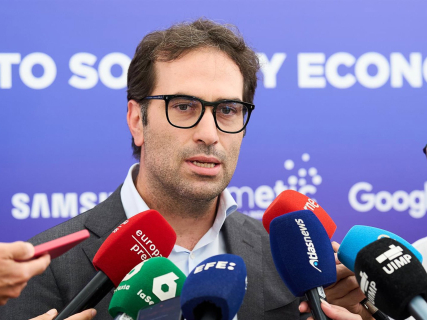

The first vice president of the Government and Minister of Economy, Carlos Cuerpo, has acknowledged this Friday that the public pension system will need "reforms" to face the increase in spending that will be caused by the retirement of the baby boom generation. His statements come after the Executive has criticized the Popular Party for questioning the sustainability of the current model and raising the need to introduce changes.
"We need to implement the necessary reforms so that it can be absorbed and that the system remains sustainable," Cuerpo has stated in an interview on Onda Cero, although he defended that this work already began with the reforms approved in 2021 and 2023, aimed at guaranteeing the purchasing power of pensioners and reinforcing the income of Social Security.
The minister has distinguished between the expected increase in spending for the coming decades and the viability of the system. "Saying that spending is going to grow does not mean that the system is not sustainable," he pointed out, rejecting that the aging of the population necessarily implies that public pensions are at risk.
Pensions enter the pre-campaign for 29N
Cuerpo's statements come amid the controversy opened by the spokesperson for the PP in Congress, Ester Muñoz, who stated in a podcast that the pension system "as it is does not work and is going to burst."
Her words have provoked a succession of reproaches between the Government and the opposition, which have placed the sustainability of pensions and their revaluation at the center of the pre-campaign for the general elections on November 29.
The president of the PP, Alberto Núñez Feijóo, tried this Thursday to close the controversy by reaffirming his commitment to the public system. "Pensions are non-negotiable, period; it's over," he stated, while promising to maintain their update according to the CPI.
For her part, the spokesperson for Vox in Congress, Pepa Millán, assured that her party intends to guarantee pensions "at any cost."
Cuerpo guarantees the increase of pensions in 2027
The first vice president has insisted that contributory pensions will be revalued with inflation in 2027, regardless of the outcome of the general elections, because that is established by current legislation.
Body has assured that the benefits will rise according to the CPI "whether Mr. Feijóo wants it or not" and has reminded that the update is included in a law approved during the term of the current Government.
"It is in the law because we put it there, against the vote of the Popular Party," he stated, before accusing PP and Vox of conveying an "alarmist" message to pensioners.
The minister has also advanced the planned calendar to approve the next revaluation. On November 27, the preliminary CPI data will be known, one of the references that will allow calculating the increase in benefits for the next fiscal year.
As he explained, the Executive, which will be in office after the elections on November 29, plans to approve the corresponding royal decree-law, "if possible before the end of the year."
The annual revaluation is calculated based on the average of the year-on-year CPI rates of the twelve months prior to December, so the preliminary data for November allows anticipating the percentage increase.
The AIReF and the reforms of 2021 and 2023
Body has defended that the reforms promoted in recent years already incorporate mechanisms to address the increase in spending derived from the aging population.
The 2021 reform restored the revaluation of pensions according to the CPI, while the 2023 reform introduced measures aimed at increasing the system's revenues, including changes in social contributions.
Both modifications are part of the commitments made with the European Commission within the framework of the Recovery Plan and include periodic mechanisms for evaluating financial sustainability.
In this regard, the vice president has recalled that the Independent Authority for Fiscal Responsibility (AIReF) concluded a few months ago that it was not necessary to activate new adjustment measures within the framework of the monitoring mechanism provided.
When asked how to finance the growth of spending without increasing taxes, reducing other budget items, or raising debt, Body referred to the agreements reached in the Toledo Pact and the reforms already approved.
"This discussion, if I may, we have already had," he responded. The minister has called for "caution and responsibility" from those who question the viability of the system and urged them to support their warnings with data.
The Minister of Inclusion, Social Security and Migration, Elma Saiz, has also demanded "rigor and responsibility" from the PP and has defended public pensions as a "fundamental pillar" of the welfare state.