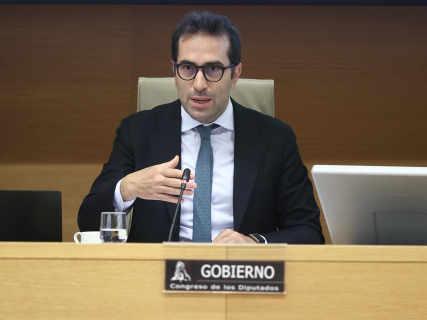

The first vice president of the Government and minister of Economy, Trade and Business, Carlos Cuerpo, emphasized this Wednesday that the increase in energy costs linked to the war in Iran has not yet been reflected in food prices, whose basket has decreased by around 0.6% since the beginning of the conflict. However, he insisted on the advisability of staying "very alert".
In an interview on RNE, reported by Europa Press, the head of Economy attributed the rise in the Consumer Price Index (CPI) to 4.9% in September to the increase in energy costs due to the war situation, and pointed out that the evolution of inflation until the end of the year will largely depend on the behavior of energy prices.
Cuerpo noted that the Government has tasked the National Commission of Markets and Competition (CNMC) with closely monitoring the shopping basket at "all steps" and "phases of that value chain," from the origin in the field to its arrival on supermarket shelves.
The minister recalled that, after the outbreak of the war in Ukraine, it was already confirmed how the increase in energy costs for producers and transporters ended up impacting food with a lag of between 8 and 12 months.
"We want to anticipate as much as possible to try to minimize or even avoid that effect. What have we seen so far? That since the beginning of the war, the price of the food basket has decreased, in fact by 0.6% if I remember correctly, that is, there has been no transfer of prices to food, but we have to be very alert and that is why we wanted to get ahead as well," he explained.
Anti-crisis measures and fuel price reductions
The head of Economy has highlighted that the anti-crisis measures approved by the Executive since March 20 have allowed "to cushion half of the overpricing effect that the war in Iran has caused."
He also emphasized that the Government's priority is to protect households and the most exposed sectors with higher energy consumption, such as transport or fishing, which are being particularly affected by the cost escalation.
In this context, Cuerpo has pointed out that the CPI data known this Wednesday, along with the evolution of diesel and gasoline, confirms that in November the 20 cents per liter bonus will be maintained at gas stations, a measure that, he said, represents a "relief for the pockets" of citizens.
Looking to winter, he added that the latest decisions of the Government incorporate additional supports to reduce the impact on the last resort tariff (TUR) of gas.
Asked about a possible reduction of the VAT on electricity, the minister detailed that the protection shield provides that, if the price of electricity rises above 15% —as is already happening with fuels or gas—, taxes will be automatically reduced to soften the increase in the bill.
However, Cuerpo has specified that, with the data published today, neither the price of electricity nor that of gas has yet exceeded that threshold of 15%, a level that gasoline and diesel have indeed surpassed, thus activating the measures planned for these products.