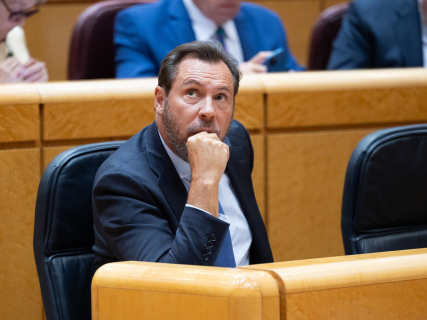

The Minister of Transport and Sustainable Mobility, Óscar Puente, accused the Popular Party this Tuesday of "sowing doubts" about the cleanliness of mail-in voting and of trying to "muddy the playing field" to divert attention from the debate on access to housing, which he considers the main problem in the country.
During an interview on the program 'Malas Lenguas' of TVE, reported by Europa Press, Puente reproached the PP for questioning the mail-in voting system, reminding that the party governs more than 3,300 municipalities, 11 autonomous communities, and several provincial councils thanks to the same electoral model.
"Electoral fraud is something absolutely indescribable from a democratic point of view," he emphasized, before stressing that mail-in voting has "rules and guidelines and absolutely shielded guarantees" and is subject to the control of the Supreme Court.
Puente also maintains that the PP seeks to remove the issue of housing from the center of public discussion. "Muddying the playing field is the logical tactic of the team that doesn't know how to touch the ball, that doesn't know how to play football," he pointed out.
Defense of the electoral call
The minister has also supported the decision of the President of the Government, Pedro Sánchez, to dissolve the Cortes and call for elections again after the parliamentary rejection of the two housing decrees.
According to Puente, the electoral call has an "absolutely democratic" foundation and, in a parliamentary system, when the Executive presents royal decrees in Congress and these are rejected, "it makes no sense to continue."
"If you bring royal decrees to Parliament and they are overturned, if you enact a Housing Law and the autonomous communities refuse to apply it, I think it is logical to give the voice to the citizens to decide what they want," he reiterated.
In this line, he defended that it should be the citizens who determine whether they prefer a Parliament with a majority capable of pushing forward measures to improve access to housing or a Government that opts for other types of policies.
The minister added that the Executive faces limits in deploying its housing policies in a decentralized State, as the competencies mainly fall on municipalities and autonomous communities.
Even so, he has defended the approval of the decrees by the Council of Ministers and the decision to refer them to the Permanent Deputation, considering it essential to maintain protection measures against evictions during this period. "I feel much more at ease if we enable some measure that protects people during this time," he has pointed out.
Criticism of the PP's housing model
Puente has also questioned the PP's proposal to build a million homes and has demanded clarification on how the plan would be financed and what role the public housing stock would play.
He has recalled that between 2000 and 2008, 4.5 million homes were built in Spain and has indicated that during those years, housing prices doubled. In his opinion, the priority must be to promote public housing, safeguard its public nature, and allocate it for affordable rent.
"If what we do is build a lot of housing, but that housing ends up in the hands of a few, as happened in the early years of this century, we find that the problem not only remains unresolved but is exacerbated and increases," he has warned.