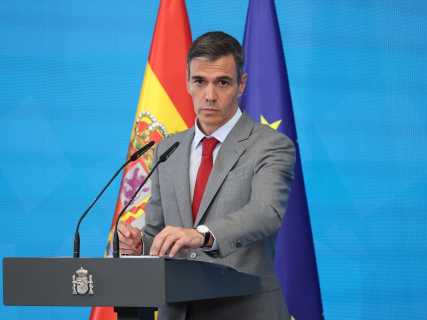
The Government will subsidize 75% of the payments to Social Security of the employers of Ceuta and Melilla.

The measure seeks to reactivate the local economy after the migration crisis and the package of 165 million euros.

1 minute

sanchez empresarios ceuta

sanchez empresarios ceuta

Add DEMÓCRATA to Google

Ask FREN

Published

Last updated

1 minute

Most read

One month after the massive entry of migrants in Ceuta, the president of the Government, Pedro Sánchez, has reappeared publicly in an interview on Cadena SER in which he has not deviated from the planned script: he has assured that the reports from the CNI did not predict the magnitude of the “avalanche,” that Morocco had nothing to do with it, and has announced a 75% bonus on the contributions to Social Security for employers in Ceuta and Melilla.

Furthermore, he has bragged about the support that his Government has given to Ceuta throughout the entire legislature: the socialist leader has indicated that his is the Executive “that has done the most for Ceuta and Melilla in history” and that he is the president who has visited the area the most and who has allocated the most resources. Specifically, he has emphasized that when the legislature ends, they will have invested 180 million euros since 2018 in the security and perimeter of the Ceuta border.

165 million euros

Just one day before the interview, El País reported that the Council of Ministers this coming Tuesday will approve a package of 165 million euros aimed at recovering economic activity and strengthening public services.

The measure would develop the extraordinary expansion of the Comprehensive Socioeconomic Development Plan that Carlos Cuerpo announced during his visit to the city. Moncloa had confirmed that expansion, but had not yet publicly communicated a figure of 165 million.

The proposed plan includes more than 80 million for immediate impact over the next four months. Another 70 million would be planned for 2027. Among the allocated items are 35 million for SMEs and self-employed, 15 million for commerce and tourism, and another 15 million linked to education, health, and justice.

The amount comes after the Chamber of Commerce estimated that Ceuta could close August with losses exceeding 27 million euros. Business owners in the city have reported hotel cancellations, a drop in consumption, and a practically lost tourist season.

Previously, the Government authorized 25 million for the care of migrant minors and the Ministry of Inclusion raised the maximum volume of its humanitarian response to 44.51 million.

More key points, information and questions with FREN

AI-GENERATED CONTENT

What is the current status of the parliamentary processing of the extraordinary extension of the Comprehensive Socioeconomic Development Plan for Ceuta and Melilla?

As of today, there is no legislative or political initiative formally processed in the Congress of Deputies or the Senate under the title "extraordinary extension of the Comprehensive Socioeconomic Development Plan for Ceuta and Melilla." The "extraordinary extension" is, for now, a Government decision articulated through Council of Ministers agreements and administrative agreements, not a bill or legislative proposal with its own parliamentary course.

1. What has been exactly announced as the "extraordinary extension"

According to the press release from the Ministry of Economy, Trade and Business dated August 24, 2026, First Vice President Carlos Cuerpo announced in Ceuta "an extraordinary and immediate extension of the Comprehensive Socioeconomic Development Plan of Ceuta," a plan promoted by both administrations since 2022 and which has already mobilized more than 180 million euros. This extension is conceived as a package of emergency measures to strengthen security, manage returns, and revitalize Ceuta's economy, to work with social agents and approve "as soon as possible" in the Council of Ministers.

The extension is therefore inserted within the same framework of the Comprehensive Plan approved by the Council of Ministers in October 2022, later developed through sectoral agreements and agreements, without the announcement being accompanied by a new bill or a specific royal decree-law subject to parliamentary validation.

2. Parliamentary processing: non-existence of a specific legislative file

Consulting the parliamentary database, no initiative registered in Congress or Senate appears with the title "extraordinary extension of the Comprehensive Socioeconomic Development Plan for Ceuta and Melilla," neither as a bill, nor as a legislative proposal, nor as a royal decree-law in the validation phase. It also does not appear under that name in the agendas of plenary sessions or committees in August and September 2026.

There are numerous initiatives about the comprehensive plans and the situation of Ceuta and Melilla, but they are for oversight or promotion, not the "extraordinary extension" as such. Among the closest to the content of the plans are:

  • In the Congress of Deputies, written question 184/019910, about the "amount executed of the Comprehensive Socioeconomic Development Plans for Ceuta and Melilla, with an investment exceeding 711 million between 2023 and 2026." This file is closed: the text was published on 02/24/2025 and the Government responded on 04/02/2025 and again on 05/12/2025, concluding the processing of the question.
  • In the Senate, question 684/006861 (15th Legislature), about progress in a new transport aid model linked to the Comprehensive Socioeconomic Development Plan of Ceuta and Melilla. This initiative was qualified and admitted for processing on 06/11/2024; it appears as a written question pending response, without associated votes.

That is, Parliament is monitoring and controlling the execution of the comprehensive plans through questions and other oversight initiatives, but it is not currently processing a specific regulation that materializes the "extraordinary extension" announced by the Executive.

3. Development through executive means and agreements

The execution of the Comprehensive Plan and its reinforcements has been mainly channeled through Council of Ministers agreements and inter-administrative agreements published in the Official State Gazette (BOE). A significant example is Resolution 420/38360/2025, dated July 22, from the Technical General Secretariat of Defense, which publishes the agreement with the City of Ceuta on actions related to the Comprehensive Socioeconomic Development Plans of Ceuta and Melilla, accessible in the BOE:

Agreements of this type specify investments, land transfers, and other measures foreseen in the Comprehensive Plan, without following a classic legislative procedure (consideration, amendments, committee, report…), but rather the general regime of agreements under Law 40/2015 and Council of Ministers agreements, which are only subject to political parliamentary control (questions, appearances, motions), but not to a specific "parliamentary processing" of the plan itself.

4. Conclusion on the "processing status"

With the available information, it can be summarized as follows:

  • There is no, as of today, a legislative file in progress in Congress or Senate identified as "extraordinary extension of the Comprehensive Socioeconomic Development Plan for Ceuta and Melilla."
  • The extraordinary extension announced for Ceuta is an executive decision (Council of Ministers and royal decree of national security interest situation, plus budget adjustments and agreements), whose details will be approved by the Government and reflected in the BOE and the Budgets, but without an ad hoc law named as such.
  • Parliamentary oversight exists through written questions and appearances about the execution of the comprehensive plans and the Ceuta crisis, but it does not constitute a "parliamentary processing status" proper to a law or royal decree-law on that specific extension.

If you are interested, I can detail which groups are promoting initiatives about Ceuta and Melilla (questions, non-legislative proposals, motions) related to the comprehensive plans and the phase each is in.

What was the specific content of written question 184/019910 about the execution of the comprehensive plans for Ceuta and Melilla? Which Council of Ministers agreements have developed the Comprehensive Socioeconomic Development Plan for Ceuta and Melilla since 2022? What recent parliamentary initiatives (PNL, motions, questions) have the different groups presented about the Ceuta crisis and the reinforcement of its socioeconomic plans?

What are the powers and functions of the President of the Government of Spain according to the Constitution?

The President of the Government of Spain is the highest authority of the executive power and the main political figure of the constitutional system. His powers are mainly regulated in the 1978 Constitution, especially in articles 97, 98, and 99, as well as in other provisions that assign him specific functions.

Government direction and political action

Article 97 of the Constitution establishes that the Government directs domestic and foreign policy, the civil and military administration, and the defense of the State, and that it exercises executive function and regulatory power. Within this collegiate body, the President of the Government is the one who:

  • Sets the general political orientation of the Government, marking the broad lines of government action and coordinating the performance of the different ministers.
  • Promotes and coordinates governmental activity, ensuring coherence between sectoral policies and the Executive's overall strategy.
  • Acts as the highest representative of the Government both domestically and politically abroad, although the Head of State corresponds to the King.

Relationship with ministers and Government structure

Article 98 defines the Government as composed of the president, vice presidents if any, ministers, and other members that the law may establish. Within this framework, the President of the Government has, among others, the following powers:

  • Propose to the King the appointment and dismissal of ministers. Although the King signs the royal decrees of appointment and dismissal, it is the president who decides the Government's composition.
  • Decide the Government's structure (number and denomination of ministries, possible vice presidencies, internal restructurings), within legal margins.
  • Convene, preside over, and set the agenda of the Council of Ministers, the collegiate body where the most relevant Executive decisions are made.
  • Resolve internal conflicts among ministers and ensure unity of action, by virtue of his direction and coordination function.

Relationship with the Cortes Generales

The Constitution designs a close relationship between the President of the Government and the Cortes, especially the Congress of Deputies:

  • According to article 99, the president is proposed by the King after consulting political groups and must be invested by the Congress through an initial confidence vote.
  • The Government, under his direction, is politically responsible before the Congress (article 108), which implies that the president must answer questions, appear, and undergo parliamentary control.
  • The president and his Government may raise the question of confidence before the Congress to reaffirm their support (article 112).
  • The Congress may require the political responsibility of the Government through a motion of censure (articles 113 and 114), which necessarily includes the election of a new president.

Powers in relation to the King and elections

Several key powers of the President of the Government are exercised by proposal to the King:

  • Propose the dissolution of the Congress, the Senate, or the Cortes Generales (article 115), except within certain temporal limits. This proposal is materialized in a dissolution decree signed by the King and countersigned by the president.
  • Propose the calling of general elections, which is also formalized by a royal decree countersigned.
  • Countersign, in general, many of the King's acts that affect the governmental sphere, which implies a political co-responsibility of the president over those acts.

Normative and general policy functions

Besides directing Government action, the president has a central role in the elaboration of norms and political decisions:

  • Leads the decision to present bills on behalf of the Government before the Cortes Generales (article 87.1).
  • Directs the Government's action in the approval of regulations and general administrative provisions, which develop laws.
  • Participates in the decision to approve royal decree-laws in cases of extraordinary and urgent need (article 86), which must later be validated by the Congress.
  • Exercises political direction in crisis situations, such as proposing the declaration of states of alarm, exception, and siege (article 116), which are approved with the intervention of the Cortes.

In sum, the Constitution configures the President of the Government as the center of gravity of the executive power and the main responsible for the political orientation of the State, always subject to the democratic control of the Congress and the constitutional framework.

What requirements must entrepreneurs in Ceuta and Melilla meet to access the 75% Social Security contribution discount?

The Social Security contribution discount for companies and self-employed workers in Ceuta and Melilla is based on the thirtieth additional provision of the consolidated text of the General Social Security Law and its regulatory development, especially in Order TAS/471/2004, of February 26, and its subsequent extensions and modifications (Orders TAS/856/2006, TAS/710/2008, and TIN/530/2010). From this framework, the material requirements are quite stable, although the discount percentage has increased over time (up to 75% in the current configuration).

1. Subjective scope: who can benefit

  • Companies: entrepreneurs who have employees or assimilated workers included in the General Social Security Regime, as well as worker-members of worker cooperatives, provided that:
    • Workers provide services in work centers located in Ceuta or Melilla.
    • The company carries out activities framed in the sectors of Commerce, Hospitality, Tourism, and Industry, excluding the subsector of Energy and Water.
  • Self-employed workers: persons included in the Special Regime for Self-Employed Workers, including cooperative members with this status, who:
    • Are engaged in the same bonified activities (commerce, hospitality, tourism, and industry — except energy and water — and certain tourism support activities, such as travel agencies and tour operators, according to the CNAE classification).
    • Reside and effectively carry out the activity in the Cities of Ceuta or Melilla.

2. Objective and territorial scope

  • The discount applies to the employer's common contingency contributions (and, according to successive regulations, also on joint collection concepts) of workers providing services in Ceuta or Melilla.
  • For self-employed workers, it applies to their common contingency contributions in the corresponding special regime.
  • It is essential that the economic activity is effectively carried out in Ceuta or Melilla; a mere formal address is not enough if the real workplace is outside.

3. Social Security requirements and entrepreneur's situation

  • Companies and other responsible parties for contributions must be up to date in fulfilling their Social Security obligations to apply any reduction or discount. This general requirement is included in the consolidated text of the General Social Security Law and applies to all contribution aids.
  • Workers must be properly registered and active in the corresponding Social Security regime, and contribution bases and rates must be correctly declared in contribution documents.
  • There must be no improper application or incompatible accumulation of discounts for the same contributions: general regulations establish that contribution benefits are, as a general rule, mutually exclusive for the same worker and period, unless a rule expressly states otherwise.

4. Bonified activities (CNAE) and verification

Order TAS/471/2004 specifies that the measure is aimed at activities framed in the CNAE (at the time, CNAE-93) of the sectors of commerce, hospitality, industry — with the exception of energy and water — and certain tourism activities (travel agencies, tour operators, and other tourism support activities). In practice, to prove the right to the discount, the company must:

  • Have its activity heading and CNAE code correctly declared before Social Security and the Tax Agency.
  • Be able to demonstrate, in case of inspection, that the real activity corresponds to the bonified activities.

5. Formal and maintenance obligations

  • The discount is managed through contribution bulletins (currently, the direct settlement system), applying the appropriate percentage when requirements are met.
  • The General Treasury of Social Security and the Labor Inspectorate may review afterwards the correct application of the discount, demanding reimbursement of improperly applied amounts plus surcharges and interest.
  • Ministerial orders indicate as an objective the maintenance and creation of employment in Ceuta and Melilla; although a rigid employment stability clause is not configured, the use of the discount must be consistent with that purpose and may be assessed in periodic evaluations of the measure.
  • It is mandatory to keep supporting documentation (contracts, payrolls, registration proofs, activity data, and workplace location) during the prescription periods.

In summary, to access the discount (currently configured up to 75% in certain cases), the essential points are: activity truly framed in the bonified sectors, workplace and/or residence and exercise in Ceuta or Melilla, correct Social Security registration, being up to date with payments, and applying the discount only on contributions and workers that meet these criteria.

Play

Test your knowledge with FREN!

How much do you know about this topic? Answer the following 3 questions.

What percentage bonus on Social Security contributions will be applied to employers in Ceuta and Melilla?

Question 1 of 3

What amount has the Government announced it will invest in a new package to reactivate the economy and public services in Ceuta and Melilla?

Question 2 of 3

To which areas will part of the 165 million from the new package for Ceuta and Melilla be allocated?

Question 3 of 3

Hola, soy Fren. ¿Cómo te ayudo?