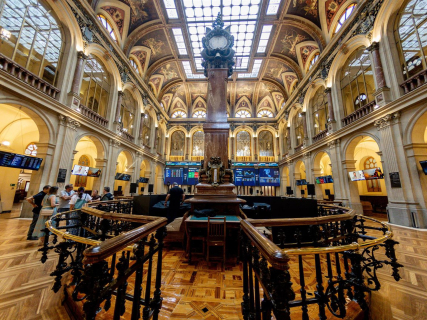

The Ibex 35 of the Madrid Stock Exchange has concluded the session this Thursday with a slight decline of 0.18%, which represents its worst performance so far in August. Specifically, the selective index has finished the day at 19,811 points, on a day again conditioned by the escalation of the conflict in the Middle East which, after the end on Monday of the 60-day truce period, has again pressured crude oil prices upwards, placing them above 93 dollars per barrel.
In the early hours of this Thursday, the President of the United States (USA), Donald Trump, has announced that he will launch against Iran "the most devastating economic operation ever undertaken," warning of "an unprecedented economic war and isolation" in which the White House will impose "tremendous economic consequences" on any country that allows any type of support to Tehran through its companies or institutions.
"Oil smuggling, exchange lines, cash transfers, currency exchanges, ship registrations, shell companies: all of this must end now. You know who you are," he stated, describing his announcement as an "economic D-Day," referring to the Normandy landing in World War II, considered a decisive moment in the Allied offensive against the Nazi occupation in Western Europe.
Likewise, the American leader has lowered expectations for resuming diplomatic dialogue to reach an agreement that ends hostilities, emphasizing that, in his opinion, the current situation in Hormuz is "very good" and that the flow of oil through the strait is maintaining without problems.
On the other hand, the Iranian Foreign Minister, Abbas Araqchi, has assured that the declaration of "economic war" launched by Trump against the Islamic Republic responds to an "unprecedented" crisis within the United States and "will only bring more defeats" for Washington. "It is a smokescreen in the face of the crisis in the United States: an unprecedented debt and skyrocketing interest costs," Araqchi has asserted.
In Israel, the Minister of National Security, the far-right Itamar Ben Gvir, who had recently suggested assassinating between "30 and 40 people" each night in Gaza, has now proposed building a prison complex with a death row for Palestinians that would even include a stand to witness the hangings.
In light of these statements and the new wave of Israeli attacks on the Gaza Strip, Qatar, Egypt, and Turkey have expressed their rejection this Thursday, emphasizing that military operations compromise efforts to stabilize the area and demanding that Israel fulfill its obligations under the plan sponsored by Donald Trump.
In their role as mediators, the three countries have shown their "strong condemnation" of the latest Israeli offensives in the Gaza Strip, highlighting that they have caused "civilian casualties, including women and children, and express their deep concern over the ongoing violations."
In this scenario, the Brent barrel, a reference in Europe, rose by 2.04% at the end of the session in the stock markets of the Old Continent, reaching 93.49 dollars, while the West Texas Intermediate (WTI), a reference in the United States, increased by 2.54%, reaching 88 "greenbacks" per barrel.
The European markets withstand geopolitical tension
In parallel, the latest minutes from the Federal Reserve of the United States (Fed) have highlighted that "many" committee members consider it "necessary" for the central bank to carry out a new interest rate hike if inflation does not continue to moderate.
"Some participants commented that current financial conditions might not be restrictive enough to facilitate a return of inflation to 2%," the minutes of the meeting held on July 29 also state, in which the institution decided to keep the reference rate unchanged.
At the same time, the U.S. Department of the Treasury has reported that the country's public debt has surpassed the threshold of 40 trillion dollars (34.4 trillion euros) for the first time, after the liabilities of the largest economy in the world have doubled in less than ten years.
In the Spanish corporate sector, Banco Santander has completed this Thursday the purchase of the American Webster Financial, a little more than six months after announcing the operation, after obtaining all the necessary authorizations from the supervisors and shareholders of the firm and completing the capital increase planned in the transaction.
On the other hand, Ferrovial has announced that it has been chosen to develop the express lanes of the I-24 Southeast in Nashville, Tennessee, which will become the largest private investment and the first public-private collaboration in the history of this southern US state. The consortium led by Ferrovial will take on the financing, design, construction, operation, and maintenance of the project, valued at 9.2 billion dollars (7.882 billion euros).
In addition, the Saudi operator STC, one of the main shareholders of Telefónica, will distribute this Thursday a total dividend of 2,746.2 million Saudi rials (634.9 million euros) among its investors.
In this context, within the Ibex 35, the most notable increases have been those of Repsol (+2.66%), Caixabank (+1.61%), Merlin (+1.15%), Fluidra (+0.94%) and Banco Sabadell (+0.91%). On the loss side, the most significant declines have been those of Acerinox (-2.74%), Sacyr (-2.28%), IAG (-1.93%), Arcelormittal (-1.74%) and Indra (-1.39%).
As for the rest of the major European markets, the closing has resulted in a mixed performance, although at historical high levels, despite the uncertainty in the Middle East. Thus, the FTSE 100 of London and the Mib of Milan have advanced by 0.04% and 0.09%, respectively, while the DAX 30 of Frankfurt has fallen by 0.41% and the CAC 40 of Paris by 0.57%.
In the foreign exchange market, the euro appreciated against the dollar, bringing the exchange rate to 1.168 "greenbacks." In the fixed income market, the yield on the Spanish ten-year bond rose to 3.704%, which raised the risk premium — the differential with the German ten-year bond — to 43.7 basis points.
Among the assets considered safe havens in times of high volatility, the price of an ounce of gold remained practically stable around 4,500 dollars, while bitcoin extended its bullish streak and was positioned in the area of 72,200 "greenbacks."