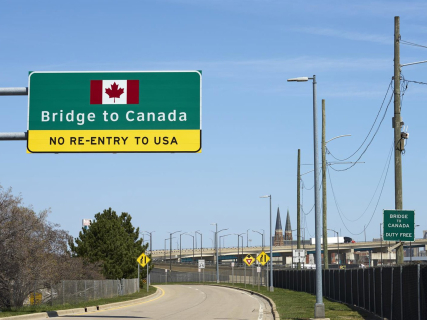

The President of the United States, Donald Trump, has communicated that the understanding with Canada regarding tariffs is practically finalized, "pending the signing of the documents," although he has not provided precise information about its content. The announcement comes after Washington decided to postpone the entry into force of a 50% levy on Canadian products by three days in order to allow room for negotiations.
"Last night we had a very productive conversation with the Prime Minister (Mark Carney) and we reached an agreement with Canada. As you know, today a 50% tariff was to be applied to Canada, but yesterday they called us and gave us the points we needed. A very fair agreement for both parties. Our farmers will not have to pay tariffs," the U.S. president indicated to reporters during a visit to the White House construction site.
As Trump has emphasized, Ottawa would have accepted Washington's main demands, although he has avoided specifying what commitments the pact includes. At the same time, he has reproached Canada for the prior imposition of "excessive" tariffs on exports from the United States.
Similarly, the President of the United States has indicated that his Administration will also implement measures requested by the Canadian side, avoiding responding to specific questions such as the reduction of levies on automobiles from Canada. "We are taking certain measures. We have to give in on something," he has maintained.
In the early morning prior, Trump and Carney had confirmed the three-day postponement in the application of the new tariffs on Canadian imports, which were to begin this Wednesday. While the U.S. leader was practically closing an agreement that would contemplate reactivating the construction of the Keystone XL pipeline, intended to connect Nebraska (U.S.) with Alberta (Canada), the Canadian Prime Minister warned that "there is still much work to be done."
The tariff package prepared by the White House includes a 50% surcharge on a wide range of goods, from wine to hockey sticks and cement, in addition to the automotive sector, with a possible estimated impact of up to $20 billion (€17.28 billion).
Washington has defended these tariffs arguing that Canada applies discriminatory treatment to U.S. exports such as vehicles, alcoholic beverages, and dairy products, issues that concentrate a good part of the negotiating pulse between both countries.
Carney, for his part, argued that the decision of the Trump Administration is part of "a series of unilateral trade actions by the United States" that he described as "measures and threats to Canadian sovereignty."