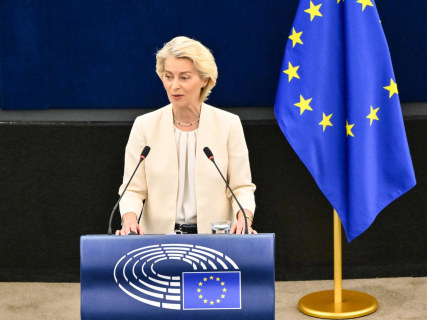
Brussels announces another 3.3 billion destined for military material for Ukraine and demands more international support

The president of the European Commission announces the disbursement for this Friday after speaking with Zelensky and proposes to develop together with Kiev a European air defense and anti-missile system based on the Freya project.

3 minutes

fotonoticia 20260916102936 1920

fotonoticia 20260916102936 1920

Add DEMÓCRATA to Google

Ask FREN

Published

Last updated

3 minutes

Most read

The President of the European Commission, Ursula von der Leyen, has announced that the European Union will disburse this Friday another 3.3 billion euros to Ukraine for the acquisition of missiles and drones, after having a phone conversation with the Ukrainian president, Volodymyr Zelensky.

The announcement comes as Russia continues its attacks on Kiev. Von der Leyen has denounced that Moscow is attacking the Ukrainian capital "without respite" and "trying to make everyday life impossible for its inhabitants," before reaffirming European support for Ukraine.

"We are with them. And with all Ukrainians," stated the President of the Commission, who placed the new disbursement within the financial and military effort that Brussels is preparing to especially reinforce Ukrainian air defense.

3.3 billion for missiles and drones

According to Von der Leyen, the 3.3 billion euros will be disbursed this Friday and will be intended for the acquisition of missiles and drones by Ukraine.

The President of the Commission also recalled that the EU approved last week funding for Patriot systems through its Support Loan to Ukraine. The measure responds to one of the main demands raised by Kiev in light of the intensification of Russian attacks and the need for more interceptors for its air defense systems.

Von der Leyen considers, however, that these measures are insufficient. "It is clear that more needs to be done," she warned.

The EU had already allocated since June 8.5 billion euros to drones and missiles through the European loan, as the President of the Commission herself explained at the beginning of September.

A European air defense system alongside Ukraine

One of the main announcements affects the future of the European defense industry. Von der Leyen has reiterated Brussels' willingness to use the remaining funds from the SAFE instrument to launch a new program of joint projects between the defense industries of the EU and Ukraine.

The goal is to jointly develop a European air and missile defense system relying on the anti-ballistic project Freya, an initiative in which Ukraine and European partners participate and which aims to strengthen the capacity to intercept ballistic missiles.

"We want to jointly develop a European air defense and missile defense system," explained Von der Leyen. Brussels thus intends to combine the experience acquired by Ukraine during the war and its capacity for innovation with European technology and industrial strength.

The president of the Commission already presented this line of action this Wednesday during her State of the Union speech, in which she defended both the funding of Patriot interceptors and greater industrial cooperation with Ukraine around Freya.

The project is still under development. Zelensky assured last week that the involved partners are working with the aim of starting tests of the first system by the end of December, before moving towards its production if the trials are successful.

Almost 15 billion mobilized this year

The support announced by Brussels is not limited to the military sphere. Von der Leyen has estimated that almost 15 billion euros are the resources mobilized this year by the EU for Ukraine and has anticipated that there will be new announcements soon.

During the phone conversation, Von der Leyen and Zelensky also addressed the reforms that the Verkhovna Rada must undertake, the Ukrainian Parliament, to unlock new funding and continue advancing in the process of Ukraine's approximation to the European Union.

The president of the Commission has thus linked the continuity of financial support with the reform process that accompanies Ukraine's candidacy to join the EU.

Von der Leyen asks allies to "intensify their support"

The announcement comes just days before Von der Leyen travels to New York to participate next week in the United Nations General Assembly.

There she intends to convey to Ukraine's international partners a message focused on a greater sharing of the effort to support Kiev.

"Europe is stepping up. Now others must also intensify their support," stated the president of the Commission.

More key points, information and questions with FREN

AI-GENERATED CONTENT

What parliamentary phase is the process of Ukraine's accession to the European Union currently in, and what are the next planned steps?

As of September 2026, the process of Ukraine's accession to the European Union is already in the formal accession negotiations phase, with several groups (“clusters”) of chapters opened, but still far from the final phase of closing chapters and signing the Accession Treaty. In European “parliamentary” terms, the European Parliament is in a phase of political monitoring and support of the process, not yet in the final consent phase for entry.

Current phase of the process

After Ukraine was granted candidate country status and the opening of negotiations was decided, the recent major leap has been the effective start of the negotiation chapters. On June 15, 2026, the so-called Group 1 (“Foundations”) was opened, which includes the core chapters on the rule of law, fundamental rights, functioning of democratic institutions, public administration reform, and economic criteria. This group opens first and will close last because it concentrates the core conditions of the process, as recalled by the European Council in its October 2025 conclusions (European Council note).

Shortly after, on July 14, 2026, the EU and Ukraine reached “another milestone” by opening Group 6 on “external relations”, which includes chapters 30 (external relations) and 31 (foreign, security and defense policy), according to the Irish Presidency of the Council (Council statement). With this, Ukraine has already started two major clusters within the total 33 chapters.

Specialized press summarizes the situation as follows: with the opening of the fundamental chapters in June and, a month later, the external relations cluster, Ukraine and Moldova have already started seven of the 33 chapters, with the groups on internal market (2), competitiveness and inclusive growth (3), green agenda and sustainable connectivity (4), and resources, agriculture and cohesion (5) still to be opened (Demócrata).

Role of the European Parliament

In strictly European parliamentary terms, the European Parliament is not yet voting on the Accession Treaty (that will come at the end of the process), but exercises a function of political oversight and guidance:

  • In July 2026, Parliament “welcomed” the opening of the first fundamental negotiation group in June 2026 and called for progress with the following groups as soon as possible (EP resolution).
  • In that same resolution, MEPs praised judicial and anti-corruption reforms but insisted that the fight against corruption and strengthening of the rule of law remain key conditions to continue advancing in accession.
  • In various debates and “press kits” prior to European Councils, Parliament has reiterated that Ukraine’s integration will be a central task of the legislature, combined with long-term financial and military support (dossier for the June 2026 European Council).

Therefore, from a “parliamentary phase” perspective, the EP is in the stage of enlargement reports and monitoring resolutions, not in the ratification phase.

Next planned steps

In the short and medium term, the following institutional steps are expected:

  • European Commission: will continue issuing its annual enlargement packages evaluating Ukraine’s progress on political, economic criteria and adoption of the acquis. Already in 2025 it highlighted “significant progress” despite the war, but pointed out key pending issues such as a fully robust anti-corruption framework (2025 enlargement report).
  • Council (Member States): at Intergovernmental Conferences it must open clusters 2, 3, 4 and 5 when it considers Ukraine meets the technical conditions, and later set benchmarks for the provisional closure of already opened chapters. The European Council has emphasized that the entire process is “merit-based”, meaning the pace will largely depend on the speed of reforms in Kyiv.
  • European Parliament: will continue approving monitoring resolutions on Ukraine, linked both to the state of reforms and to financial and security support. Only at the end of the process, when an Accession Treaty between Member States and Ukraine has been agreed, will Parliament have to give its binding consent before the treaty goes to ratification by national parliaments.

In parallel, the EU maintains strong financial and security support to Ukraine (for example, the €90 billion loan approved in 2026 for budget support and defense capabilities, according to the European Parliament itself), which is conceived as part of the same path towards full integration. Politically, EU leaders, including the President of the European Council, António Costa, have indicated that advancing enlargement in the coming months is “especially urgent” to anchor future peace and continental stability (January 2026 speech).

In summary, Ukraine has already passed the preliminary phase of mere candidate status and is in full accession negotiations phase, with several chapters opened and a very marked emphasis on rule of law and anti-corruption reforms. The decisive parliamentary stage — the vote on the Accession Treaty — will come only when, after years of reforms and technical negotiation, the Council and Commission consider the country ready to fully integrate into the Union.

What are the main powers and functions of the President of the European Commission according to the EU treaties?

The President of the European Commission is the highest political leader of the Union's executive body. Her powers and functions are mainly defined in Article 17 of the Treaty on European Union (TEU) and, to a lesser extent, in provisions of the Treaty on the Functioning of the EU (TFEU) and associated protocols. Below is a summary of her essential powers according to the treaties.

1. Political leadership of the Commission

The TEU establishes that the Commission acts under the leadership of its President. This implies:

  • Setting the general political guidelines of the Commission, that is, the major priorities and lines of work for the entire mandate (e.g., climate, digitalization, industrial policy, migration).
  • Defining the annual work programme of the Commission, marking which legislative and non-legislative initiatives will be presented, in what timeframes and with what approach.
  • Ensuring coherence, effectiveness and collegiality of the Commission's action, coordinating the work of the different Commissioners and resolving conflicts of competence among them.

2. Internal organization and appointment of the Commission

Article 17 TEU grants the President a central role in the composition and functioning of the College of Commissioners:

  • Selection and distribution of portfolios: proposes to the Council and Parliament the allocation of portfolios to Commissioners designated by Member States, decides which policy areas each one handles and who holds the Vice-Presidencies.
  • Reorganization of competences: can reassign portfolios among Commissioners during the mandate to adapt to political changes or resolve dysfunctions.
  • Requesting the resignation of a Commissioner: can ask a Commissioner to resign if she considers that they no longer meet the conditions or do not respect their obligations (art. 17.6 TEU). Formally, the resignation is individual but driven by the President.
  • Establishing internal rules of procedure: leads the drafting and application of the Commission's internal rules of procedure, which determine how decisions are adopted, how proposals are prepared, and how work is coordinated among Directorates-General.
  • Representation and political discipline: the President is responsible for ensuring that Commissioners act independently and in the general interest of the Union, not as representatives of their Member State, as required by the treaties.

3. Legislative function and normative initiative

Although the legislative initiative corresponds to the Commission as a whole, the President guides and controls its use:

  • Prioritizing and launching legislative proposals on behalf of the Commission, in line with its political guidelines and adopted work programme.
  • Deciding which proposals are finally submitted to the European Parliament and the Council, after internal preparation procedures (consultations, impact assessments, etc.).
  • Coordinating legislative response to crises or unforeseen events, promoting urgent measures or revisions of existing legislation.

Each year, the President also delivers the State of the Union Address before the European Parliament, presenting the year's review and the Commission's future legislative and political priorities.

4. External representation of the Union

Article 17 TEU provides that the Commission guarantees the external representation of the Union in areas of its competence, “except for the common foreign and security policy,” where the main role lies with the President of the European Council and the High Representative. Within this framework, the President:

  • Represents the Union in matters within the Commission's competence, such as trade, competition policy, economic and regulatory aspects of the internal market, climate policy, etc.
  • Participates in international summits (G7, G20, climate conferences, meetings with third countries) as head of the European executive in those areas.
  • Coordinates with the President of the European Council and the High Representative the EU's positions, to ensure a coherent message between the executive, intergovernmental, and diplomatic dimensions.

5. Relationship with the European Parliament and political responsibility

The President of the Commission is elected by the European Parliament, on a proposal from the European Council, taking into account the outcome of the European elections (art. 17.7 TEU). From this derive several functions:

  • Account periodically to Parliament, answering questions and participating in plenary debates.
  • Defend the College of Commissioners in investiture procedures and potential political crises, since the Commission as a whole is responsible to Parliament.
  • Manage interinstitutional relations with Parliament and Council, promoting interinstitutional agreements on legislative planning and political coordination.

6. Guarantee of the general interest of the Union

In summary, the treaties configure the President as guarantor of the general interest of the Union within the Commission. She must:

  • Ensure that all Commission initiatives respect the treaties and the Charter of Fundamental Rights.
  • Ensure uniform application of EU law, supervising the use of the Commission's monitoring and infringement powers against Member States.
  • Maintain institutional balance with Parliament, Council, Court of Justice, and other Union bodies.

What legal requirements and conditions must Ukraine meet to receive new tranches of funding from the European Union?

The new EU funding tranches to Ukraine are subject to strict conditionality, both under the Ukraine Mechanism 2024‑2027 (up to €50 billion in grants and loans) and under the new €90 billion support loan for 2026‑2027. In both cases, disbursements are not automatic: they depend on Kyiv fulfilling previously agreed reforms and maintaining minimum standards in democracy, rule of law, and sound financial management.

Ukraine Mechanism 2024‑2027: Ukraine Plan and conditioned tranches

The legal core of the conditionality is the Ukraine Plan, positively evaluated by the Commission in April 2024 and approved by the Council in May 2024. This plan:

  • Defines a reform and investment strategy for four years.
  • Includes 69 reforms and 10 investments, broken down into 146 qualitative and quantitative indicators.
  • Covers 15 areas: energy, agriculture, transport, green and digital transition, human capital, public enterprises, business environment, public finances, and decentralization, among others.

Periodic payments (usually quarterly) under the Mechanism are made only when:

  • Ukraine submits a motivated payment request corresponding to a tranche.
  • The Commission verifies that the associated reform and investment indicators for that tranche, as set out in the Council Implementing Decision, have been met.
  • The Commission proposes and the Council adopts an implementing decision declaring those conditions fulfilled.

Concrete examples of conditionality already applied:

  • For the first regular payment of about €4.2 billion, the Commission confirmed compliance with nine indicators related to public finance management, governance of state-owned enterprises, business environment, energy, and demining.
  • For a second payment of about €4.1 billion, the Council highlighted reforms in anti-corruption and anti-money laundering, reforms of the Criminal Code and Criminal Procedure Code, business environment improvements, and progress in energy, ecological transition, and environmental protection.
  • Even the exceptional “bridge” financing of €1.5 billion was conditioned on steps in judicial reform, anti-money laundering, public finance management, business environment, and agriculture, as well as reporting obligations to ensure transparent use.

Rule of law, governance, and anti-corruption requirements

Beyond technical indicators, there is a general precondition for all Mechanism aid: Ukraine must continue respecting effective democratic mechanisms. The Plan's architecture emphasizes:

  • Improvement of governance and administrative capacity.
  • Strengthening accountability and integrity of the judiciary.
  • Reinforcement of the anti-corruption and fraud framework.
  • Progressive alignment with the EU acquis (public administration, public procurement, anti-money laundering, transport, agri-food, etc.).

To protect the Union's financial interests, the Plan establishes:

  • A robust framework of transparency, audit, and control.
  • The obligation for Ukraine to strengthen its national control and audit systems.
  • The creation of an independent Audit Board, which helps prevent mismanagement, fraud, corruption, conflicts of interest, and irregularities.

€90 billion support loan (2026‑2027)

The new €90 billion loan approved through enhanced cooperation also incorporates strong conditionality:

  • The macroeconomic assistance part (about €30 billion) is conditioned on fulfilling reforms set out in a Memorandum of Understanding, focused on:
    • Revenue mobilization (tax reform, broadening the tax base).
    • Anti-corruption and strengthening anti-corruption bodies.
    • Fiscal transparency and responsible budget management.
  • The defense industrial capabilities pillar is subject to specific control mechanisms, with a separate account and Commission supervision.
  • Ukraine must submit each year a Financing Strategy detailing needs and income sources, which serves as a basis for planning the tranches.
  • Continuous respect for democratic principles, rule of law, and human rights, including minority rights, is required.

The loan's design limits the burden on Ukraine: principal repayment is linked to future reparations or compensation from Russia, and the EU can subsidize interest and administrative costs. But effective access to tranches remains conditioned on the agreed macroeconomic, governance, and anti-corruption reforms.

In sum, to receive new disbursements, the key is not only Ukraine's military or budgetary situation but its verifiable progress in structural reforms, rule of law, and anti-corruption, monitored by the Commission and validated by the Council at each tranche.

Play

Test your knowledge with FREN!

How much do you know about this topic? Answer the following 3 questions.

What additional amount did the European Commission announce for Ukraine to acquire missiles and drones?

Question 1 of 3

What is the goal of the Freya anti-ballistic project mentioned in the news?

Question 2 of 3

How many billion euros has the EU mobilized in support of Ukraine so far this year, according to Von der Leyen?

Question 3 of 3

Hola, soy Fren. ¿Cómo te ayudo?