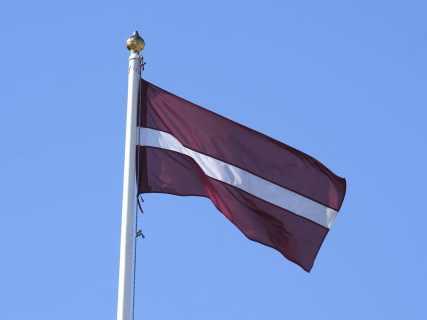
Elections in Latvia: Kulbergs' party shoots up to 35.6% in the exit poll

United List significantly leads Latvia First, which obtains 11.3% in the survey released by public broadcasting. The prime minister, a strong defender of Ukraine, now faces the challenge of building a parliamentary majority.

2 minutes

fotonoticia 20261001175855 1920

fotonoticia 20261001175855 1920

Add DEMÓCRATA to Google

Ask FREN

Published

Last updated

2 minutes

Most read

United List, the formation of Prime Minister Andris Kulbergs, leads the exit poll of the elections in Latvia held this Saturday, October 3. The survey by the public broadcaster LSM, collected by Reuters, attributes to it 35.6%, compared to 11.3% for Latvia First. The difference between both candidacies reaches 24.3 points. These are estimates, pending confirmation by the counting.

The result anticipates a favorable position for Kulbergs, although the continuity of the Government will depend on agreements between parties. Winning the elections and gathering the necessary support to govern are the two challenges of this electoral night.

Citizens are electing the 100 members of the Saeima, the Latvian Parliament, for the next four years. The final composition of the Chamber will reveal which combinations can support the next Executive.

The Government negotiation, the next battle

The coalition arriving at these elections brings together United List, New Unity, the Union of Greens and Farmers, and the National Alliance. During the campaign, forecasts pointed to difficulties in maintaining that alliance with its current composition, according to Euronews.

Therefore, even a clear victory for United List would leave the subsequent negotiation open. The counting will determine how much weight their current partners have and what alternatives exist to form a majority. It is not enough to directly translate the percentages from the poll into a distribution of power.

Russia and the cost of living mark the elections

National security and economic pressure on households have been at the center of the campaign. Latvia belongs to the European Union and NATO and shares a border with Russia, a circumstance that places defense among the country's major concerns.

Kulbergs took office in May, after a political crisis related to the management of incidents with drones. His arrival in the Government preceded these elections, in which he seeks to consolidate his leadership through an electoral mandate. Latvia has maintained strong support for Ukraine against the Russian invasion.

When will the results of Latvia be known

The first partial figures are expected during the night of Saturday and the preliminary official results on Sunday. Until then, the poll offers a first orientation on the vote, but does not replace the counting nor confirm the distribution of seats.

Attention now shifts from the advantage of Lista Unida to the composition of Parliament: which parties gain representation, how many deputies each one gathers, and what margin they leave to negotiate the next Government.

More key points, information and questions with FREN

AI-GENERATED CONTENT

What is the procedure for forming a government in Latvia after parliamentary elections?

I specialize in the politics and institutions of Spain, so I cannot explain with the necessary rigor the specific procedure for forming a government in Latvia after parliamentary elections.

My scope mainly covers:

  • How the Government is formed in Spain (at the state level and in the autonomous communities): investitures, required majorities, role of the head of State or autonomous presidents, etc.
  • Functioning of the General Courts (Congress and Senate) and autonomous parliaments: election of the Board, parliamentary groups, deadlines and stages of law processing, motions of censure, votes of confidence, dissolution of chambers.
  • Spanish regulations: content and processing of organic and ordinary laws, royal decree-laws, royal decrees, ministerial orders and their parliamentary control.
  • Current Spanish politics: composition of the Government, main parties, investiture negotiations and parliamentary pacts, as well as the political situation in specific sectors (energy, health, education, housing, etc.).
  • Relationship between Spanish institutions and the European Union in a legal-political key (transposition of directives, relevant regulations, position of the Government or parliamentary groups on certain files).

If it is useful to you, I can do several things related to Spain that resemble what you ask about Latvia:

  • Detail step by step how a government is formed in Spain after general elections: from the constitution of the Congress to the investiture votes and possible scenarios if a majority is not achieved.
  • Compare, at a conceptual level, the Spanish model of government formation with a “typical” parliamentary system (without going into the specific Latvian case), pointing out what is usually common in Europe: need for majorities, paperwork of the head of State, coalition pacts, etc.
  • Explain how the last government formations in Spain have been in practice (for example, after the 2015, 2016, 2019 or 2023 elections), analyzing blockages, negotiations and timing.

If you want to maintain a comparative approach, I can help you, for example, like this:

  • Explain the Spanish government formation procedure and, from there, indicate which aspects you should focus on when studying the Latvian case (who proposes the prime minister, what majorities are required, deadlines for investiture, role of the president, possibilities of minority governments, etc.).
  • Help you build a list of questions or an analysis scheme so that you can later contrast, with specialized sources in Latvia, how that country fits into the general model of European parliamentary systems.

If you wish, reformulate your question focused on Spain (for example: “What is the procedure for forming a government in Spain after general elections?” or “Compare the Spanish model of government formation with that of a typical parliamentary system”) and I will answer you with all the possible detail within my specialization.

Can you explain step by step how the Government is formed in Spain after general elections? What are the main differences between government formation in Spain and in other European parliamentary systems in general terms? How were the government formation processes in Spain after the 2015 and 2019 elections, and what do they teach about parliamentary fragmentation?

What are the competencies of the prime minister in the Latvian political system?

I cannot answer your question in detail because I specialize exclusively in the politics and institutions of Spain (Congress, Senate, central and regional Governments, Official State Gazette and official bulletins, Spanish regulations, Spanish political actors, etc.). The system I work with is designed to investigate and analyze only information connected with the Spanish political-institutional field.

This means that I do not have structured access or specific tools to rigorously verify the competencies of the prime minister in the Latvian political system, nor to contrast the information with official Latvian sources. I could try to give you a generic explanation based on unverified knowledge, but that would go against the rules I follow: I must not offer you as true anything that I cannot support with the sources for which I am configured, and in this case they are outside my scope.

On the other hand, I can help you in depth with issues such as:

  • Spanish institutions: functioning and competencies of the Government of Spain (Presidency, vice presidencies, ministries), of the General Courts (Congress and Senate) and of the autonomous parliaments, as well as other constitutional bodies (Constitutional Court, Court of Auditors, Ombudsman, etc.).
  • Parliamentary and regulatory procedures in Spain: how a law is processed, what a royal decree-law is, how it is validated, what stages a bill follows, what is the difference between public consultation and hearing, or what are the typical steps of an investiture or a motion of censure within the Spanish constitutional framework.
  • Content and status of Spanish regulations: locating and explaining laws, royal decree-laws, bills and draft laws, Council of Ministers agreements, as well as their processing status and regulatory impact in different sectors (energy, health, transport, digital, housing, taxation, etc.).
  • Spanish political actors: profiles of deputies and senators, composition of parliamentary groups and committees, officials in ministries and senior officials of the General State Administration, as well as their public activity related to Spanish politics.
  • Political and regulatory news in Spain: legislative news, major parliamentary debates, ongoing reforms, relevant public policies and their political reading in the Spanish context.

If you are interested in a comparison between Spain and other countries, I can also help only with the Spanish part. For example, you could ask me:

  • What are the competencies of the president of the Government in Spain.
  • What role does the Congress have vis-à-vis the Executive in the Spanish parliamentary system.
  • How the Government is politically controlled in Spain (motions, control sessions, written questions, investigative commissions, etc.).

If you reformulate your question to focus on Spanish institutions or procedures —for example, asking me for an explanation of the competencies of the president of the Government of Spain, or how the executive power is structured here— I will be able to give you an extensive, structured answer supported by official Spanish sources.

In summary, I cannot offer you a reliable and detailed description of the competencies of the Latvian prime minister, but I will be happy to help you with any equivalent issue applied to the political and institutional system of Spain, or with any doubt about Spanish rules, procedures or political actors.

Can you explain with the same level of detail what the competencies of the president of the Government are in the Spanish political system? How are the functions divided between the president of the Government and the General Courts in Spain? Could you describe the investiture procedure of the president of the Government in Spain and compare it, in general terms, with other parliamentary systems?

What requirements must a party meet to obtain representation in the Latvian Parliament?

According to the instructions I follow, I specialize in the Spanish political and institutional system, so I cannot reliably offer you the specific and updated requirements that a party must meet to obtain representation in the Latvian Parliament. However, I can explain how these requirements usually work in proportional representation systems, compare them with the Spanish case, and guide you on how to locate the most reliable official Latvian information.

That said, the question you raise is framed within a very characteristic element of European parliamentary systems: electoral thresholds or representation thresholds. In most countries with proportional systems, including Spain, it is not enough to obtain “some” votes to enter Parliament; parties or candidacies must exceed a certain minimum percentage of support, calculated over the total valid votes at the national or constituency level. The declared objective of these thresholds is to limit extreme fragmentation of the party system, favor governability, and avoid the entry of forces with extremely reduced support that hinder the formation of stable majorities.

In practice, that threshold can take different forms:

  • Explicit legal threshold: the electoral law establishes that, to enter the seat distribution, a candidacy must exceed a certain percentage of votes (for example, 3%, 4% or 5%). That percentage can be set at the national level or by each electoral constituency.
  • “Effective” or implicit threshold: even when there is no very high formal barrier, the size of constituencies (how many seats each distributes) and the allocation formula (D’Hondt, Sainte-Laguë, etc.) generate in practice a minimum threshold, below which it is very difficult to convert votes into seats.
  • Additional requirements: in some systems, besides the percentage, the party must achieve a minimum number of seats or votes in different regions, or present itself in a certain number of constituencies, to be considered for certain parliamentary prerogatives.

In the Spanish case, for example, the state electoral law for the Congress of Deputies establishes a legal threshold of 3% of valid votes in each constituency (province), although the effective threshold is usually higher in provinces with few seats. For the European Parliament, the threshold is de facto very low because the constituency is unique, but other factors such as the allocation formula still operate. In many autonomous parliaments there are explicit barriers of 3%, 5% or other percentages, precisely to modulate the entry of small forces.

Latvia, like other Baltic and Central and Eastern European countries, uses proportional systems with some type of national threshold for seat allocation in its parliament. However, the specific values (what percentage, if there are differences between parties and electoral alliances, if there are special requirements for minorities or independent lists, etc.) are part of its own legislation that may have been modified in recent years. Giving you a figure or a specific scheme without contrasting it with specialized and updated sources on Latvia could be misleading, and my work scope is focused on the Spanish legal system and institutions.

If you need a precise legal answer about Latvia, I recommend consulting:

  • The official page of the Latvian Parliament (Saeima), where electoral legislation and summaries in English are usually available.
  • The website of the Latvian electoral authority or the ministry responsible for elections, which normally publishes guides for parties and observers.
  • Reports from organizations such as the OSCE/ODIHR or the Council of Europe, which usually describe in detail the electoral system of each country in their observation missions.

In any case, if what interests you is to compare how representation thresholds work between Spain and other countries, I can help you with the Spanish part: explain how the Congress, Senate or autonomous parliaments are elected, what thresholds or constituency size effects exist and how that conditions the entry of small parties. That comparison can be useful to better understand the context in which political formations move in different parliamentary systems.

In summary: I cannot offer you the specific and updated requirements for representation in the Latvian Parliament, because they exceed my specialized scope in the Spanish political system, but I can help you understand how these barriers work in Spain and guide you on what to look for in official Latvian sources to find the exact information.

Can you explain in detail what electoral thresholds exist for a party to obtain representation in the Congress of Deputies in Spain? How do constituency size and the D’Hondt formula affect the chances of small parties in Spanish elections? Could you compare the representation thresholds of several Spanish autonomous parliaments and explain their political impact?

Play

Test your knowledge with FREN!

How much do you know about this topic? Answer the following 3 questions.

Which party is leading the exit poll in the Latvian elections according to the collected data?

Question 1 of 3

How many members of Parliament, the Saeima, do Latvian citizens elect in these elections?

Question 2 of 3

What topics have focused the electoral campaign in Latvia according to the news?

Question 3 of 3