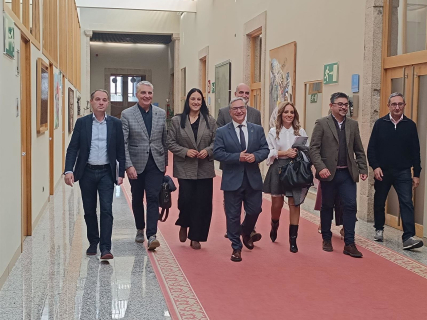

The president of the Diputación de Ourense, Luis Menor, has defended a draft budget for the institution that stands at almost 113 million euros in 2027, after an increase that he has described as "modest" but "rigorous", and he has once again insisted on the "very necessary" review of the local financing system.
During his appearance this Monday before the Commission of Economy, Facenda e Orzamentos of the Parliament of Galicia, Menor specified that the accounts reach 112,750,000 euros, which represents an increase of 2.06% compared with the previous fiscal year.
"We continue growing in resources, surpassing the more than 110 million of the previous year in this current fiscal year and we do so in a moderate and rigorous way because, obviously, some elements are missing, as we all know, since there are no State budgets," indicated the head of the Diputación.
As in previous years, he emphasized that the central axis of the budget will be the cooperation plan with the municipalities, the Plan CooperOU, which this year they aim to raise to 20 million euros, one more than in the current accounts. "It places cooperation with the town councils at the center of provincial management with stable, direct and transparent funds," he emphasized.
He advanced that the town councils will have greater room to carry out investments, thanks to the extension of the justification deadlines, and he specified that the exceptional possibility of allocating 100% of the program to current expenditure and debt amortization in cases of serious financial insufficiency will be maintained.
In his intervention, Menor also called for the elimination of the fiscal rules that, in his view, "limit" local entities and keep more than 3.5 million euros of the Diputación immobilized. He also took advantage of his passage through the Galician Chamber to defend "the deep reform" that, he considers, local financing requires.
"We are talking about the reform of regional financing, very necessary, but that reform of the financing of the local world is also very necessary," the provincial president reiterated.
Among the specific items, he detailed the plan for equipping residences and expanding senior centers in the province, endowed with 3.4 million for 16 actions in as many municipalities.
He added that, despite it not being a direct responsibility of the institution, resources for the provincial housing plan will be tripled to 1.5 million, and he advanced that the personnel chapter will amount to 45.7 million euros. According to what he explained, this item increases by a little more than 3.7 million due to the incorporation of workers from the O Barco de Valdeorras garbage collection service and the collection service that the Diputación will assume by delegation from that council.
Menor closed his first intervention by emphasizing that the provincial government of Ourense "fulfills its duties" and presents a budget for 2027 that continues to rise. "A provincial government that fulfills its commitments and reinforces the backbone of our accounts, raising the CooperOU Plan to 20 million," he stressed, also claiming cooperation with the Xunta to "structure the road network" of the province and the "social policy model", in a context of dialogue with the forces represented in the Diputación.
They will have to be approved in plenary session
After Menor's presentation, the word was taken by the deputy of Democracia Ourensana, Armando Ojea, who reminded him that the accounts will have to pass the Diputación plenary process and that, for this, "he will have to convince a significant number of the rest of the opposition deputies that these projects are good".
In his opinion, the provincial president should have sent the document with more margin to the opposition groups. "We are here reasoning or talking about something that, for the moment, is, well, we could even call it a shot in the dark," he reproached.
Ojea questioned that the "jewel in the crown" of the budget, the CooperOU Plan, "does not even reach 20% of the budget", and he also criticized that almost half of the resources "goes to personnel spending". "We all know that the Diputación has had a reputation for decades of placement or job creation, a burden that you inherited. I am not going to say that you continued with that dynamic, but it is clear that that remains a burden," he added.
The socialist deputy Carmen Rodríguez Dacosta joined the criticism over the lack of prior information to the opposition. "We are facing the last budgets of this term and, therefore, an opportunity to do something more than announce figures and present new actions. It is appropriate to take stock, to know what commitments were fulfilled," she indicated.
Rodríguez Dacosta has claimed to know the real scope of the changes after the end of the Baltar era at the head of the Diputación and whether progress was made toward a more equitable distribution of funds among all the municipalities or whether decisions marked by discretion persist.
Likewise, she has lamented that the Diputación maintains a structure that absorbs nearly half of its resources. "What ourense needs are commitments that are not repeated every year, it needs a Diputación that invests where it is most needed, that treats everyone equally and responds to the needs of the province," she defended.
For his part, the BNG deputy Iago Tabarés has taken advantage of the proximity of the end of the term to take stock and ensure that "there was no change whatsoever". "There was a change in the presidency, but it is nothing more than a change of names, because really, in essence, they have been exactly the same," he stated, denouncing that "partisan interests" have continued to be placed ahead of those of the citizenry.
In contrast, the PPdeG parliamentarian José Luis Ferro has highlighted that Ourense has a diputación that listens, cooperates and offers answers, and has defended that "this is precisely one of the main characteristics that can be highlighted in this budget project".
"They are not simply some budgets of the provincial Administration, they are budgets conceived and presented to accompany, complement and multiply the resources with the help of other administrations, especially the Xunta," he indicated.
The president of the Diputación de Ourense has closed his intervention by responding to the criticisms for not having sent the document "with enough time". "I am not here to negotiate the budgets, I am here to explain their general lines," he specified. He assured that the accounts will be known "in due time and form, they will go to committee" and will be debated "with everyone", but he emphasized that he only "lacks one deputy" to approve them and "by 112 votes".