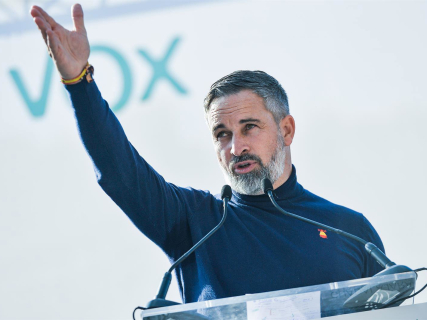
Abascal did answer Broncano’s classic questions: what was not seen from his interview on 'La Revuelta'

The answers from Vox leader to the program’s classic questions were left out of the television broadcast due to lack of time, although they were formulated during the recording

fotonoticia 20261110105733 1920

fotonoticia 20261110105733 1920

Add DEMÓCRATA to Google

Ask FREN

Published

2 minutes

Most read

Elecciones 29N · Encuestas

La media de las encuestas

Media a 10 de noviembre de 2026 · 15 institutos

  • PP31,5 %
  • PSOE26,8 %
  • Vox19,1 %
  • Frente Amplio6,2 %
  • ERC2,5 %
01020304050ene 2024jul 2024ene 2025jul 2025ene 2026jul 2026

Media del último estudio de cada instituto en 30 días y su evolución semanal desde el 23J. Partidos con al menos un 2 %.

Todas las encuestas

Elecciones generales del 29 de noviembre · Demócrata

The interview of Santiago Abascal in 'La Revuelta' this Monday left a moment that viewers of La 1 could not see. The leader of Vox did respond to David Broncano’s traditional questions about the money he has in the bank and sex during the last month, but both were left out of the television segment broadcast due to the length of the conversation.

The images of that segment show how Abascal said he had 21,000 euros in a shared account with his wife and refused to answer the question about his sex life, arguing that it is an intimate matter.

Abascal says he has 21,000 euros in the bank

When the time came for the classic questions, Broncano asked his guest if he was willing to answer them. "Well, I don't know, it depends," the president of Vox replied at first.

The host began by asking him about his assets. Abascal recalled that his assets and income are declared before the Congress of Deputies and said that he had reviewed his accounts before going on the show because he knew he was going to receive that question.

"21,000 euros in marital property [gananciales], that's what I have in the bank and my savings is the payment for a mortgage", explained the leader, who specified that this amount corresponds to both members of the marriage.

Immediately after, Abascal took the opportunity to joke about the host's pay: "Between my wife and me, we could pay you, I think, for a program or something, right?". Broncano responded, laughing: "Maybe, yes, yes, more or less".

The sex question that Abascal preferred not to answer

The second habitual question of the format had a different answer. When Broncano started asking him about his sexual relations during the last month, the Vox leader interrupted him: "Don't ask me that, leave it, cut that roll there [that thing]".

Abascal justified his refusal by the possibility that his children might be watching the program. "I understand the tone of the show, the humor, but for me it's part of my privacy," he explained.

The president of Vox insisted that he preferred to keep that part of his life out of television: "I don't talk about intimate things in public". He also mentioned his mother, his relatives, and his wife, and said that they would be "much more pleased with this position and with this shyness."

An interview of more than two hours that had to be cut down

The conversation between Abascal and Broncano, held on Monday, November 9, lasted for more than two hours and forced the team of 'La Revuelta' to select the parts that were finally broadcast on La 1.

During the interview, both addressed issues such as immigration, gender-based violence, climate change, and the funding of public television. There were also tense moments due to Vox's criticisms of the host and the decision to modify the program's usual audience for the visit of the candidate for the general elections of November 29.

The absence of the classic questions in the broadcast drew attention because they are one of the most recognizable elements of the format.

More key points, information and questions with FREN

AI-GENERATED CONTENT

What is the current status of the electoral campaign ahead of the general elections on November 29?

As of November 10, 2026, the general elections on November 29 are in the final stretch of the pre-campaign: the official campaign has not yet started and will begin on Friday the 13th. Most recent polls place the PP first and point to a possible parliamentary majority with Vox, but there are significant differences between pollsters. The competition is marked by the Urda train accident, housing, the Ceuta crisis, and the discussion about the polls themselves.

Schedule: three days before the official start

The call was published on October 6 through Royal Decree 806/2026. The schedule sets the proclamation of candidacies on November 2 and their publication on the 3rd; therefore, the electoral preparation has already passed those phases (Central Electoral Board).

  • November 12 to 13: posting of posters and official start at 00:00.
  • November 19: last day to request postal voting.
  • November 23: last day to publish electoral polls.
  • November 25: ordinary deadline to deposit postal votes.
  • November 27, 28, and 29: campaign closure, reflection day, and voting day, respectively.

These dates appear in the Demócrata electoral calendar. 38,728,356 voters are called to vote, according to the National Institute of Statistics.

Polls: PP advantage, with relevant discrepancies

The DYM poll published today offers this snapshot: PP, 33.1% and 135–139 deputies; PSOE, 27.3% and 104–108; Vox, 18.6% and 63–66; Broad Front, 5.6% and 8–10; and Podemos, 1.9% and 1–2. Interviews were conducted from November 4 to 6 (DYM, November 10).

The arithmetic sum of the PP and Vox ranges reaches 198–205 deputies, above the 176 needed for an absolute majority. However, this does not constitute a joint confidence interval nor guarantee a government agreement (DYM, November 10).

The gap between PP and PSOE varies greatly depending on the institute: NC Report attributes a seven-point advantage to PP; 40dB., two; and SW Demoscopia places PSOE 2.2 points ahead. These are studies with different dates and methods: they should not be confused with a single trend (poll comparison).

Movements and issues marking the pre-campaign

PSOE has opened a round of interviews with Sánchez's visit to "La Revuelta" and has expressed willingness to a face-to-face on November 16 and a four-way debate on RTVE on the 26th. This willingness does not equate to confirming the participation of all candidates (Demócrata, October 22).

PP has presented its candidates with an audiovisual format and criticisms of Sánchez, while Feijóo has warned against taking the elections for granted (Demócrata, November 9).

Urda and Óscar Puente's resignation have placed railway management and political responsibilities in the spotlight. Along with Ceuta and the rejection of housing decrees, these are the highlighted events in the pre-campaign monitoring; poll variations do not automatically attribute specific electoral effects to them (Demócrata monitoring).

In short, the campaign begins with a polling advantage for PP in most measurements, but without a closed result: debates remain, fifteen days of campaigning, and the effective decision of the voters.

What are the competencies and functions of the president of Vox according to the party's statutes?

According to the VOX statutes approved in 2023 and subsequently amended, the president exercises the representation, leadership, and superior coordination of the party's action. Their competencies include external representation, internal leadership, and execution of the agreements of the bodies they are part of. These attributions must be distinguished from decisions that correspond to collegiate bodies: presiding over them does not mean substituting all their competencies.

Representation and general leadership
  • Represent the party. The president represents VOX before authorities, institutions, courts, entities, and individuals. This function includes exercising the rights, actions, and resources corresponding to the organization. Therefore, presidential representation is not limited to political communication: it also includes the party's institutional and legal relations.
  • Lead and coordinate its action. They are responsible for the superior leadership and coordination of VOX's activity. This is the general attribution that places the presidency at the head of the political and organizational action of the formation, within the distribution of responsibilities established by the statutes.
  • International representation. The president represents VOX in its international relations. The statutes allow delegating this function, so it does not require that all those relations be personally exercised by the person holding the presidency.
Functioning of internal bodies
  • Preside over collegiate bodies. They preside over the National Executive Committee, known as CEN, and the party's collegiate bodies of which they are a member. This competence must be read together with the attributions that the statutes reserve for each body.
  • Execute agreements. They can take the necessary measures to fulfill the agreements of the CEN, the Political Action Committee, the Management Committee, and other bodies in which they participate. Here their function consists of making the adopted agreements effective, not only intervening in their deliberation.
  • Issue internal instructions. They are empowered to issue orders and instructions related to the internal functioning of the party. This capacity is exercised within the statutory framework and is part of their leadership and coordination responsibilities.
Other specific attributions
  • Relationship with the Disenso Foundation. They are responsible for directing the relationship between VOX and this foundation linked to the party. This is a specific attribution related to the relationship between both organizations.
  • Electoral representation. They appoint the general electoral representative, dependent on the National Electoral Office, for procedures related to the presentation of candidacies. This specific competence should not be confused with a generic faculty to decide alone all aspects of the internal electoral process.
  • Complementary powers. They may exercise the necessary attributions to develop the responsibilities assigned by the statutes. These powers are linked to fulfilling those responsibilities and do not constitute unlimited competence.
What limits should be kept in mind

The presidency holds a central position, but does not automatically concentrate all party decisions. For example, calling extraordinary assemblies corresponds to the CEN, by its own decision or at the written request of at least 20% of full members, as noted by Demócrata on the statutes.

In short, the president represents VOX, leads and coordinates its activity, and ensures the execution of agreements. These are internal competencies of a political organization: they do not grant, by themselves, public powers or authority over State institutions.

What political and professional trajectory did Santiago Abascal have before leading Vox?

Before presiding over Vox in September 2014, Santiago Abascal had developed almost twenty years of activity in the People's Party, mainly in the Basque Country. His path combined municipal and regional positions, youth responsibilities in the PP, leadership of entities linked to the Community of Madrid, and the presidency of the DENAES Foundation. His professional trajectory was, therefore, closely linked to politics and institutional management.

Origin, studies, and entry into politics

Born in Bilbao in 1976 and raised in Amurrio, Álava, he grew up in a family linked to Alianza Popular and later to the PP. His father, Santiago Abascal Escuza, was a councilor and party leader in Álava. The family's political activity was marked by ETA threats; Abascal himself received threats and had bodyguards during his Basque stage. This context appears in youth reconstructions published by El Diario Vasco.

He joined the PP when young: consulted biographies place his entry around 1994, although some date formal affiliation to 1996. He studied Sociology at the University of Deusto and obtained his degree in 2003, when he was already exercising political responsibilities, according to Infobae.

Councilor, youth leader, and Basque parliamentarian

His first institutional stage focused on Álava and Basque institutions. The main milestones were:

  • 1999-2007: PP councilor in the Llodio City Council.
  • 1999-2003: advisor to the Government Subdelegation in Álava, according to biographies about his work trajectory.
  • 2000-2005: president of the PP's New Generations in the Basque Country and member of the party's National Board.
  • 2003-2004: procurator in the Álava General Assemblies, the territory's representative institution.
  • Between 2004 and 2009: deputy in the Basque Parliament, in two parliamentary terms.

These responsibilities show that before jumping to his own organization, he had accumulated municipal, territorial, regional, and organizational experience within the PP. The sequence is recorded in profiles from El Confidencial and La Razón.

DENAES and responsibilities in Madrid

In 2006 he participated in the creation of the Foundation for the Defense of the Spanish Nation, DENAES, which he presided over until 2014. The entity promoted the defense of the Spanish nation and territorial unity. It provided him with a platform for public activity outside his institutional positions, through events and campaigns, as explained by Onda Cero.

In 2010, during Esperanza Aguirre's regional presidency, he was appointed director of the Data Protection Agency of the Community of Madrid. He also represented the community on the Advisory Council of the Spanish Data Protection Agency. In 2013 he went on to direct the Foundation for Patronage and Social Sponsorship, linked to the Madrid Administration. These were leadership and institutional management responsibilities, not private practice of sociology. Telecinco also mentions a business activity related to a hospitality business in Madrid, although without sufficiently specifying its dates.

From PP to the presidency of Vox

Abascal left the PP in November 2013. He then participated in the creation of Vox, constituted at the end of 2013 and publicly presented in January 2014. In September of that year he was elected president. In summary, he did not come to Vox from a professional career unrelated to politics: he came from a continuous trajectory of militancy, public representation, advising, and leadership of organizations and foundations.

Play

Test your knowledge with FREN!

How much do you know about this topic? Answer the following 3 questions.

Why were Abascal's answers to Broncano's classic questions not broadcast on television?

Question 1 of 3

What was Abascal's response to the question about his sexual relations in the last month?

Question 2 of 3

What amount did Abascal claim to have in the bank during the interview?

Question 3 of 3