
The Government has expressed its deep discomfort with the Supreme Court's decision to maintain the precautionary suspension of the right to vote for those naturalized under the known as "grandchildren's law" in view of the general elections on November 29. The resolution of the high court, which potentially affects 163,020 Spanish citizens residing abroad, has provoked a new political confrontation between the PSOE and the Popular Party, with mutual accusations regarding the protection of the right to vote and the legality of the electoral roll.
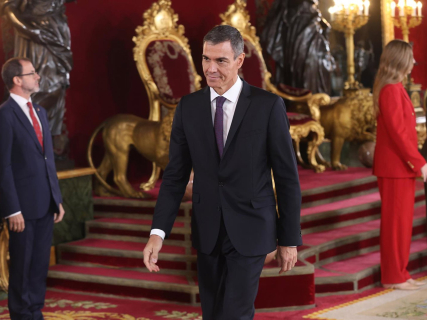
The Minister of the Interior, Fernando Grande-Marlaska, has been one of the first representatives of the Executive to question the judicial decision. During an informal conversation with journalists at the reception at the Royal Palace on the occasion of National Day, the Interior Minister lamented that a measure is being maintained that could prevent thousands of Spaniards who obtained their nationality under the Democratic Memory Law from voting. "It seems that the right to vote is not so relevant for some", the minister pointed out, highlighting the Government's disagreement with the Supreme Court's criteria.
The resolution has been adopted by the Fourth Section of the Administrative Litigation Chamber, which has rejected the requests of the State Attorney and the Prosecutor's Office to lift the suspension agreed upon on September 8. The court considers that the measure must be maintained while the legality of certain registrations in the Electoral Roll of Absent Residents (CERA) is examined, a matter that has gained special significance after Pedro Sánchez brought forward the general elections to November 29.
Marlaska criticizes the Supreme Court's decision and the Government studies its options
The Minister of the Interior has conveyed the Executive's concern about the consequences that the decision may have on the exercise of a fundamental right. Grande-Marlaska has questioned the maintenance of the vote suspension when the electoral calendar makes it practically impossible to review the files of those affected before the elections are held.
The Interior Minister has explained that it is now up to the State Attorney's Office to examine the scope of the resolution and the possible legal avenues available, including the assessment of whether the decision on the precautionary measures is definitive for the purposes of any eventual challenge. The Government had already warned that the electoral advance substantially modified the circumstances that existed when the Supreme Court initially agreed to the suspension.
The main difficulty lies in the deadlines. The valid electoral roll for the elections on November 29 is the one closed on August 1, 2026, while the period to consult the data and submit claims extends from October 12 to 19. According to the legal services of the Executive, it is materially impossible to individually examine the files of thousands of naturalized citizens and distinguish which registrations must be maintained before the census review procedure concludes.
The State Attorney's Office had requested the Supreme Court to reconsider its decision in light of the risk of causing an effective deprivation of the right to vote, since any subsequent ruling favorable to those affected would not allow recovering the lost vote in elections that have already been held.
The PSOE attacks Feijóo and Abascal: "They have stumbled again on the stone of Francoism"
The most forceful response has come from the Socialist Party, which has accused Alberto Núñez Feijóo and Santiago Abascal of supporting an action that, in the party's view, harms the descendants of those who had to leave Spain during the Civil War and the Franco dictatorship.
Socialist sources have denounced that the leaders of the PP and Vox have stumbled again on the "stone" of Francoism, considering that the controversy over the electoral roll represents a new questioning of the rights recognized to the victims of exile and their families.
"Are the grandchildren of the exiles of Francoism not going to be able to vote while the grandchildren of the Franco regime can?", they have asked from the PSOE, which interprets the decision as an "outrage" against thousands of Spanish citizens.
The socialists have raised the tone of their criticisms by asserting that Feijóo and Abascal intend to prevent the descendants of exiles from participating in the general elections. "For Feijóo and Abascal, the damage caused by the dictatorship was not enough, but they want to continue punishing the descendants of the Spaniards who had to flee Spain to save their lives," the same sources have stated.
The PSOE has also linked this controversy with previous controversies related to voting by mail and the functioning of the electoral system. In their opinion, PP and Vox are successively questioning different mechanisms of political participation and now focus on the suffrage of Spaniards nationalized under the Law of Democratic Memory.
"In a democracy, the right to vote is not prohibited, it is guaranteed", the socialists have defended, asserting that they will continue to denounce what they consider an attempt to restrict fundamental rights. The accusations are part of the PSOE's political interpretation and contrast with the position of the parties that advocate for the revision of the census to ensure the regularity of registrations.
PP celebrates the resolution and accuses Sánchez of trying to manipulate the census
The reaction of the Partido Popular has been completely opposite. The popular party has welcomed the Supreme Court's resolution and considers that it represents a limit to the Executive's actions regarding the electoral census. From Feijóo's party, they maintain that judicial institutions must ensure that elections are held with a voter registry that complies with the law.
One of the most notable responses has been from the popular deputy Cayetana Álvarez de Toledo, who has directly accused Pedro Sánchez of trying to intervene in the composition of the electorate.
"Pedro Sánchez wanted to tamper with the electoral census, but Spain has institutions capable of putting limits on power. On November 29, clean elections. That is the first victory of democracy", the parliamentarian has written on her X account.
In the same vein, the mayor of Badalona, Xavier García Albiol, also from the PP, has stated that "it seems that the attempt to manipulate the electoral census has not gone well".
These statements reflect the political position of the PP, although the precautionary resolution does not establish that the Government has manipulated the census nor does it prove the existence of electoral fraud. The judicial procedure focuses on determining whether certain registrations meet the legal requirements and whether they should be maintained while the main appeal is resolved.
What the Supreme Court has decided and why it affects more than 163,000 Spaniards
The origin of the controversy lies in the appeals promoted by Vox and Iustitia Europa against certain registrations in the Census of Absentee Residents linked to the application of the Law of Democratic Memory.
This law, approved in 2022, opened the possibility of obtaining Spanish nationality for certain descendants of people who had to flee for political, ideological, belief, or sexual orientation reasons. Subsequently, an instruction from the Ministry of Justice established criteria to facilitate the accreditation of the status of exile in certain historical cases.
The Supreme Court provisionally questioned the application of that instruction, considering it necessary to verify whether the electoral registrations made through that procedure complied with the legislation. The suspension was initially adopted on September 8, when the general elections had not yet been called.
The electoral advance has considerably complicated the implementation of the measure. According to the latest data provided by the Government, 163,020 people are potentially affected by the suspension for the 29N, although the specific application depends on the administrative situation of each voter.
It is important to note that the Supreme Court's decision does not imply the withdrawal of Spanish nationality nor does it necessarily affect all beneficiaries of the grandchildren's law. The controversy refers to the exercise of the vote and to certain electoral registrations whose legality is pending review.
A magistrate disagrees with the decision and warns of irreversible damage
The Supreme Court's decision has not been unanimous. Magistrate Alicia Millán has issued a dissenting opinion, considering that the early call for elections constitutes a new circumstance that should have led to a reconsideration of the suspension.
In her argumentation, the magistrate warns that the maintenance of the measure may provoke an irreversible consequence on the fundamental right of political participation, as those affected would not be able to recover the possibility of voting in the elections of November 29.
The majority position of the court, on the other hand, prioritizes the need to guarantee the regularity, veracity, and transparency of the electoral roll while the litigation is resolved. The magistrates consider that the protection of the electoral process justifies maintaining the precautionary measures, despite the practical difficulties that their application poses.
This discrepancy reflects the main legal conflict of the case: how to reconcile the guarantee of a census adjusted to legality with the political participation right of Spanish citizens whose nationality remains valid.
The conflict erupts in the midst of the countdown to the elections of 29N
The judicial decision comes at a particularly sensitive moment in the electoral calendar. This Monday, October 12, the deadline has opened to consult the census for the general elections of November 29, which will remain available for claims until next October 19.
Resolutions regarding the detected errors or omissions must be communicated within the established deadlines, with October 23 as the reference date for their exposure. The proximity of these procedures reduces the margin to review the files of the affected naturalized citizens and apply possible modifications before the voting.
The controversy occurs, moreover, in a scenario of increasing confrontation between the Government and the opposition, with the parties preparing their candidacies and electoral strategies. PSOE denounces an unjustified restriction of the right to vote, while PP defends the Supreme Court's actions as a guarantee of electoral cleanliness.
With the general elections less than seven weeks away, the situation of the 163,020 potentially affected naturalized citizens becomes one of the main legal and political conflicts of the call. The Executive is studying the steps it can take after the resolution, while the Supreme Court maintains the precautionary suspension and the final resolution on the legality of the questioned registrations remains pending.