Feijóo, homeland and sacrifice: to the conquest of the vote of the working class

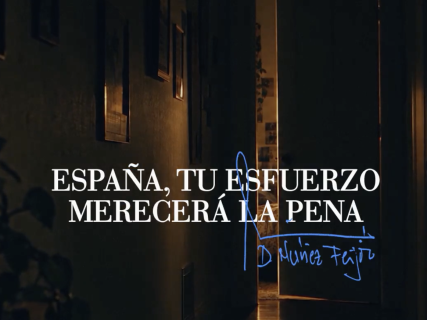
The Popular Party has launched a new electoral video that focuses on workers, self-employed, healthcare professionals, small businesses, and families under the slogan "Spain, your effort will be worth it." The piece recalls for its audiovisual language the famous "Morning in America" with which Ronald Reagan built in 1984 a narrative of optimism around American daily life, although Feijóo uses those images from the opposition to promise that the effort of citizens will be rewarded.

5 minutes

Screenshot 2026 10 11 at 17.30.45

Screenshot 2026 10 11 at 17.30.45

Add DEMÓCRATA to Google

Ask FREN

Published

Last updated

5 minutes

Most read

Alberto Núñez Feijóo barely appears in the new announcement from the PP. Before him, a worker preparing bread, travelers crossing a station, a worker surrounded by sparks, healthcare professionals, merchants, and families trying to balance work with care arrive. Spain wakes up, works, and ends the day tired. Only at the end does the candidate's signature appear alongside the message that summarizes the piece: "Spain, your effort will be worth it".

Released this Sunday October 11, the video is part of the PP's strategy for the general elections on November 29 and seeks to unite two ideas that traditionally have not always traveled the same path in political discourse: national identity and material living conditions. The country is not represented first through flags or institutions, but through those who lift a shutter, work, care, study, or return home at the end of the day.

From "Morning in America" to "Spain, your effort will be worth it"

The most obvious comparison is with Ronald Reagan and his "Morning in America" from 1984, one of the most well-known electoral advertisements in American politics. That piece showed people going to work, families, homes, and everyday scenes to build an image of recovery and national confidence. The new PP video uses similar language: the nation appears through normality and those who sustain it every day.

The political difference is important. Reagan governed and presented that recovery as a reality already achieved; Feijóo is in the opposition and promises a future reward. The verb "will deserve" is therefore central: it stems from the idea that there is a distance between the effort that citizens make and what they receive in return, and places the candidate as one who promises to reduce it.

There is no evidence in the consulted sources that Feijóo's team has directly taken Reagan's campaign as a reference. The similarity lies in the audiovisual language and in a recognizable political tradition: using scenes of everyday life to associate the candidate with a certain idea of the country. There is also a parallelism with the British conservatives of David Cameron, who in 2015 sought to present themselves as the party of those who work and linked that message with economic stability, housing, and family care.

The PP seeks to contest the vote of workers

The selection of protagonists allows for interpreting the announcement as an attempt to broaden the PP's connection with the working electorate, although the social portrait is deliberately broader. In the same narrative appear salaried workers, self-employed, qualified professionals, small business owners, and families. They are not united by a specific labor category, but by an idea: to work, to fulfill, to persevere, and to hope that this effort has a reward.

It is a way of approaching the world of work from the center-right. While the left tends to build its discourse around concepts such as labor rights, redistribution, or collective protection, the PP emphasizes merit, autonomy, effort, and the possibility of improvement. They are different frameworks that can compete for citizens who share concerns about wages, housing, work-life balance, taxes, or public services.

The announcement, however, barely enters into concrete proposals. Its objective is emotional and prior to the program: to convey recognition and build a connection with the viewer. The credibility of that promise will subsequently depend on the measures that the PP presents to address those material concerns.

Feijóo appears at the end and leaves the spotlight to the citizen

Another significant decision is that Feijóo is not the center of the video. The piece first allows the viewer to recognize situations, professions, and routines before fully identifying the political sender. Only when that emotion is built does the candidate's signature appear, which tries to associate itself with respect for those who work and with an expectation of improvement.

The approach also complements the slogan "Finally", used by the PP during this pre-campaign. If those two words mainly appeal to the desire for political alternation, "Spain, your effort will be worth it" tries to explain what that change should mean in daily life. The first formula indicates the end of a stage; the second promises a consequence for those who work, undertake, or care.

The polls explain why Feijóo needs to strengthen his profile

The video arrives in a scenario where the PP has an advantage in several polls, but where Feijóo still has room to strengthen his own valuation. The survey by 40dB., conducted through 800 online interviews on October 7 and 8, placed the PP at 31.9%, compared to 28.1% for the PSOE and 18.9% for Vox. However, when asked who would be a better president, Pedro Sánchez received 32.2% compared to 29.3% for Feijóo, while 33.4% responded that neither of the two.

The same study calculated that 15.6% of those who remember having voted for the PP in 2023 would now lean towards Vox. Another survey, conducted by Hamalgama Métrica through 1,000 telephone interviews between October 5 and 8, reduced that transfer to 12.9%, but agreed in pointing out a shift towards Santiago Abascal's party. This last poll granted 144 seats to the PP and 68 to Vox.

These are data prior to the announcement's publication and, therefore, do not allow measuring its effectiveness. They do help to understand its objective: Feijóo needs to attract citizens dissatisfied with the Government, but also to strengthen his bond with those who already voted for the PP and might seek another option within the right-wing space.

From the "Blue Summer" of 2023 to the early mornings of 2026

The contrast with the 2023 campaign is evident. Back then, one of the pieces from the PP resorted to "Verano Azul", with Borja Sémper barefoot on the sand, umbrellas, and a relaxed staging. Three years later, the register changes: early mornings, displacements, workdays, care, and fatigue appear. The future is no longer represented as rest or a change of environment, but as a reward still pending.

There are also precedents within the party's own history. In 2011, the campaign "Súmate al cambio" linked political alternation with employment, opportunities for young people, the situation of families, and the recovery of trust. The difference is that the piece from 2026 practically reduces all that message to a succession of images and a final phrase: it argues little and represents much.

A processional march to accompany daily effort

The music also contributes to the tone. According to the information gathered in the reference text, the soundtrack used is "La Esperanza de María", a processional march by the Sevillian composer Alejandro Blanco. Over scenes of work, care, and displacements, the composition adds solemnity and allows for an emotional connection between effort, community, and hope.

Political advertising has been using music and images for decades to reinforce emotions and activate prior identifications. That does not mean that a video capable of evoking emotions necessarily changes the vote: it can mobilize those who already sympathize with a candidacy, improve the candidate's perception, or increase their circulation on social networks without causing an electoral transfer.

Feijóo tries to build a positive reason for change

The PP does not want Feijóo's candidacy to depend solely on the government's wear and tear. This announcement seeks to add a positive reason for change: to recognize those who sustain the country through their work and promise that this dedication will have a reward. The candidate reserves himself for the end and lets the citizens visually build the idea of Spain beforehand.

There is also the main challenge of the campaign. The video can recognize the fatigue of workers, freelancers, and families, but that identification will have to translate later into responses about salaries, housing, taxation, public services, or work-life balance. For now, Feijóo has chosen to start with a well-known image in the history of political communication, from Reagan to Cameron: a country told through the ordinary people who get up every morning to make it work.

More key points, information and questions with FREN

AI-GENERATED CONTENT

What is the current status of the PP's electoral campaign and what are the next steps for the pre-campaign ahead of the general elections?

As of October 11, 2026, the PP's campaign is in a fully electoral pre-campaign phase, with the calendar already underway towards the November 29 general elections. The party's machinery is activated both organizationally (campaign committee, spokespersons, program) and symbolically and communicatively (mass event at IFEMA, slogan “Finally”, offensive on social media with “#ElectionsNow”). The focus is on presenting the PP as a government alternative and turning the November 29 vote into a plebiscite on the continuity of Pedro Sánchez.

Current situation of the PP campaign

After the early election call on October 5, the PP quickly moved from internal preparation to the public staging of the pre-campaign:

  • Pre-campaign launch in Madrid: the first major event was held at the IFEMA North Auditorium, with full capacity and supporters left outside. Feijóo was supported by Isabel Díaz Ayuso and José Luis Martínez-Almeida, projecting unity between Génova, Puerta del Sol, and the Madrid City Council. The party presents it as a “mobilization success” and the starting gun for the race to November 29.
  • “Finally” message and #ElectionsNow: since the day of the election announcement, the PP has flooded its communication with the slogan “Finally” and social media campaigns demanding elections and celebrating that “finally we can choose.” Leaders and deputies echo the narrative that “Spain can’t take it anymore” and that it is time to “give the word to the Spanish people.”
  • Political framework: change and “national reconstruction”: Feijóo frames the elections as more than just an alternation: he talks about “national reconstruction” focused on institutions, family economy, housing, coexistence, and immigration control. He commits to a “calm but forceful change” and to governing “with the truth upfront.”
  • Confrontation with Sánchez: the popular discourse contrasts “decency” and “order” against the “decadence,” “corruption,” and institutional deterioration attributed to the Government. It is emphasized that the elections are “about Spain beating Sánchez and what he represents,” rather than a conventional PP–PSOE duel.
  • Thematic axes already visible: besides the general criticism of the legislature’s record, three fronts stand out: housing (as the Government’s weak flank), immigration and security (with Feijóo’s early visit to Ceuta), and the integrity of the electoral system (internal debate on postal voting, recourse to the Central Electoral Board, while defending that the system is “clean and guarantees rights”).

Campaign architecture and communication strategy

Organizationally, the PP’s electoral structure is already defined and communicated:

  • Miguel Tellado, secretary general, assumes campaign leadership.
  • Marta Varela, Feijóo’s chief of staff, acts as deputy director.
  • Alma Ezcurra coordinates the drafting of the electoral program.
  • Ester Muñoz, spokesperson of the Popular Group in Congress, becomes campaign spokesperson, a role coordinated with the public projection of Borja Sémper.

Génova pursues a very centralized message architecture: “one voice” around Feijóo, with territorial leaders —Ayuso, Almeida, and other regional barons— acting as multipliers but without disputing the narrative focus.

The communication strategy combines:

  • Controlled polarization (high contrast with Sánchez, appeals to “save democracy” and “elections now”) with the image of a “moderate and managerial” alternative.
  • Rapid offensive on every Government move, trying to set the campaign framework before the PSOE consolidates its own (for example, on housing).
  • Territorial and digital mobilization, with explicit instructions to provincial structures to fill events, organize buses, and stir the narrative on social media.

Next steps of the pre-campaign

From now until the formal start of the campaign (November 13), the PP’s key steps will likely be:

  • Feijóo’s territorial deployment: the electoral committee has “prepared a calendar that aims to take him throughout Spain.” The goal is to maintain the mobilization level seen at IFEMA, transferring it to competitive constituencies.
  • Strengthening the Madrid axis: a greater joint presence of Feijóo, Ayuso, and Almeida is expected, using Madrid as a showcase of “good management” and unity between national leadership, community, and capital.
  • Programmatic specification: after a more symbolic first phase, the PP will have to detail proposals on housing, economy, health, immigration, and institutions. Some sectoral vectors, such as health, are already being shaped as “essential pillars” of their project.
  • Debate preparation: the PP has accepted at least one Sánchez–Feijóo face-to-face and other plural formats. Preparing these debates will mark much of the campaign team’s internal agenda.
  • Closing candidate lists and internal cohesion: in parallel, the party must finalize candidate lists before the legal deadlines in October, managing territorial balances without eroding the recently displayed image of unity.

In summary, the PP arrives in mid-October with the pre-campaign launched, a clear narrative of “change and reconstruction,” and a campaign structure already named, but with the challenge of transforming organizational muscle and internal euphoria into a concrete programmatic offer and effective mobilization at the polls on November 29.

Can you break down in more detail what the PP proposes on specific issues such as housing, economy, and health within this pre-campaign? What specific role are Ayuso and Almeida playing in the PP’s national electoral strategy ahead of November 29? How does the PP’s pre-campaign strategy compare with that of the PSOE for these general elections?

What are the powers and attributions of Alberto Núñez Feijóo as leader of the opposition and president of the Partido Popular according to Spanish legislation?

In the Spanish legal system, there is no specific legal figure generally called “leader of the opposition” at the state level. Alberto Núñez Feijóo’s powers derive, on one hand, from his status as a deputy and head of the main opposition parliamentary group in the Congress of Deputies, and on the other, from his position as president of the Partido Popular (PP), regulated by political party regulations and the PP’s own internal statutes.

1. General framework: what the legislation says (and does not say)

The 1978 Spanish Constitution and organic laws do not recognize a “statute of the leader of the opposition” in the Cortes Generales. Unlike some parliamentary systems (for example, the United Kingdom), in Spain the opposition as such does not have a unitary legal regime nor a single-person body defined by the Constitution.

What is regulated is:

  • The position of deputies and their rights and duties (Constitution and Congress Rules).
  • The role of parliamentary groups, including opposition groups.
  • The regime of political parties (Constitution and Organic Law of Political Parties), which supports the existence, organization, and functioning of the Partido Popular.

Feijóo acts, therefore, as leader of the opposition in a political and parliamentary sense, but his specific powers are articulated through these legal figures: deputy, spokesperson or reference of the Popular Parliamentary Group, and president of a political party with majority representation in the opposition.

2. Powers and attributions in the parliamentary sphere

As the top leader of the main opposition party with its own group in Congress, his powers fall within the rights and faculties of the parliamentary group and its members:

  • Government oversight function: participation, directly or through his group, in:
    • Questions to the Government in control sessions (oral in Plenary or written).
    • Interpellations and motions resulting from interpellations.
    • Proposals to create investigative commissions.
    • Requests for appearances of Government members.
  • Parliamentary initiative: his group can present bills, non-legislative motions, amendments to bills, information requests, etc. Although formally presented by the group or signing deputies, the political line is set by the party leadership he presides over.
  • Participation in the Board of Spokespersons and in the Plenary: the organization of speaking times and turns recognizes a special role to the largest groups. The leader of the main opposition group usually intervenes in key debates (investiture, motions of censure, major laws, state of the Nation debates), but the legal basis is in the Chamber’s rules of procedure, not in a personal statute.
  • Promotion of constitutional control instruments: in practice, he can lead his group’s decision to:
    • Promote a motion of censure (which requires an alternative candidate and a minimum number of signing deputies).
    • File constitutional appeals (with the support of at least 50 deputies or senators from his group).

    Formally these are acts of the parliamentary group or its members, but politically they are associated with the leadership of the main opposition party.

3. Powers as president of the Partido Popular

As president of the Partido Popular, Feijóo’s powers are based on:

  • Article 6 of the Constitution, which recognizes parties as a fundamental instrument of political participation and requires democratic organization and functioning.
  • The Organic Law of Political Parties, which guarantees freedom of internal organization within that democratic framework.
  • The PP’s internal statutes, which specify the functions of its president (bodies he convenes, ability to propose candidates, political direction, appointment of spokespersons, etc.).

Although details vary according to those statutes, generally the PP president usually has, among others, these political functions:

  • Political and strategic direction of the party, including defining the opposition line to the Government.
  • Proposal or decisive influence in the designation of candidates for general, regional, local, and European elections, and in the formation of electoral lists, within internal rules.
  • Coordination of the party’s parliamentary groups in Congress, Senate, and regional parliaments, so that institutional action responds to a common strategy.
  • Representation of the party before other political forces, institutions, and the public opinion.

These powers are not individually set by state law but are part of the party’s organizational autonomy recognized by the Constitution and the Organic Law of Political Parties. The legal limit is respect for internal democracy, members’ rights, and laws in general.

4. Summary

In summary, Alberto Núñez Feijóo does not have a specific “legal status” as leader of the opposition granting him powers different from those of any other deputy or party president. His role derives from:

  • The parliamentary powers of the Popular Group as the main opposition group (government oversight, legislative and political initiative, participation in major debates and instruments such as motions of censure or constitutional appeals).
  • The internal powers recognized by the Partido Popular’s statutes as its president, supported by the Constitution and the Organic Law of Political Parties.

He is, therefore, a fundamentally political and parliamentary figure, rather than a legal-constitutional category with a specific regime detailed in legislation.

Could you detail which specific parliamentary control instruments the PP can promote as the main opposition party? Is there any specific statute for the leader of the opposition in any regional parliament that recognizes specific functions? What are the differences between the powers of the Prime Minister and those of the leader of the opposition in the Spanish constitutional system?

What results did the Partido Popular obtain in the last general elections and how is the Congress of Deputies currently composed in terms of seats by party?

The last general elections held in Spain were on July 23, 2023 (23-J). In those elections, the Partido Popular (PP) was the most voted force and obtained 8,091,840 votes, which represented approximately 33.1% of valid votes for candidacies and a total of 137 seats in the Congress of Deputies. Although it was the party with the most votes and deputies, it fell short of an absolute majority, set at 176 seats in a 350-seat chamber.

The overall result of 23-J configured a very fragmented Congress, with two large state-wide parties, two medium-sized state-wide forces (Vox and Sumar), and a set of nationalist and regionalist formations completing the seat distribution. Based on those results, the composition of the lower chamber was as follows:

  • Partido Popular (PP): 137 seats – first force in votes and number of deputies.
  • Partido Socialista Obrero Español (PSOE): 121 seats – second force, 16 deputies behind the PP.
  • Vox: 33 seats – third force at the state level, with presence in most constituencies.
  • Sumar: 31 seats – fourth force; a confluence candidacy that then included Podemos.
  • Esquerra Republicana de Catalunya (ERC): 7 seats.
  • Junts per Catalunya (Junts): 7 seats.
  • Euskal Herria Bildu (EH Bildu): 6 seats.
  • Partido Nacionalista Vasco (PNV): 5 seats.
  • Bloque Nacionalista Galego (BNG): 1 seat.
  • Coalición Canaria (CC): 1 seat.
  • Unión del Pueblo Navarro (UPN): 1 seat.

The sum of these results gives the 350 deputies that make up the Congress. Since the legislature’s constitution, several individual deputy replacements have occurred (resignations, changes of position, etc.), but according to available information, the numerical balances between parties have not changed: each formation maintains the same number of seats obtained at the polls, although with different names occupying some seats.

In terms of blocs, the resulting distribution from 23-J can be read as follows:

  • Right-wing bloc (PP + Vox + UPN, and potentially CC):
    • PP: 137
    • Vox: 33
    • UPN: 1
    • CC: 1 (although Coalición Canaria has maintained its own negotiating position)

    The clearest combination PP + Vox sums 170 seats; adding UPN would be 171 and, with CC’s seat, 172. In any case, they fall short of the absolute majority of 176.

  • Government bloc and potential allies (PSOE, Sumar, and nationalist/independentist forces that have facilitated the investiture):
    • PSOE: 121
    • Sumar: 31
    • ERC: 7
    • Junts: 7
    • EH Bildu: 6
    • PNV: 5
    • BNG: 1
    • CC: 1 (when it has supported certain votes)

    Depending on specific combinations, this bloc may or may not exceed the absolute majority, which explains the high dependence of the Government on several different partners in each key vote.

Returning to the focus on the Partido Popular, its 137 seats in the 2023 elections placed it well above the results obtained four years earlier and consolidated its status as the main opposition force to the coalition Government led by the PSOE. However, the inability to gather the necessary support from other forces to reach 176 deputies prevented Alberto Núñez Feijóo from being invested president, despite having won the elections in votes and seats.

In summary, to date the Congress of Deputies is composed, numerically, as it was after 23-J: the PP holds 137 of the 350 seats, the PSOE 121, Vox 33, Sumar 31, and the rest of the territorial forces complete the chamber with between 1 and 7 deputies each. This distribution explains both the centrality of the PP as the main parliamentary force and the need for broad agreements among parties to pass any stable majority.

How were the seats distributed in the Senate after the July 23, 2023 general elections? What pacts and supports made Pedro Sánchez’s investiture possible with this parliamentary arithmetic? How have voting intention polls evolved for PP, PSOE, Vox, and Sumar since the 2023 elections until now?

Play

Test your knowledge with FREN!

How much do you know about this topic? Answer the following 3 questions.

What is the slogan that summarizes the new electoral ad of the PP?

Question 1 of 3

What audiovisual resource does the new PP ad use to emotionally connect with viewers?

Question 2 of 3

According to the polls mentioned in the news, what percentage of PP voters in 2023 now considered voting for Vox according to the 40dB. survey?

Question 3 of 3