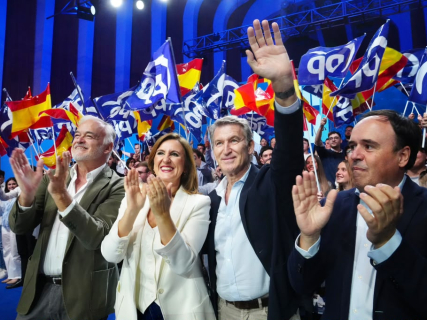
Feijóo promises one million homes, a reduction of the IRPF in 2027, and an audit of government spending.

The leader of the PP claims in Valencia his reconstruction plan of 12,000 million euros, announces fewer ministries and high positions, and gets emotional remembering the dana: "I deeply love this community"

WhatsApp Image 2026 10 23 at 18.25.42

WhatsApp Image 2026 10 23 at 18.25.42

Add DEMÓCRATA to Google

Ask FREN

Published

Last updated

6 minutes

Most read

Elecciones 29N · Encuestas

La media de las encuestas

Media a 23 de octubre de 2026 · 15 institutos

  • PP31,4 %
  • PSOE26,9 %
  • Vox18,8 %
  • Sumar6,4 %
  • Podemos3,1 %
  • ERC2,2 %
010203040ene 2024jul 2024ene 2025jul 2025ene 2026jul 2026

Media del último estudio de cada instituto en 30 días y su evolución semanal desde el 23J. Partidos con al menos un 2 %.

Todas las encuestas

Elecciones generales del 29 de noviembre · Demócrata

The president of the Popular Party, Alberto Núñez Feijóo, has promised to build one million homes, lower the IRPF in 2027, and order an audit of government spending if he reaches La Moncloa after the general elections on November 29. During a rally held this Friday in Valencia, the popular leader presented these measures as part of his commitment to regain the trust of citizens and accused Pedro Sánchez of prioritizing his continuity in power over the needs of Spaniards.

"It is about leaving behind hypocrisy and governing with honesty," Feijóo defended, summarizing his political proposal in a phrase directed at the current president of the Government: "Spain needs a servant and not an impostor". In his opinion, Sánchez lives "obsessed with power" and has lost the ability to fulfill his commitments.

The PP candidate dedicated a good part of his speech to the situation in the Valencian Community after the dana. He expressed his affection for the neighbors of Oliva affected by the storm and congratulated the president of the Generalitat, Juanfran Pérez Llorca, for the management of his Executive. The most emotional moment came at the end of his speech when, visibly moved, he recalled what happened during the storm: "I feel everything that has happened. I deeply love this community".

In this context, he reaffirmed his commitment to the Valencia Plan, endowed with 12 billion euros of investment, and assured that he will execute it if he reaches the Government. "I presented the Valencia Plan, endowed with 12 billion euros of investment. I presented it, I signed it, and I will fulfill it. I am not Sánchez," he proclaimed.

An audit from the first Council of Ministers

Feijóo accused Sánchez's Executive of having more economic resources than its predecessors without, in his opinion, that situation translating into a sufficient improvement of public services and infrastructure.

"We have the most expensive Government in history, with more money than ever," he stated, before posing the question that, as he pointed out, citizens are asking: "Where has all this money gone?".

The popular leader linked this criticism to the pending infrastructure in the Valencian Community. He reproached the central Government that, both before and after the dana, it has not executed the works he considers necessary to reduce the risks associated with new episodes of torrential rains.

In terms of organization of the Executive, he has promised a Government with fewer ministries and fewer high-ranking officials. In addition, he has announced that in the first Council of Ministers he will request an audit of public spending made during the last years.

As he has explained, the objective will be to review the destination of the funds and clarify possible irregularities. Feijóo has used a particularly harsh expression by stating that he wants to know "how much money has been stolen these years," an accusation he has directed at the current Executive without specifying a figure or identifying specific items in that intervention.

He has also promised to restore "the value of the word" to politics and ensure that the president of the Government fulfills the commitments he makes to the citizens.

A reduction of the IRPF and exemptions for those earning the minimum wage

In fiscal matters, Feijóo has announced that in 2027 he will approve a reduction of the IRPF to alleviate the impact of inflation on wages. The president of the PP has reminded that his party has been demanding since 2022 a reduction of the tax rate and has assured that he will carry it out if he governs.

"In 2027 there will be a reduction of the IRPF so that inflation and taxes do not eat up the salary of the Spaniards," he has promised. In his opinion, the Government has benefited from the increase in prices through tax collection. "It is immoral for the Government to charge twice for inflation: when shopping and when filing the tax return", he has criticized.

The popular leader has defended that workers must regain purchasing power and has assured that the tax reduction will begin with those who have endured greater economic difficulties. "Because bleeding people with taxes, that is indeed a sacrifice. It is taking the fruit of your effort and your work," he has stated.

In addition, he has promised that those earning the minimum interprofessional wage (SMI) will not pay IRPF by law. To this end, he proposes that the income threshold exempt from the tax automatically increases every time the minimum wage is raised.

"The Government has boasted a lot about raising the minimum wage, but then it was trying to tax it," he has pointed out. Feijóo has assured that his proposal will prevent future increases in the SMI from forcing its recipients to pay this tax.

A new generation of owners

The housing has been another of the axes of his speech. Feijóo has assured that one of his priorities will be to regain the trust of young people in the possibility of accessing home ownership, given the difficulties they face in becoming independent.

To this end, he has reiterated his commitment to promote the construction of one million homes and reduce the tax burden associated with their acquisition. The leader of the PP has defended that access to property must again be a real possibility for new generations.

"On November 29 we also vote to have a new generation of homeowners in our country," he has stated, directly linking his housing proposal with the electoral date.

Feijóo has also related corruption to the lack of resources to meet social needs. "Every euro that is stolen is a home that is not built", he has assured during his speech.

Do they give lessons in feminism?

The president of the PP has also attacked the feminist discourse of the Government. "They give lessons in feminism. The worst Government in history for women," he has stated, before asking: "Is being a feminist living at the expense of prostitution money?".

At another moment in the rally, Feijóo has resorted to irony to attack the president of the Government for the judicial investigations affecting José Luis Ábalos, Koldo García, and Santos Cerdán. "Now Sánchez boasts that he is left-handed. It must be because his two right hands have already been to prison", he has pointed out.

The Valencia Plan and pending infrastructures

In addition to the 12 billion euros of the Valencia Plan, Feijóo has made specific commitments regarding transport and infrastructures.

He has assured that his Government will promote the undergrounding of the railway tracks and the Valencia bypass tunnel, two actions that he has included among the pending needs of the city.

The president of the PP has linked these projects with his proposal to improve State investments in the Valencian Community and has reproached Sánchez for the lack of progress in infrastructures that he considers priorities.

Català claims Valencia and assures that she will continue to be mayor

Before Feijóo, the mayor of Valencia and head of the PP list for Congress for the province, María José Català, has intervened, defending the unity of Spain and presenting the Valencian Community as a land with "hope for change".

"When democracy is at stake, you cannot look the other way," he has stated. He also recalled the mobilization held in the town hall square in defense of Ceuta: "Ceuta is not for sale, Ceuta is defended".

Català has wanted to make it clear that her political priority will continue to be the city of Valencia, despite heading the popular candidacy for Congress. "I am going to continue being the mayor of Valencia and, if you want, I will continue to be so in May 2027", she has assured.

The mayor has also criticized the central government for what she considers a lack of investments and attention to the municipalities. In this regard, she has questioned the fulfillment of Sánchez's announcements regarding industrial and construction projects in Valencia.

She has also responded to the feminist discourse of the PSOE. "I am a woman who believes in feminism and equality and who is offended by the idea of 'I am a feminist because I am a socialist,'" she has stated.

Three women at the head of the candidacies

The president of the Generalitat Valenciana, Juanfran Pérez Llorca, has highlighted that the PP presents three women at the head of its candidacies for Congress in the Community of Valencia: María José Català for Valencia, Macarena Montesinos for Alicante, and Helena Albalat for Castellón.

"Look, three women," he has emphasized. "We are the only party that puts three women at the head of the candidacies, because we are the party of women and we are the party of Rita Barberá, and we will continue to be so", he has added.

Pérez Llorca has also directed his criticisms at Compromís and the electoral alliances of the left. He has accused the Valencianist formation of moving towards independentist positions and has defended the identity signs of the Community of Valencia.

"We want Catalonia as a sister land, but we have our own identity signs, like the senyera, and the senyera is not to be touched," he has stated. He has also claimed that being Valencian is compatible with being Spanish.

The regional president has accused Compromís of acting based on interests foreign to the Community of Valencia and of integrating into Frente Amplio in Valencia, which he has referred to as "the new hodgepodge of the left."

More key points, information and questions with FREN

AI-GENERATED CONTENT

What is the parliamentary status of the Valencia Plan and what are the procedures and deadlines planned for its approval and implementation?

The Valencia Plan announced by Alberto Núñez Feijóo on January 20, 2025 is a political investment proposal, not a bill identified by that name. The sources consulted do not show a parliamentary file that allows placing it in a specific approval phase, nor a binding schedule for its execution. There is an announcement to take it to the Senate, but that announcement does not prove that it has been debated or approved.

What was announced and its scope

The document proposes 12 billion euros over ten years, with an average investment of 1.2 billion annually. Its declared objectives are to repair the damage caused by the DANA, prevent new floods, and advance the main Valencian infrastructures. These are magnitudes of the proposal, not budget credits whose approval is evidenced by the announcement (PP presentation).

The Valencia Plan document includes actions in environment, housing, waste, roads, railways, ports, airports, and industrial parks. Therefore, it should not be confused with a single work or a single regulation: it groups measures of different nature, whose approval and execution would require specific decisions.

Accredited parliamentary status

In its presentation, Feijóo offered the document to the Government of Spain and announced that it would be taken to the Senate to leave a parliamentary record of the proposal. He also linked it to a possible PP government program. The sources consulted do not show the subsequent approval of that announced commitment, nor an identified initiative that fully incorporates the plan (announcement of presentation).

The distinction matters: presenting a proposal, obtaining parliamentary support, and having financing to execute it are different milestones. There is no basis to affirm that the Valencia Plan is pending amendments, a committee report, or a final vote. It is also not appropriate to attribute to it the status of other Valencian initiatives on reconstruction or administrative simplification.

Procedures for its approval and implementation

The materialization of the document would require separate actions, according to each measure. There is no known single approval procedure for the whole. The instruments mentioned in the located information are:

  • Budgetary financing: allocations in the General State Budgets or other budgetary decisions that financially support the actions.
  • Sectoral planning: incorporation or development of projects in the instruments corresponding to transport, water, housing, and other matters.
  • Administrative coordination: agreements between competent administrations when actions require collaboration.
  • Project execution: approval of specific projects and their corresponding tenders, without the political document replacing these procedures.
  • Specific regulations: approval of legal modifications that certain measures might need.
What deadlines are planned

The only documented global horizon is the ten years announced in January 2025. This does not equate to a legal deadline counted from a parliamentary approval, nor does it allow setting start and end dates for each infrastructure. There is also no detailed schedule of annual budgets, tenders, or commissioning.

Consequently, the practical answer is that there is no accredited approval or implementation date for the entire Valencia Plan. To assess concrete progress, announcements must be distinguished from budgetary, administrative, and legislative decisions that develop each action. If you refer to another program informally called Valencia Plan, the promoting body or the announcement link would allow differentiating it from this proposal.

What are the powers and attributions of the President of the Government of Spain according to the Constitution and current legislation?

The President of the Government directs the Executive's action and coordinates its members, but does not concentrate all its powers: certain decisions correspond to the Council of Ministers and others to each minister. His powers are mainly supported by the Spanish Constitution, especially article 98.2, and article 2 of Law 50/1997, of the Government.

1. Political direction and coordination

He is responsible for representing the Government, establishing its political program, determining the guidelines of domestic and foreign policy, and ensuring their compliance. He can give instructions to ministers and resolve conflicts of powers between ministries, respecting the competence and direct responsibility of each holder.

He also convenes and presides over the Council of Ministers and sets its agenda, without prejudice to the constitutional possibility that the King presides over it, at the president's request, to be informed of State matters.

2. Organization and composition of the Government
  • Proposes to the King the appointment and dismissal of vice presidents and ministers —article 100 of the Constitution—. The joint composition of vice presidencies and ministries must guarantee a minimum of 40% of each sex, according to article 12.2 bis of the Government Law.
  • Creates, modifies, and abolishes ministerial departments and secretariats of State by royal decree, and approves the organic structure of the Presidency.
  • Entrusts functions to vice presidents, determines ministerial substitutes, and proposes to the Council of Ministers the creation, modification, or abolition of delegated commissions.
3. Relations with the Congress and electoral decisions

He can raise a vote of confidence before the Congress, after deliberation of the Council of Ministers: he requests that the Chamber confirm its political support.

He can also propose to the King the dissolution of the Congress, the Senate, or both Chambers, after Council deliberation and under his exclusive responsibility. Article 115 prevents doing so while a motion of censure is being processed and, as a general rule, before one year has passed since the previous dissolution.

He also proposes to the King the calling of a consultative referendum, with prior authorization from the Congress.

4. Crown and Constitutional Court

He countersigns the acts of the King when appropriate and assumes responsibility for them: countersigning is the signature that gives them constitutional validity. He submits laws and other norms with the force of law to the monarch for sanction. He does not countersign his own appointment, which corresponds to the president of the Congress. Additionally, he is empowered to file appeals of unconstitutionality.

5. Defense, norms, and exceptional situations

He directs defense policy and exercises the functions over the Armed Forces attributed to him by the corresponding legislation. This direction must be distinguished from collegiate decisions: approving bills, budgets, decree-laws, and development regulations corresponds to the Council of Ministers, not the president individually.

He also does not declare exceptional states alone. According to article 116 of the Constitution and Organic Law 4/1981, the alarm state is agreed upon in the Council of Ministers; the exception requires prior authorization from the Congress; and the siege is declared by the Congress at the exclusive proposal of the Government.

6. Limits and responsibility

He is subject to parliamentary questions, interpellations, and appearances. The Government is jointly responsible before the Congress and must resign if it loses confidence or a motion of censure succeeds. The criminal responsibility of the president is demanded before the Criminal Chamber of the Supreme Court, according to article 102. Additionally, he is subject to incompatibility rules: he cannot engage in professional or commercial activities nor other public functions unrelated to the office, except parliamentary mandate.

What has been the political and professional trajectory of Alberto Núñez Feijóo and which party does he belong to?

Alberto Núñez Feijóo belongs to the People's Party (PP), of which he has been national president since April 2, 2022. His trajectory combines an initial stage as a civil servant and public manager, responsibilities in the state Administration, and thirteen years as president of the Xunta de Galicia, between 2009 and 2022.

Education and early professional steps

Born in Ourense in 1961, Feijóo holds a Law degree from the University of Santiago de Compostela. In 1985 he began his career as a civil servant of the Superior Body of the General Administration of the Xunta de Galicia. Therefore, his initial professional activity was linked to public Administration, before assuming political and party leadership responsibilities. These backgrounds are recorded in his profile on Demócrata.

In 1991 he was appointed technical secretary general of the Ministry of Agriculture, Livestock, and Forests. Later he moved to the General Secretariat of the Ministry of Health and Social Services. This stage allowed him to develop experience in administrative and health management within the Galician regional Government.

Responsibilities in the state Administration

In 1996 he joined the central Administration during José María Aznar's Government. Until 2000 he held the position of Secretary General of Health Assistance of the Ministry of Health and Consumption and presided over the National Health Institute, known as Insalud. His work then focused on state health management, according to the biographical note from El Confidencial.

Between 2000 and 2003 he presided over Correos y Telégrafos. With this, he expanded his management trajectory beyond the health field, by leading a public entity of national scope. His professional career prior to the Galician presidency was therefore concentrated in public organizations and services.

Return to Galicia and regional leadership

In 2003 he returned to Manuel Fraga's Galician Executive as Minister of Territorial Policy, Public Works, and Housing. In 2004 he also assumed the First Vice Presidency of the Xunta. Both positions lasted until 2005, the year he was elected deputy of the Parliament of Galicia for Pontevedra. The sequence of these responsibilities appears in the biography published by CNN.

In 2006 he succeeded Fraga as head of the People's Party of Galicia (PPdeG), the Galician organization of the PP, not a different party. After a period in regional opposition, he won the 2009 elections and became President of the Xunta. He renewed the position in the 2012, 2016, and 2020 elections: four consecutive absolute majorities, according to his biographical profile.

His regional presidency extended from 2009 to 2022. This was the longest stage of his career leading a government and preceded his definitive move to the national party leadership.

National presidency of the PP

On April 2, 2022, he was elected national president of the People's Party at the extraordinary congress held in Seville, after the internal crisis that ended Pablo Casado's leadership. He obtained 98.35% of the votes, as Demócrata recalls about that change.

After leaving the Xunta, he was a senator by designation of the Parliament of Galicia between May 2022 and July 2023. In 2023 he moved to the Congress as a deputy for Madrid during the XV Legislature, according to his parliamentary biography. He currently continues leading the PP and serves as leader of the opposition; his position as president appears on the official party website.

Play

Test your knowledge with FREN!

How much do you know about this topic? Answer the following 3 questions.

What fiscal measure has Feijóo announced for 2027 if he becomes President of the Government?

Question 1 of 3

How many homes has Feijóo promised to build as part of his electoral proposals?

Question 2 of 3

What investment has Feijóo promised for the Valencia Plan?

Question 3 of 3