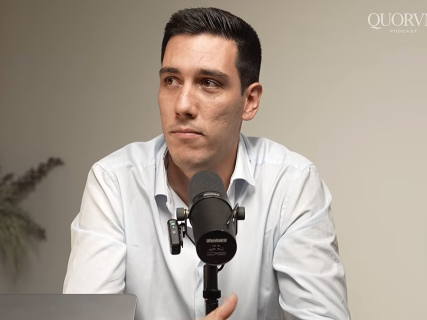

Javi Cabello has been talking about politics on the internet for years, but one of his latest interviews has managed to make his content jump from social media to the center of the electoral pre-campaign. On October 13, he published a conversation with the spokesperson of the PP in Congress, Ester Muñoz, in which the leader warned that the current pension system "is going to blow up". Her words provoked an immediate response from the Government and the PSOE, who accused the popular party of preparing cuts if they reach La Moncloa.
Behind that interview is Javier Cabello, known on social media as Ciudadano Alternativo, a content creator with a conservative ideology who does not hide his political positions or his criticisms of Pedro Sánchez's Executive. Through videos, comments on current events, and conversations with political leaders, he has managed to gather an audience that exceeds half a million followers across his different profiles.
His content does not aim to be neutral. Cabello defends right-wing ideas, questions the Government's economic and social policies, and regularly participates in debates about taxes, corruption, pensions, and the functioning of institutions.
Who is Ciudadano Alternativo?
Javi Cabello was born in Cartagena in 1995 and studied Mechanical Engineering at Carlos III University of Madrid. Before becoming a well-known figure on social media, he developed his professional activity in the fields of marketing, advertising, and business, an experience that has also influenced his way of communicating.
His digital profile has been built around Ciudadano Alternativo, the name under which he publishes comments on political and economic current events. Unlike creators who started by doing entertainment and later incorporated political opinions, Cabello has made politics the main content of his channels.
His way of communicating is direct, with frequent criticisms of the Government and explanations about economic issues that he seeks to convey in everyday language. He talks about taxes, public spending, corruption, housing, or pensions, and often accompanies his opinions with fragments of interviews, news, or parliamentary interventions.
This activity has also allowed him to transfer his ideas to other formats. In 2023 he published The system and the mother who bore it, his first book, and in 2026 he has returned to bookstores with The great scam of power, a work focused on his vision of the functioning of politics and Spanish institutions.
He does not hide his ideology
Cabello identifies with liberal and conservative positions and does not believe that a communicator should hide their opinions to talk about current events.
In an interview published in July 2026 by The Diary of Madrid, he even defended that the right should learn to communicate its ideas better and ensure that its messages circulate more strongly on social media. For him, the problem is not only about having arguments but also about knowing how to present them in a way that reaches the public.
After the conversation of Alberto Núñez Feijóo with Aimar Bretos on Cadena SER, Cabello publicly offered the PP a free preparation session to face this type of meetings and ensure that social media worked in their favor.
Esto es lo que hubiera contestado yo a Aimar Bretos pic.twitter.com/TME10Aj7YO
— Javi Cabello (@ciudadanoalt) October 23, 2026
His professional experience in marketing occupies an important place in that vision. Cabello understands that a political publication competes for users' attention with thousands of videos, news, and entertainment content, so the language and the way of telling things are decisive.
He has also recognized the risks of consuming only information that confirms one's own ideas. In that interview, he explained that he had started to follow left-wing profiles and those favorable to the Government to prevent algorithms from always showing him opinions similar to his own.
Quorvm, the podcast with which he interviews politicians
The project that has most popularized his activity as a communicator is Quorvm Podcast, a space for interviews and long conversations in which he receives political leaders and people linked to current economic and social affairs.
The format allows him to dedicate much more time to his guests than a conventional television interview. Instead of limiting himself to brief questions, the conversations can extend to issues such as state funding, housing, immigration, corruption, or the future of pensions.
Cabello also uses his social profiles to distribute the highlights of each episode. A long conversation can thus become several short videos that circulate on X, YouTube, and other platforms, where each fragment generates its own reactions. That mechanism has been especially visible with the interview with Ester Muñoz. A conversation published on his channel ended up provoking statements from ministers, responses from political leaders, and new debates about the proposals of the PP.
The commented interview with Ester Muñoz
On October 13, Cabello published in Quorvm an interview with Ester Muñoz, spokesperson for the PP in Congress. During the conversation, the popular leader talked about the future of pensions and warned that the current system "is going to blow up" if changes are not introduced.
"We have to be brave and understand that the model needs to be changed because it doesn't work", said Muñoz, who questioned the system's ability to respond to the aging population and the retirement of the baby boom generation. The popular spokesperson defended that those who are close to retiring should receive the benefits they are entitled to, but insisted on the need to reform the model.
Ester Muñoz sobre las pensiones: "Creo que tenemos que ser valientes y entender que el modelo hay que cambiarlo porque no funciona, porque el sistema actual tal como está va a petar" pic.twitter.com/qb7fI9qI0z
— Javi Cabello (@ciudadanoalt) October 13, 2026
The interview quickly acquired a political dimension. The PSOE used the statements to accuse the PP of preparing cuts to pensions, while several ministers demanded that the popular party clarify what changes they proposed. Elma Saiz, Minister of Social Security, responded to Muñoz's arguments with data on the relationship between contributors and pensioners.
The debate also reached the environment of the PP itself, whose president, Alberto Núñez Feijóo, had defended the guarantee of pensions and their revaluation according to the CPI. The words of their spokesperson thus opened a discussion on how to finance the system in the future and what reforms a potential popular government would propose.
Cabello did not stay out of the controversy. On October 15, he published an article titled "You have been scammed" in The Objective, in which he argued that respecting the elderly also means talking about the funding problems of the system. Days later, on October 20, he dedicated another episode of Quorvm to pensions, public debt, and the aging population.
The error beyond pensions
The conversation with Muñoz provoked a second controversy, this time related to some words from Cabello himself about Pedro Sánchez.
While both commented on the attitude of the president of the Government in Congress, the interviewer stated that it would be very difficult for him not to "grab him by the neck". The expression generated criticism for its tone, but the controversy became complicated when the program Mañaneros 360, from RTVE, displayed a banner that incorrectly attributed the phrase to Ester Muñoz.
The spokesperson for the PP had not uttered those words. It was Cabello who had said them. The fact-checker Newtral reviewed the interview and confirmed the attribution error. For his part, Jesús Cintora clarified during the broadcast who had made the comment and the program ended up apologizing for the banner.
El clip entero sin cortes.
— Javi Cabello (@ciudadanoalt) October 14, 2026
Se pueden sacar de contexto mis palabras, pero es sólo una expresión que refleja la impotencia. Podéis decir lo que queráis, pero la gente no es idiota.
Por cierto, última vez que utilizáis mi contenido para alimentar vuestras mentiras. https://t.co/3pXPk0pps6 pic.twitter.com/g21DTNElkC
Cabello responded by disseminating the complete fragment of the conversation and stated that his expression reflected frustration, not a literal intention to attack the president of the Government. He also criticized the treatment that his interview had received on public television.
The influence of the podcast format before the 29N
Javi Cabello represents a generation of communicators who have found in social networks a way to participate directly in the political debate. He does not need a television program or a daily column in a newspaper for his opinions to circulate and reach thousands of people.
He himself acknowledges that he is not a journalist. In an interview with El Diario de Madrid, he explained that his work consists of commenting on information published by media professionals and adapting it to the formats consumed by his audience. He has also defended that, when the Government changes, the new political leaders must receive equal or even greater scrutiny.
However, he has shown support for the interview format proposed by Jordi Wild during the electoral campaign. He has publicly congratulated the interviewer through X and has also acknowledged that all left-wing parties are invited to sit on his podcast if they wish, except for EH Bildu.
Lo mejor de las entrevistas en Jordi Wild es el mensaje a los medios tradicionales:
— Javi Cabello (@ciudadanoalt) October 24, 2026
Sorry, hemos llegado para quedarnos y quitaros la tarta.
Weeks away from the general elections of November 29, her interview with Ester Muñoz is an example of the space that podcasts and political creators have gained in the pre-campaign. A conversation that started on YouTube ended up provoking responses from the Government, criticisms from the opposition, journalistic verifications, and new debates about pensions.
Cabello does not hide his conservative ideas or his opposition to Sánchez, and precisely there lies an important part of his digital identity. His followers know from which positions he comments on current events, although that does not mean they necessarily share all his opinions.