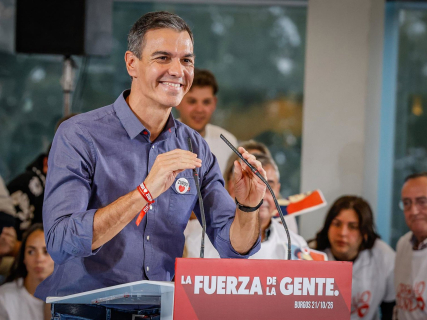
Sánchez confirms that he will go to 'The Wild Project' by Jordi Wild: the four candidates accept the interviews of 29N

The president of the Government accepts the invitation of the content creator and completes the electoral interview poster alongside Feijóo, Abascal, and Colau. The programs are expected to be published starting from November 9.

fotonoticia 20261022190725 1920

fotonoticia 20261022190725 1920

Add DEMÓCRATA to Google

Ask FREN

Published

Last updated

3 minutes

Most read

Elecciones 29N · Encuestas

La media de las encuestas

Media a 23 de octubre de 2026 · 15 institutos

  • PP31,4 %
  • PSOE26,9 %
  • Vox18,8 %
  • Sumar6,4 %
  • Podemos3,1 %
  • ERC2,2 %
010203040ene 2024jul 2024ene 2025jul 2025ene 2026jul 2026

Media del último estudio de cada instituto en 30 días y su evolución semanal desde el 23J. Partidos con al menos un 2 %.

Todas las encuestas

Elecciones generales del 29 de noviembre · Demócrata

Pedro Sánchez has confirmed that he will participate in 'The Wild Project', the podcast of Jordi Wild, ahead of the general elections on the upcoming November 29. The president of the Government publicly accepted the invitation this Friday, becoming the last of the four summoned political leaders to confirm his attendance.

"Thank you for the invitation, @JordiWild. I will be there," Sánchez wrote on his X account. The head of the Executive accompanied his response with a joke directed at the photographer Nacho Amela: "@NachoAmela, remember that my good side is the left one!".

Your confirmation clears the main unknown that remained pending for the celebration of the interviews. Alberto Núñez Feijóo, Santiago Abascal, and Ada Colau had already accepted to participate in the initiative, which aims to transfer part of the electoral pre-campaign to YouTube through long-duration individual conversations.

The recordings are scheduled for publication during the second week of November, starting from the 9th, although the definitive dates have not yet been announced.

Sánchez completes the interview lineup

The proposal by Jordi Wild began to take shape at the beginning of October, when the content creator publicly invited the main candidates for the Presidency of the Government to participate in a special edition of The Wild Project dedicated to the general elections.

Feijóo was the first to accept, just a few hours after the call. Wild himself acknowledged his surprise at the speed of the response from the president of the PP, whom he initially considered one of the most difficult leaders to incorporate into the project.

Shortly after, the confirmation from Santiago Abascal arrived. With the two main candidates from the right willing to attend, attention turned to the pending responses from the PSOE and Frente Amplio.

The third addition was Ada Colau, candidate of Frente Amplio, who resumed her activity on X after five years to accept the invitation. The former mayor of Barcelona responded affirmatively this Tuesday, after Wild had publicly insisted on his intention to include representatives from different political options.

Sánchez was, therefore, the only one of the four leaders initially invited who had not yet confirmed his attendance.

From negotiations with the PSOE to Sánchez's confirmation

The participation of the president of the Government had generated special anticipation during the last weeks. As Jordi Wild explained, before making his proposal public, he had maintained contacts with a person very close to Sánchez to explore the possibility of interviewing him.

The creator assured that he had communicated from the beginning the conditions of the conversation, including his intention to ask questions about sensitive issues. The response received then was that the proposal needed to be studied internally with the campaign managers.

In the absence of a confirmation, Wild had set this Friday, October 23, as the deadline to receive responses.

Initially, the person responsible for The Wild Project had conditioned the celebration of the interviews on the acceptance of the four guests. However, this Monday he modified his position and announced that he would interview the candidates willing to participate, even if someone rejected the proposal.

Finally, Sánchez's affirmative response allows the content creator to count on the four leaders to whom he had directed his original invitation.

Interviews of up to 90 minutes and without agreed questions

The format announced by Jordi Wild includes individual interviews of between 50 and 90 minutes, with common conditions for all participants.

Unlike traditional electoral debates, the conversations will not necessarily be organized into rigid blocks on economy, housing, immigration, or foreign policy. The creator intends to maintain an open dialogue, with questions adapted to each leader and some shared issues that allow for comparing their positions.

The candidates' teams will not receive the questions in advance. Wild has also announced that the interviews will be recorded, but he commits to publishing them in full, without removing fragments or modifying the responses.

The participants will also not be able to subsequently request the removal of parts of the conversation. The intention is to formalize these conditions before the recordings to avoid discrepancies regarding the editing and dissemination of the programs.

The plan is to publish the four interviews during the second week of November, although it is still pending to decide whether they will be released simultaneously or distributed over several days.

Sánchez's participation is also known after his recent appearance on La Revuelta, David Broncano's program on Televisión Española. With his incorporation into The Wild Project, the president expands his presence in entertainment formats and digital platforms during the pre-campaign for 29N.

More key points, information and questions with FREN

AI-GENERATED CONTENT

What are the powers and functions of the Prime Minister according to the Spanish Constitution?

The Spanish Constitution assigns the Prime Minister the direction of government action and the coordination of ministers. Additionally, it reserves specific functions in their relations with the king, the Cortes Generales, and the Constitutional Court. However, many powers correspond to the Government as a whole and not to the Prime Minister individually.

Direction and coordination of the Government

Article 98.2 establishes their main function: "The Prime Minister directs the action of the Government and coordinates the functions of the other members thereof, without prejudice to the competence and direct responsibility of these members in their management."

Therefore, they set the political orientation of the Executive and ensure coordination among its members, but do not replace the individual responsibility of each minister. It is important to distinguish this function from the powers of the Government set out in Article 97: directing domestic and foreign policy, the civil and military administration, and the defense of the State, and exercising executive functions and regulatory authority.

Formation and composition of the Executive

  • Propose the appointment and dismissal of ministers. According to Article 100, the other members of the Government are appointed and dismissed by the king at the proposal of the Prime Minister.
  • Request that the king preside over the Council of Ministers. Article 62.g allows this presidency when the monarch deems it appropriate, at the request of the Prime Minister and to be informed of matters of State.

Relations with the Congress and the Cortes

  • Raise a vote of confidence. According to Article 112, after deliberation by the Council of Ministers, the Prime Minister may ask the Congress to confirm its confidence in their program or a general policy statement. It is considered granted if a simple majority of deputies is obtained.
  • Propose parliamentary dissolution. Article 115 allows, after deliberation by the Council of Ministers and under their exclusive responsibility, to propose the dissolution of the Congress, the Senate, or both chambers, which is decreed by the king. This cannot be done while a motion of censure is pending. Nor can a new dissolution occur within one year of the previous one, except in the case of Article 99.5.

These instruments have additional limits: Article 116.5 prevents dissolving the Congress while states of alarm, exception, or siege are declared.

Referendum and constitutional reform

Article 92 assigns the Prime Minister the power to propose to the king the calling of a consultative referendum on political decisions of special significance, subject to prior authorization by the Congress. The Prime Minister cannot call it alone nor dispense with that authorization.

They also have a specific role in constitutional reform: according to Article 168.3, they countersign the calling of the referendum necessary to ratify a reform approved through the aggravated procedure.

Countersigning acts of the king

Article 64 establishes that acts of the king are countersigned by the Prime Minister and, where appropriate, by the competent ministers. The person who countersigns assumes responsibility for the act. There are exceptions: the proposal and appointment of the Prime Minister, and the dissolution provided for in Article 99, are countersigned by the President of the Congress.

Defense of the Constitution and responsibility

Article 162.1.a legitimizes the Prime Minister to file appeals of unconstitutionality. Likewise, Article 161.2 allows the Government to challenge autonomous provisions and resolutions; this latter power corresponds to the Executive, not exclusively to its Prime Minister.

Finally, their political leadership is subject to parliamentary control: the Government is collectively responsible before the Congress, according to Article 108. Losing a vote of confidence or the approval of a motion of censure requires the Government to resign, according to Article 114.

What legal requirements must a podcast meet to organize electoral interviews during the campaign?

A podcast can organize electoral interviews during the campaign, but its obligations depend on who manages it and how it is broadcast. An independent podcast should not automatically be equated with a radio or television station: the LOREG establishes specific obligations for certain media, while prohibitions on propaganda and polls also apply to the internet.

1. Determine the applicable regime

Article 66 of the Organic Law of the General Electoral Regime distinguishes:

  • Public media: must respect political and social pluralism, equality, proportionality, and informational neutrality.
  • Private radio and television broadcasters: must respect pluralism and equality.
  • Private televisions: must also respect proportionality and neutrality in interviews, debates, and electoral information.

The sources consulted do not show a specific rule that automatically subjects any private and independent podcast to all these obligations. Having an audience, publishing periodically, or including video is not enough by itself to affirm such equivalence. If it belongs to a public broadcaster or media, it must be framed within its corresponding regime.

2. Selection of guests and timing

For media subject to these obligations, Instruction 4/2011 of the JEC allows deciding whether to organize interviews but requires respecting the applicable principles. Proportionality especially considers the results of the last equivalent elections; it does not mean granting identical minutes to all candidacies.

Public media must submit their coverage plans, including interviews and informational criteria, to the competent Electoral Board. They must also consider significant political groups according to the 2015 amendment. This obligation to submit a plan cannot be simply transferred to an independent podcast.

As a recommendation, not as a universal requirement, it is advisable to document criteria for invitation, responses, duration, and promotion of each interview. This helps justify decisions and respond to complaints.

3. Separate interview and advertising

An editorial interview should not be confused with a space purchased by a candidacy. Article 60 prohibits contracting electoral advertising in public media and private televisions. Identifying content as sponsored does not make a prohibited contract lawful.

If there is payment or financing linked to a candidacy, it must be analyzed as possible electoral advertising, not simply journalism. Also, institutional resources should be avoided for electoral promotion of a public official: Article 50.2 imposes limits from the call.

4. Respect time limits

During the campaign, electoral interviews may be conducted. Before its start, Instruction 3/2011 allows interviews with candidates as long as they do not include an explicit request for votes and limits contracted advertising.

After the campaign ends, Article 53 prohibits campaign acts and propaganda during the reflection day and voting. This does not mean prohibiting all political information. It is advisable to suspend new interviews and promotions that function as propaganda, also reviewing clips and scheduled publications. Instruction 4/2007 confirms that electoral limits apply to electronic media.

5. Control polls

Article 69.7 prohibits publishing, disseminating, or reproducing electoral polls during the five days prior to voting, also in digital formats. Control must reach guests, graphics, and clips. When publication is allowed, they must be accompanied by the legally required technical information.

In summary: first identify the nature of the podcast; then separate legal obligations from good practices. There is no universal accredited obligation to interview all candidacies or to give them exactly the same time.

What was the result of the last general elections in Spain and how many seats did each of the parties represented by the interviewed candidates obtain?

The last general elections held in Spain were on July 23, 2023. The People's Party won in votes and seats, with 137 deputies, followed by the PSOE with 121; Vox with 33; and Sumar with 31. No candidacy alone reached the 176 deputies that mark the absolute majority in the Congress (Demócrata, results of 23J).

There is an important clarification regarding the second part of your question: you have not indicated who the interviewed candidates are nor which interviews you refer to. Therefore, I cannot assign parties to them without that reference. To help you locate the parties you are interested in, here is the complete distribution of the 350 seats in the Congress resulting from those elections.

Seats obtained by each candidacy

  • People's Party (PP): 137 seats. It was the candidacy with the greatest representation and was 39 deputies short of the absolute majority.
  • Spanish Socialist Workers' Party (PSOE): 121 seats. It was the second candidacy in representation, with 16 deputies fewer than the PP.
  • Vox: 33 seats. It occupied the third position by number of deputies, two ahead of Sumar.
  • Sumar: 31 seats. It was the fourth candidacy by representation. Podemos ran integrated within this coalition, not as a separate candidacy.
  • Republican Left of Catalonia (ERC): 7 seats. It obtained the same number of deputies as Junts.
  • Junts per Catalunya: 7 seats. Shared that number of representatives in Congress with ERC.
  • EH Bildu: 6 seats. Its representation was one deputy less than each of the two previous candidacies.
  • Basque Nationalist Party (PNV): 5 seats. It obtained one deputy less than EH Bildu.
  • Galician Nationalist Bloc (BNG): 1 seat. It had one representative in Congress.
  • Canarian Coalition: 1 seat. Also obtained a single representative.
  • Navarrese People's Union (UPN): 1 seat. Completed the distribution of candidacies with parliamentary representation.

These figures correspond to the electoral result, not to a vote estimate or a subsequent poll. The distribution can be consulted in the electoral results information; the representation of the main candidacies also appears in the historical comparison published by Demócrata.

What the result meant

The sum of PP and Vox was 170 deputies, six less than the absolute majority. Meanwhile, PSOE and Sumar gathered 152 deputies, so they also did not reach that threshold together. These calculations describe only the sum of their seats: they should not be confused with the result of a specific parliamentary vote (Demócrata, electoral comparison).

The subsequent outcome was the re-election of Pedro Sánchez as Prime Minister. Therefore, it is important to distinguish between winning the elections by number of votes and deputies, which corresponded to the PP, and gathering parliamentary support to form a Government. The analysis by Demócrata on the investiture explains this difference and the relevance of the different parties with representation.

How to relate it to the interviewees

If the interviews include representatives of PP, PSOE, Vox, and Sumar, the figures you should associate with them are, respectively, 137, 121, 33, and 31 seats. If a Podemos representative appears, it should be noted that their party ran within Sumar in 2023: it does not correspond to add a separate electoral result to the 31 deputies of that candidacy. With the names of the interviewees or the link to the interviews, it is possible to specify exactly which part of this distribution answers your question.

Play

Test your knowledge with FREN!

How much do you know about this topic? Answer the following 3 questions.

What format will the interviews organized by Jordi Wild for the general elections have?

Question 1 of 3

What condition had Jordi Wild initially set to hold the interviews on 'The Wild Project'?

Question 2 of 3

Who was the last candidate to confirm their participation before Pedro Sánchez?

Question 3 of 3