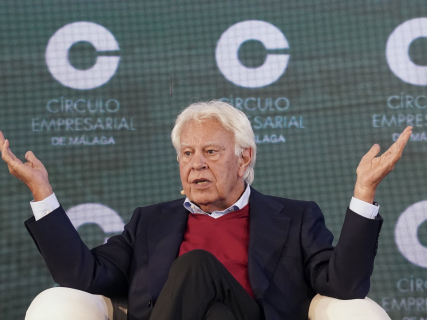
THE PHOTO OF THE DAY | Felipe González and his blank vote

The former president of the Government confirms that he will not support the PSOE of Pedro Sánchez nor any other candidacy in the upcoming general elections, considering that none represents him.

EuropaPress 7861620 expresidente gobierno felipe gonzalez interviene encuentro lideres (1)

EuropaPress 7861620 expresidente gobierno felipe gonzalez interviene encuentro lideres (1)

Add DEMÓCRATA to Google

Ask FREN

Published

Last updated

1 minute

Most read

Elecciones 29N · Encuestas

La media de las encuestas

Media a 21 de octubre de 2026 · 15 institutos

  • PP31,6 %
  • PSOE26,9 %
  • Vox18,7 %
  • Sumar6,3 %
  • Podemos3,1 %
  • ERC2,2 %
010203040ene 2024jul 2024ene 2025jul 2025ene 2026jul 2026

Media del último estudio de cada instituto en 30 días y su evolución semanal desde el 23J. Partidos con al menos un 2 %.

Todas las encuestas

Elecciones generales del 29 de noviembre · Demócrata

Felipe González has starred this Thursday in one of the political images of the day during a business colloquium held in Málaga, where he has confirmed that he will vote blank in the general elections on the upcoming November 29.

"I don't see anything that represents me," stated the former president of the Government, who has also expressed his criticisms of Pedro Sánchez's management and an opposition that he reproaches for not offering an alternative project for the country.

The photograph captures a new episode of the public distancing between González and the current socialist leadership. The historic leader of the PSOE had already anticipated in February his intention to vote blank if Sánchez ran again in the elections.

More key points, information and questions with FREN

AI-GENERATED CONTENT

What are the competencies and functions of a former Prime Minister of Spain according to current legislation?

A former Prime Minister of Spain does not retain executive powers by having held the Presidency. Their status grants them access to a statute of recognition, material support, and protection, but does not allow them to lead the Government, give instructions to the Administration, or make decisions on its behalf. It is therefore important to distinguish between the functions of a public office and the rights recognized after leaving it.

1. The main rule: a support statute

The specific regulation is Royal Decree 405/1992, of April 24, which regulates the Statute of Former Prime Ministers. Its Article 1 establishes that they shall enjoy, from their cessation, the "consideration, attention, and support due to those who have held this office."

The decree does not establish a portfolio of mandatory public functions: it does not entrust them with supervising the Executive, advising it periodically, intervening in the drafting of regulations, or automatically representing the State. The treatment of president also does not mean they continue exercising the Presidency. The powers of the Government and its president are regulated in the Law 50/1997, of the Government.

2. Protocolary treatment and external support

Article 2 of the statute recognizes two specific elements:

  • Treatment as "President" and the protocolary place corresponding to them according to the General Order of Precedences in the State.
  • Possible diplomatic support during their travels outside Spain, through the services of the Spanish diplomatic representation.

This second recognition is formulated as a possibility of support. It does not constitute, by itself, a power to negotiate international agreements, commit the Government, or act as an official representative of Spain.

3. Staff, office, transportation, and security

Article 3 allows for means to attend to the needs arising from their status:

  • Two support positions, one at level 30 and another at level 18, filled at the former prime minister's proposal by free appointment. Their staff is considered temporary cabinet personnel; civil servants move to special services.
  • Office allocation, social care, and, when appropriate, rental of properties. The amount is determined in the General State Budgets.
  • Official car with drivers from the State Administration.
  • Security services deemed necessary by the Ministry of the Interior authorities.
  • Free pass on regular state land, sea, and air transport companies, under the literal terms of the decree.

These resources are means of assistance, not powers to intervene in administrative management. In particular, security depends on the Interior Ministry's assessment, and the office allocation does not have a fixed amount in the statute.

4. Economic rights and family protection

Article 4 recognizes the right to the indemnity pension for cessation provided in the legislation it refers to. It also contemplates the passive rights of the former prime minister and their family members according to passive classes legislation. These provisions should not be confused with a salary for exercising executive functions after cessation.

Royal Decree 1306/2008 added that, after the death of the former prime minister, the provisions on car with drivers and security apply to the spouse or the person united by a similar affective relationship.

In short, being a former prime minister is a recognized and protected status, not an extension of presidential power. Any additional institutional function must be distinguished from the rights granted by this statute.

What has been Felipe González's political and professional trajectory since leaving the presidency of the Government?

Since leaving the Presidency of the Government in May 1996, Felipe González has combined a gradual withdrawal from political positions with international, business, and opinion activities. His subsequent trajectory can be understood on three levels: disengagement from the PSOE leadership, assignments for reflection and diplomacy, and work as an advisor and lecturer.

1996-2004: departure from leadership, but not immediate exit from politics

After losing the 1996 elections, González remained as secretary general of the PSOE until June 1997, when he resigned and was replaced by Joaquín Almunia. He kept his seat in Congress until 2004: therefore, leaving La Moncloa did not mean immediately abandoning parliamentary activity. Afterwards, he maintained ties with socialist debate and advisory bodies, including his incorporation in 2009 into the PSOE's Council of International Policy and Cooperation, according to his official biography.

International and European projection

One of his first external responsibilities was acting, between 1996 and 1998, as OSCE representative in the Federal Republic of Yugoslavia. He also extended until 1999 his vice presidency of the Socialist International, started during his previous term. Both roles are recorded in his European Commission profile.

His most notable European assignment came in December 2007, when he was appointed president of the Reflection Group on the Future of Europe. The team delivered in 2010 a report on the Union's challenges with a 2020-2030 horizon: competitiveness, aging, energy, innovation, and social cohesion. It was a temporary strategic analysis task, not the presidency of the European Council or the Commission, as his official biography clarifies.

Simultaneously, he participated in forums such as the Montevideo Circle, the InterAction Council, Notre Europe, and the International Council of the Peres Center for Peace. These affiliations, described in his speaker profile, correspond to debate and cooperation networks, not necessarily permanent public offices.

Professional and business activity

His main documented business position was as independent director of Gas Natural Fenosa, now Naturgy. He joined in December 2010, with a profile linked to his international experience and knowledge of Algeria, as reported by elEconomista. He left the board in March 2015 after deciding not to renew, according to Europa Press.

His tenure at the energy company fueled debate about so-called revolving doors: the transition of former public officials to private companies. Controversy also arose from his membership in the Doñana Governing Council while the company promoted gas storage in its surroundings, an issue covered by elDiario.es.

Lectures, foundations, and public presence

Since 1996 he has been active in the Progreso Global Foundation and has worked as a lecturer, advisor, and columnist, especially on Europe, Latin America, democracy, and governance. His Latin American presence remains visible: in December 2024 he called to support Edmundo González's return to Venezuela, according to Nueva Economía Fórum.

In Spain, his recent role has been marked by distancing from Pedro Sánchez: in February 2026 he announced he would cast a blank vote, according to Demócrata. Simultaneously, he received the Order of the Golden Fleece in November 2025, as recorded by La Moncloa. Overall, he has moved from direct exercise of power to public influence, advisory, and international debate activities.

What legal requirements must a blank vote meet to be considered valid in general elections in Spain?

In general elections in Spain, a blank vote is perfectly valid as long as it meets the same formal requirements as any other vote, with the only difference being that the envelope does not contain a ballot (or contains an officially provided “blank ballot,” if any, which in practice is equivalent to an empty envelope). What matters is not the subjective intention of the voter, but how that vote physically arrives at the ballot box.

1. What is legally a blank vote

According to Spanish electoral regulation, a blank vote is considered to be an envelope that:

  • Is correctly deposited in the corresponding ballot box (Congress or Senate).
  • Does not contain a valid ballot for any candidacy nor marks that can be attributed to a candidacy.

In practice, for the Congress of Deputies, a blank vote is usually an official envelope without a ballot inside. For the Senate, it is considered blank if there is no ballot or if an envelope without a ballot but with marked names is used (normally, however, a blank vote is also an empty envelope). The key point is that no support is expressed for any specific candidacy.

2. Formal requirements for validity

For that blank vote to be considered valid (and not null), all of the following must be met:

  • Use of official envelopes and ballots: the envelope must be the official one provided by the Electoral Administration. If a different envelope or obvious manipulations are used (envelopes of another color, size, conspicuous stickers, etc.), the vote may be declared null.
  • Deposit in the correct ballot box: the envelope must be placed in the ballot box of the corresponding process (Congress or Senate ballot box). An envelope for Congress placed in the Senate ballot box, or vice versa, is considered invalid for that election.
  • Compliance with identification and issuance guarantees:
    • If voting in person, the person must be registered in the census of that polling station, identify themselves with accepted documentation (valid Spanish DNI, passport, or driver’s license, among other accepted documents), and be admitted by the polling station.
    • If voting by mail, formal steps must be followed (prior request, receipt of documentation, sending within deadline, correct identification at the Post Office, etc.). Leaving the inner envelope empty does not make the vote null if everything else is in order.
  • Absence of identifying elements: the envelope cannot contain:
    • Identifiable inscriptions or messages.
    • Objects other than the ballot itself (e.g., coins, leaflets, cards, etc.).

    If the polling station finds any foreign object or annotations, it is usually considered a null vote, not a blank vote.

  • Respect for the secrecy of the vote: no special behavior is required for the blank vote, but if the way it is presented breaks the secrecy of the vote (for example, the voter shows it publicly before placing it or presents it in a way that reveals their identity and decision), the polling station could react. In practice, secrecy is protected the same as with any other vote.

3. Difference with null vote

It is essential to distinguish:

  • Blank vote: official envelope, in the correct ballot box, with empty or equivalent content, without symbols or messages. It is a valid vote, counts towards participation, and is added to the total valid votes cast.
  • Null vote: includes envelopes with more than one ballot from different candidacies, with messages or drawings, with unofficial ballots, with foreign objects, or unofficial envelopes. It is not added to the total valid votes.

4. Effects of the blank vote on seat allocation

From a legal point of view, the blank vote:

  • Counts as a valid vote cast.
  • Is used to calculate the minimum percentage needed to access seat allocation (the 3% electoral threshold of valid votes in general elections to Congress, by constituency).
  • In practice, raises the bar for small candidacies to reach that percentage, because it increases the denominator (the total valid votes) without assigning votes to any party.

5. Special cases

Some common situations and their legal consideration:

  • Empty Congress envelope in the Congress ballot box: valid blank vote.
  • Congress envelope in the Senate ballot box: null vote for that ballot box.
  • “Homemade” blank ballot written by the voter: usually considered null as it is not an official ballot.
  • Envelope with a single ballot but with cross-outs, drawings, or messages: according to usual interpretation, usually considered null if those elements interfere with clear identification of the candidacy.

In summary, a valid blank vote is, legally, a vote cast regularly (same procedure and identification as any other), but by means of an official empty envelope without elements that make it a null vote. It counts as a valid vote and affects percentage calculations, although it does not assign representation to any candidacy.

What consequences does the blank vote have on the formation of majorities in Congress? How does the treatment of blank votes differ in general, regional, and municipal elections? How are blank votes exactly counted in the official scrutiny and in the records of polling stations?

Play

Test your knowledge with FREN!

How much do you know about this topic? Answer the following 3 questions.

In which city did Felipe González confirm that he will vote blank in the upcoming general elections?

Question 1 of 3

Who has Felipe González criticized for not offering an alternative country project?

Question 2 of 3

What reason has Felipe González given for voting blank?

Question 3 of 3