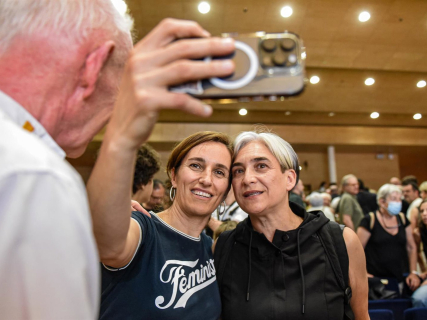
Together, mixed up or to the slaughterhouse: the messes of the left to form a Broad Front

The left-wing parties have a week to agree on a coalition that tries to repeat the result of three years ago and support the PSOE in the Government. For now, they have not yet decided on their candidate.

5 minutes

fotonoticia 20261008095748 1920

fotonoticia 20261008095748 1920

Add DEMÓCRATA to Google

Ask FREN

Published

5 minutes

Most read

Without a candidate, nor alliances and with a path to travel to reach the desired single ballot. This is how the electoral advance caught the possible left, the left that has accompanied the PSOE inside and outside the Government under different leaderships and names in the last eight years.

The margin to reach an agreement is narrow: according to the deadlines of the Organic Law of the General Electoral Regime, coalitions must communicate their constitution before the end of October 16. The submitted lists will be published on October 28 and the proclaimed candidacies on November 2.

Precisely one day after the deadline to present candidacies, on October 17, the coalition formed by Movimiento Sumar, Izquierda Unida, Más Madrid, and the Comuns plans to present its project and head of the list for the elections.

To that timeline is added the proposal from Podemos, led by Irene Montero, to hold meetings on October 14 and 15 and define the candidates to be presented.

Fight together, die alone

The Spanish electoral system distributes the seats of Congress by provinces using the D'Hondt formula, which considerably reduces the representation possibilities of small parties outside the most populated territories.

In provinces that elect three, four, or five deputies, a candidacy can gather a significant percentage of votes and end up without representation if other forces concentrate their support better. A coalition would allow accumulating votes and competing for more seats, in addition to leveraging electoral mobilization.

If Pedro Sánchez aspires to govern again, he needs his possible allies on the left to obtain enough deputies to build, along with territorial formations like ERC and EH Bildu, an alternative majority to PP and Vox.

Where is the problem?

Despite the differences in program and strategy that may exist, the greatest discrepancy is of personal affinity and, above all, the preparation of the lists to place leaders in positions with more representation possibilities.

Ada Colau, candidate who demands consensus

The former mayor of Barcelona stands as the figure around which the different parties are studying to build the new candidacy. Her profile offers a possible meeting point between organizations that maintain significant differences.

And, for greater benefit, Colau conditions her participation on the existence of a broad agreement capable of integrating all the formations, including Podemos.

Comuns: you to Madrid and I to Barcelona

In the Catalan organization, they do not officially want to talk about lists, but rather focus first on the necessary agreements to form a coalition as broad as possible. But knowledgeable sources of the negotiations indicate that their idea is to place Ada Colau as the head of the list for Madrid and Ernest Urtasun as number one for Barcelona.

By placing Colau in Madrid, the Comuns would leave the first position in Barcelona for Urtasun and increase their chances of achieving representation on their lists.

Más Madrid: 'there's no room for so many people'

She has ended up leaning towards Colau, after among her options was the Minister of Health, Mónica García, who had decided months ago to run again for the Community of Madrid, after an internal struggle with Emilio Delgado, which placed the latter in a starting position for the general elections.

The formation prefers that Colau heads the list for Barcelona, which would leave them more space in Madrid to place their own candidates, among whom are the aforementioned Garcia and Delgado, the deputy Tesh Sidi, and the councilor Eduardo Fernández Rubiño.

The entry of Podemos complicates that distribution. Más Madrid is one of the organizations that has shown the most reservations about the incorporation of the purples, both due to the accumulated differences between their leaders --the party was established as a split from the purples-- and due to the direct competition for the positions in Madrid.

Moreover, if Podemos were to integrate into the Frente Amplio, in Más Madrid they have even suggested that Irene Montero, head of the purples and from Madrid, accompany Colau in Barcelona.

Podemos: primaries, primaries, primaries

Scarred from the last negotiation to form Sumar, in which Irene Montero was vetoed, Podemos demands primaries to decide the candidates that they have already launched on a specific website.

The narrow margin (and the little willingness of the rest of the formations) does not invite optimism. The registration of pre-candidacies starts this Friday and ends on Sunday.

Their main interest is to secure a prominent position for Irene Montero in Madrid, where a good part of the aspirations of their possible allies are also concentrated.

Izquierda Unida: first, global agreement

United Left shares the bet on Colau, according to sources knowledgeable about the negotiations, although it has criticized the public bet launched by Más Madrid, with whom it already has a coalition agreement.

The formation defends that the preparation of the candidacies should be part of a global pact among the parties, avoiding that each organization closes its positions separately before determining the scope of the coalition.

Its objective is to preserve its own representation within a space that could lose deputies compared to the last elections. Its launched candidate is Toni Valero.

And Rufián, what?

After defending for months the need to build a leftist alliance at the state level, the possibility that Gabriel Rufián would lead a candidacy has been losing strength due to his reiteration of the will to lead Esquerra Republicana (and his party's rejection of integrating into a coalition).

In recent hours, several media have published the idea of ERC working with a plan B with an alternative candidate if Rufián did not head the lists. The one who has been the parliamentary spokesperson for the republicans in Madrid publicly expressed in a message on X his willingness to represent ERC, but "accompanied by other leftist forces": "This cannot be won alone."

The Valencian case, an example of a single ballot?

While the state leftist parties negotiate the composition of the Broad Front, Compromís has taken the initiative in the Community of Valencia to promote a single candidacy to the left of the PSOE in the three provinces, with the intention of integrating Esquerra Unida, Podemos, Sumar, and Esquerra Republicana del País Valencià.

The proposal aims to avoid the dispersion of the vote, although with a particularity: the Valencianist coalition wants to lead the agreement from the territory, without being subordinated to the state structure of the Broad Front. It is not yet an electoral pre-agreement among all the parties, but rather an initiative supported by the different sensitivities that make up Compromís.

The Valencianist formation demands to head the candidacy and maintain its own identity, a position that has also been defended by Joan Baldoví, who demands that the name of Compromís appears on the ballot.

The Valencian proposal thus introduces a different formula than the one being negotiated in Madrid and Barcelona. Compromís aims to concentrate leftist forces in a common candidacy, but without integrating organically into the state-wide Frente Amplio. The agreement is still pending finalization and the resolution of the distribution of positions, although its promoters believe that electoral unity can be built from each territory without the need to share the same political structure throughout Spain.

More key points, information and questions with FREN

AI-GENERATED CONTENT

What parliamentary procedures and deadlines established by the Organic Law of the General Electoral Regime must coalitions follow to be able to participate in the general elections?

For a coalition of parties to be able to participate in general elections to the Congress and the Senate, it must follow a sequence of formal acts before the Electoral Administration regulated, above all, in Organic Law 5/1985, of June 19, on the General Electoral Regime (LOREG). The key milestones are: constitution and communication of the coalition, designation of representatives, and submission of candidacies within the deadlines set by the electoral calendar.

1. Legitimate subjects and nature of the coalition

The LOREG establishes that the following can submit candidacies: a) parties and registered federations, b) coalitions constituted in accordance with the law itself, and c) groupings of electors. This regime is reflected in the provision where it is expressly stated that:

"Candidates or lists of candidates may be presented by: a) Parties and federations registered in the corresponding registry. b) Coalitions constituted according to the provisions of the following section. c) Groupings of electors…".

This reference corresponds to Article 44.1 LOREG, which defines the coalition as a pact between already existing parties or federations that decide to run jointly in a specific election.

2. Constitution and communication of the coalition (art. 44.2 LOREG)

The central requirement for the coalition to be valid for electoral purposes is its communication before the competent Electoral Administration within a very strict deadline counted from the Royal Decree of the call:

  • General deadline: "Parties and federations that establish a coalition pact to run jointly in an election must communicate it to the competent Board, within ten days following the call" (art. 44.2 LOREG).
  • Competent body: for general elections of a national scope, the communication is generally addressed to the Central Electoral Board (JEC); if the coalition is limited to a specific constituency, the communication can be made before the Provincial Electoral Board, a criterion specified by Instruction 1/2010 of the JEC, expressly cited as an interpretation of article 44.2.
  • Minimum content of the communication: it must include "the name of the coalition, the rules governing it, and the persons holding its management or coordination bodies" (art. 44.2).

Additionally, article 44.3 prevents the same party or federation from presenting both its own lists and lists integrated into the coalition in the same constituency simultaneously, and article 44.4 prohibits coalitions that effectively succeed illegalized parties.

3. Designation of representatives before the Electoral Administration (art. 168 LOREG)

Once the coalition has been communicated, the parties, federations, and coalitions intending to run in the elections must designate their representatives before the Electoral Administration:

  • According to article 168.1 LOREG, "each of the parties, federations, and coalitions intending to run in the elections shall designate, in writing, before the Central Electoral Board, a general representative, before the ninth day following the call of the elections." The written document must include the acceptance of the designated person.
  • According to article 168.2, "each of the general representatives shall designate before the eleventh day following the call, before the Central Electoral Board, the representatives of the candidacies" presented in each constituency.
  • The JEC communicates these appointments to the Provincial Electoral Boards within two days (art. 168.3), and the representatives of the candidacies must appear before the Provincial Board before the submission of the lists.

4. Submission of candidacies (art. 46 and related)

The relationship between the coalition procedure and the submission of lists is articulated in the articles on candidacies:

  • Candidacies "are submitted before the competent Electoral Board between the fifteenth and twentieth days following the call" (provision corresponding to article 46 LOREG).
  • They must be signed by the representatives of the parties, federations, and coalitions (or promoters of groupings of electors) and clearly state the name, initials, and symbol of the coalition, as well as the list of candidates.

In summary, without the valid communication of the coalition within the first ten days and the designation of representatives on the 9th and 11th days, the coalition could not present lists as such in the period from the 15th to the 20th day.

5. Abbreviated regime in case of repeated elections due to investiture deadlock

The LOREG contains a specific regime for elections to the General Courts called as a consequence of the provisions in article 99.5 of the Constitution (failure of investiture). In this case, the special provision establishes:

  • The call is published and comes into effect the day after the expiration of the two-month period, and the elections are held on the forty-seventh day following the call.
  • Coalitions wishing to run jointly must communicate the coalition pact within an abbreviated period of five days following the call (letter d) of the special provision).
  • If they wish to maintain exactly the same coalition with which they ran in the immediately previous general elections, a maintenance letter addressed to the JEC (or to the Provincial Board if the scope is provincial) suffices.
  • Candidacies are submitted (or maintained) between the eighth and thirteenth days following the call (letter e)).

Thus, in repeated elections due to lack of investiture, deadlines are shortened, but the same procedural logic is maintained: communicate the coalition on time before the competent Board, designate representatives, and submit or maintain candidacies within the legally established calendar.

What are Ada Colau's competencies and functions as former mayor of Barcelona and what political trajectory has she developed in her party?

Ada Colau is today a key leader of the Comuns and left-wing municipalism, but she no longer holds any institutional position in the Barcelona City Council. Her formal competencies therefore derive from the positions she assumes in political or social organizations — such as the presidency of the Sentit Comú Foundation — and not from an administrative title of former mayor, which is basically political and ceremonial in nature.

Competencies and functions as mayor of Barcelona (2015‑2023)

Between 2015 and 2023, Colau was mayor of Barcelona for Barcelona en Comú, the first woman to hold the highest municipal representation of the city. As mayor, she assumed the functions provided in the local regime and the specific organization of the Barcelona City Council, which can be summarized as:

  • Political leadership of the municipal government: she set the city's priorities, coordinated government areas and the work of all council departments.
  • Institutional representation: she represented the City Council and the city before the Generalitat, the central government, other administrations and international organizations, and participated in city networks.
  • Presidency of governing bodies: she convened and presided over the Municipal Plenary and the Government Board or Commission, and promoted the execution of their agreements.
  • Municipal executive power: she issued decrees, resolutions, and management orders within the framework of local competencies (urban planning, public housing, social services, mobility, local taxation, etc.).
  • Budget management and organization: she participated in budget preparation, guided resource allocation, and exercised the highest authority over municipal staff.
  • Metropolitan and international projection: linked to the Mayoralty, she held responsibilities in the Barcelona Metropolitan Area (AMB) and strengthened the city's presence in European and global urban forums and networks.

Her government action focused on housing and residential emergency, tourism regulation, social policies and equality, ecological transition and mobility (superblocks, traffic calming), with an explicitly progressive reading and confrontation with large property owners and certain urban lobbies.

Status as former mayor: scope and limits

After the 2023 municipal elections, she left the Mayoralty when Jaume Collboni (PSC) was invested. Initially, she continued as a councilor and spokesperson for Barcelona en Comú, but she left the council in autumn 2024, so today she has no municipal executive competencies or administrative signature.

As former mayor, she retains an important political and symbolic projection — recognized, for example, with the Gold Medal of the City — and a ceremonial role in events honoring mayors of the democratic era. However, this status does not by itself entail decision-making functions over the administration: any real competency depends on new positions she may assume in parties, foundations, or other entities.

Political trajectory and role in her party

Ada Colau's career can be divided into three major stages:

  • Social activism: coming from neighborhood movements and defense of public services, she emerged as a national figure when she promoted the Platform for Mortgage Victims (PAH) in 2009, of which she was spokesperson until 2014. Her leadership in the fight against evictions and for the right to housing earned her, among others, the European Citizen's Prize from the European Parliament.
  • Building the Comuns space: in 2014 she promoted Guanyem Barcelona, which crystallized into the Barcelona en Comú candidacy, with which she won the 2015 municipal elections. She became the main figure of this convergence space, which ended up integrated into the broader framework of Catalunya en Comú and, at the national level, in successive projects to the left of the PSOE (Unidas Podemos, Sumar, now debates around a Broad Front).
  • Municipal government and subsequent projection: she renewed the Mayoralty in 2019 thanks to agreements with the PSC and remained until 2023. After leaving the council, she strengthened her profile as a political and intellectual reference: she presides over the Sentit Comú Foundation, linked to Catalunya en Comú, participates in campaigns and mobilizations — especially on housing and Palestine — and has positioned herself at the center of the debate on a broad left front, to the point of being proposed by various forces as a possible candidate for the Presidency of the Government.

Within Barcelona en Comú and the Comuns, Colau has mainly exercised political and symbolic leadership rather than a classic organic role: she has been the municipal lead candidate, a reference for the project, and a figure of cohesion between Barcelona municipalism and the Catalan and national space. Today her influence is exercised through strategy definition, discourse development, and mobilization capacity, rather than through a specific institutional portfolio.

How many initiatives or coalitions similar to the proposed Broad Front have been presented in previous general elections in Spain?

The current proposal for a Broad Front for the November 29 general elections is part of a long discussion on how to unite the left to the left of the PSOE. According to Demócrata's analysis on “polls and broad front” and the academic literature cited in recent studies on left-wing coalitions in Spain, two answers can be distinguished depending on the criterion used.

If we apply a strictly electoral and recent criterion — state-wide coalitions that aim to group "all" the alternative left — there are four clear major precedents before the current Broad Front. If we broaden the historical and conceptual focus, including more diffuse but comparable convergence experiences, we can talk about about eight relevant experiences.

Strict criterion: recent major state-wide coalitions

Taking only the formulas that, like the 2026 Broad Front, have been explicitly proposed as a unitary candidacy or common home of the alternative left in general elections, the fundamental precedents are:

  • United Left (IU): born in 1986 as a coalition around the PCE, with other leftist and ecosocialist currents. It is the first major stable attempt to federate the non-socialist left in democracy, with a vocation for permanence and state presence.
  • Podemos and its confluences (2015–2016): the emergence of Podemos quickly articulated with broad candidacies in key territories (En Comú Podem, En Marea, Compromís-Podemos, etc.), combining party-movement and territorial alliances. They do not always carry a unique state brand, but operate de facto as a broad alternative bloc.
  • Unidas Podemos (2016–2023): formalizes the coalition of Podemos, IU, and other forces, already as a clear convergence brand to the left of the PSOE. It is the first large coalition experiment that reaches the central government and lasts several general elections.
  • Sumar (July 23, 2023): coalition led by Yolanda Díaz that integrates IU, Comuns, Más Madrid, Compromís, Verdes Equo, and other territorial allies. The space itself later acknowledges that Sumar functioned as an imperfect “broad front” and that its capacity to bring together all organizations was limited, fueling the current debate on a new formula (IU analysis).

From this point of view, the 2026 Broad Front would be the fifth major phase of a cycle that goes from IU to Podemos, Unidas Podemos, and Sumar, always with the same underlying problem: how to coordinate parties of similar weight, with different organizational cultures, under a single electoral offer for the Congress.

Broad criterion: the long historical sequence

If we broaden the focus beyond the recent stage and add experiences with similar traits — attempts to sum several left-wing families or ideological blocks — the list collected by comparative analyses reaches eight milestones:

  • Popular Front (1936), a coalition of left-wing republicans, socialists, and communists in the Second Republic. It is the great symbolic precedent of a unitary anti-fascist candidacy, although in a very different political and institutional context from the current one.
  • Alliances around the PCE and PSUC during the Transition, where communist and left-wing forces cooperated electorally in several calls, anticipating the convergence logic that would crystallize in IU.
  • United Left as a stable federation of parties since 1986, with its successive ecosocialist and territorial expansions.
  • IU–ICV and other ecosocialist coalitions in the 1990s and 2000s, where confederal formulas were tested between IU, Initiative for Catalonia, Greens, etc.
  • Podemos and its territorial confluences after 15M, with broad candidacies in Catalonia, Galicia, or the Valencian Community.
  • Unidas Podemos as a consolidated state coalition.
  • Sumar in 2023, with a coalition of multiple labels under the same ballot.
  • Broad Front, the new brand that Sumar, IU, Más Madrid, and Comuns promote for November 29, with the intention of also integrating social and civic organizations (Demócrata modeling and Sumar's call).

With this looser criterion, the Broad Front is the eighth major experience of broad convergence, although the institutional differences between Republican Spain, the Transition, and the current stage advise caution in comparisons.

And what about the right-wing blocs?

The question also alludes to “left and right blocs.” Demócrata's analyses of the bloc system emphasize that, on the right, the PP and Vox have configured in the last decade a very coordinated electoral and government bloc, but it has not materialized in state electoral coalitions comparable in form to IU, Unidas Podemos, Sumar, or the Broad Front itself. Rather, it has been articulated through:

  • A structuring party (the PP) that concentrates most of the vote.
  • Post-electoral pacts for investiture and government with Vox in autonomous communities and municipalities.

Therefore, in terms of “initiatives or coalitions similar” to the Broad Front proposal, the most comparable experiences are concentrated in the non-socialist left, with between four and eight precedents depending on the strictness of the criterion used.

Play

Test your knowledge with FREN!

How much do you know about this topic? Answer the following 3 questions.

Who is the proposed figure as a consensus point to lead the Broad Left Front candidacy?

Question 1 of 3

Which party demands the holding of primaries to decide its candidates in the coalition process?

Question 2 of 3

What date marks the legal deadline for coalitions to communicate their constitution before the elections?

Question 3 of 3