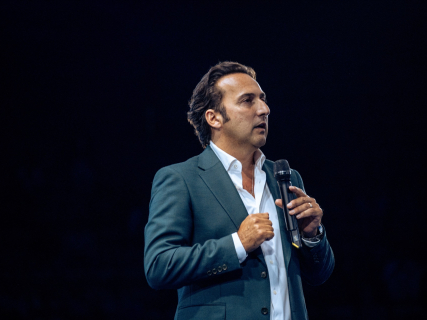

From investigating psychophonies and haunted houses to analyzing during prime time the electoral advance of Pedro Sánchez. The professional evolution of Iker Jiménez Elizari (Vitoria, 1973) explains why his name has ended up appearing in an electoral campaign in which the parties know that a good part of the battle will also be fought outside traditional rallies and debates. The host of "Cuarto Milenio" has been on Cuatro for more than 20 years, but his second major format, "Horizonte," has radically expanded his territory: national politics, immigration, events, security, wars, protests, and social crises now occupy a good part of his broadcasts.
The importance of Jiménez in this electoral cycle does not derive from an institutional function. He is not part of any candidacy nor is it recorded that he plays an organic role for PP, PSOE, Vox, or any other party. His weight is in the studio and in the audience. Spain will vote on November 29 and the official campaign will take place between the 13th and the 27th, although the pre-campaign practically began at the moment Sánchez announced the electoral advance on October 5. In that scenario, "Horizonte" arrives with a daily presence in the "access prime time" and with figures that have placed it some nights ahead of the two major giants of that time slot.
From Vitoria to the mystery radio
Iker Jiménez was born in Vitoria on January 10, 1973 and studied Information Sciences. His relationship with radio began very early: according to the biography published by Mediaset, he was already working at stations at 17 years old and later passed through media such as Onda Madrid, Radio Voz, or spaces linked to the journalist and popularizer Fernando Jiménez del Oso. In 1995, he joined the magazine "Enigmas de la Ciencia y el Hombre," specialized in mystery, ufology, and unexplained phenomena, where he ended up serving as deputy director.
The great transformation came in 2002, when he started on Cadena SER "Milenio 3." The program turned the weekend nights into Jiménez's natural territory and consolidated a community of followers around stories of mystery, crime news, history, and paranormal phenomena. It remained on air until 2015, but by then the journalist had already made the leap that would definitively define his career: television.
"Cuarto Milenio," the program that turned him into a national face
The 16th of November 2005 began to air "Cuarto Milenio" on the newly born Cuatro. Alongside journalist Carmen Porter, his partner and professional collaborator for decades, Jiménez built one of the longest-running programs on the channel. UFOs, archaeology, crimes, legends, artificial intelligence, history, science, and events have coexisted for more than two decades in a format that has survived numerous schedule changes and television habits.
For years, that was the public character associated with Iker Jiménez: the journalist of mystery. His narrative tone, his final monologues, and a recognizable staging also made him a recurring object of imitations and parodies. But the true mutation into the Iker that today appears in political debate occurred much later and was triggered by a completely real event: the pandemic.
The pandemic changes the course: "Horizonte" is born
In September 2020, "Cuarto Milenio" returned after the television break caused by COVID-19 with two specials. One was called "Origen" and focused on the coronavirus; the second was named "Horizonte" and brought together virologists, doctors, and researchers to analyze the pandemic, its consequences, and its management. That broadcast obtained an 11.7% share and around 1.4 million viewers, according to Mediaset.
The experiment ended up becoming an independent program. "Horizonte" gradually stopped being a space focused on COVID to address current political and social issues. With Jiménez and Porter at the helm, their tables began to analyze matters that were traditionally reserved for political discussions: government decisions, immigration, security, corruption, protests, wars, or institutional conflicts. Iker had moved from mystery to current affairs without completely abandoning the style that made him popular.
This change is fundamental to understanding his current role. "Cuarto Milenio" continues to be his flagship on Sundays, but it is "Horizonte" that places him today within the political conversation.
From weekly program to competing every night with Motos and Broncano
The growth of the format accelerated during 2025. Mediaset closed that year calling it the best in the history of "Horizonte," with an average of 9.1% share and 603,000 viewers, a 17% increase in share compared to 2024. The network then decided to try a daily edition starting on January 26, 2026, in the "access prime time," directly facing programs like "El Hormiguero," "La Revuelta," or "El Intermedio."
What was initially going to be a one-month experience ended up consolidating. After a few initial weeks with irregular results, Mediaset decided to keep "Horizonte" from Monday to Thursday and the space began to grow in the following months. By March, it reached 1.1 million viewers in some of its daily broadcasts.
This decision now has an evident political consequence: unlike other programs that occasionally interview a leader during the campaign, Jiménez has a daily showcase in one of the most contested time slots on television just as Spain enters an electoral process.
Ayuso shoots "Horizonte" to its historical record
The most evident demonstration came just a few days before the electoral advance. On October 1, Isabel Díaz Ayuso sat in front of Iker Jiménez and Carmen Porter on "Horizonte" amid the controversy over the housing camp in Puerta del Sol. The Madrid president used the interview to launch harsh accusations against Pedro Sánchez and the left and to present her interpretation of the protests.
The audience responded. The broadcast reached 1,630,000 viewers and a 13.8% share, the best result for the program since its conversion to a daily format. During the specific interview with Ayuso, the figure rose to 1,885,000 viewers and a 15.5%, surpassing both "La Revuelta" and "El Hormiguero" in that time slot.
The figure helps explain why "Horizonte" has gained electoral relevance. A politician sitting in that studio can access nearly two million live viewers, in addition to the subsequent circulation of clips on social media, YouTube, and Mediaset platforms.
Sánchez had already turned Iker into a matter for Congress
The relationship between Jiménez and national politics had reached a particularly significant moment much earlier. On February 11, 2026, Pedro Sánchez directly mentioned the presenter during an intervention in Congress with a phrase that immediately went viral: "Iker Jiménez has an audience, there are people willing to believe anything."
Jiménez responded that same night from "Horizonte." He defended the work of his team and invited Sánchez to come to the program for an interview, assuring that he could sit there without knowing the questions beforehand. He also claimed that his profession was to tell what was happening "with freedom and investigation."
That dispute revealed something that was already happening: the presenter had ceased to be a peripheral character regarding politics. The Prime Minister himself considered his audience sufficiently relevant to cite him from the podium of Congress, and Jiménez responded a few hours later from a program followed by hundreds of thousands of people.
The electoral announcement immediately enters "Horizonte"
The call for 29-N confirmed that transformation. The same day Sánchez announced the elections, "Horizonte" dedicated part of its broadcast to the president's speech. The program turned to, among other profiles, a psychologist and language expert who described the intervention as a message "loaded with manipulative potential" and broke it down into different phases before the viewers.
This is not an isolated episode. Political news regularly occupies the format: the program has analyzed confrontations between Sánchez and Feijóo, decisions of the Executive, regional elections, street protests, immigration, and issues related to security and public order. Looking ahead to 29-N, the question is not so much whether "Horizonte" will talk about the campaign but which leaders will end up sitting in front of Jiménez and Porter and what space the different political positions will receive.
Until this October 11, a closed round of interviews with all the presidential candidates has not been publicly announced. The presence of a certain politician on the program does not make Jiménez a participant in their campaign: he remains the host of a private medium with the ability to decide its content and guests.
Is Iker Jiménez right-wing?
It is one of the questions that accompanies his media transformation, but it is advisable to differentiate between the labels that others attribute to him and how he defines himself. Jiménez does not publicly belong to any party and has rejected in interviews the rigid division between left and right. Over the last few years, however, "Horizonte" has received criticism from media and commentators who believe that some of its panels, approaches, or guests lean more towards conservative or right-wing positions. This is an editorial assessment discussed by the presenter himself and by his followers, who claim the program as an independent space.
The interview with Ayuso has reinforced that debate, especially because the Madrid president was able to develop during a long conversation some of her harshest accusations against Sánchez. At the same time, Jiménez had publicly invited the president of the Government months before. There is, for now, no formal participation of the presenter in the electoral strategy of any party.
The controversies that are also part of his trajectory
Jiménez's notoriety has not been without controversies. One of the biggest occurred during the DANA of Valencia in 2024, when he and some collaborators from "Horizonte" spread unverified information about the supposed existence of numerous corpses in the parking lot of the Bonaire shopping center. The Police later confirmed that no fatalities had been found in that parking lot and the handling of the matter provoked strong criticism for misinformation.
In recent weeks, the program has also received criticism for some content related to Maricarmen Abascal, the woman whose eviction triggered the housing mobilization that preceded the political crisis and the early elections. "Horizonte" has rejected certain accusations about its coverage and Jiménez has assured that some fragments disseminated on social media had been taken out of context.
These episodes are relevant because they help to understand the figure that arrives on the 29-N: for his followers, Jiménez represents journalism willing to address issues that other media do not cover or to question official versions; for his critics, the format has sometimes given space to insufficiently verified claims or alarmist approaches. This dispute over credibility, independence, and narrative will probably also accompany the program during the electoral period.
From psychophonies to the center of political debate
Few Spanish television careers have experienced such a change. The journalist who began telling mystery stories on small stations, went through "Milenio 3" and turned "Cuarto Milenio" into a television phenomenon now presents four nights a week a current affairs space capable of competing with Pablo Motos and David Broncano.
In fact, Broncano himself joked after the electoral call about the weight acquired by Jiménez. After commenting on the audiences of "Horizonte," he joked on "La Revuelta" that perhaps in December the presenter could become "Minister of the Interior." It was a joke, not a known political possibility, but it serves as a thermometer of how far Jiménez has entered the imagination of this campaign.
What role does Iker Jiménez really have in the elections of 29-N
His role can be summarized in a fundamental distinction. Iker Jiménez is not a formal electoral actor, but he is already a relevant media actor of the electoral period. He does not present a candidacy, does not officially ask for votes for a party, and is not part of the structure of any party publicly known. What he has is something that candidates will seek during the coming weeks: audience, daily presence, and the ability to turn an interview or a controversy into a national conversation.
The BOE sets the official campaign between November 13 and 27, but the media battle has already begun. "Horizonte" arrives at it after its best year of audience, turned into a daily program and with a recent record of almost two million viewers during the interview with Ayuso.
For this reason, if in previous elections politicians sought to appear on "El Hormiguero," the major radio interviews, or the highest-rated news programs, on the 29-N one will also have to look at Iker Jiménez's set. The mystery presenter is not running for election, but the show he directs is already part of the ground where a part of the campaign narrative will be contested.