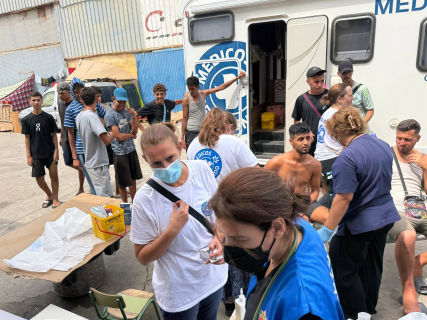

The Nursing College of Ceuta has claimed this Wednesday that a state of alarm should be declared due to the "unprecedented health collapse" that the autonomous city is experiencing after the recent migration crisis.
The request is made after reviewing the latest health report, which reflects an "extreme care activity." According to the collegiate organization, nurses attend to about 200 daily consultations, with peaks exceeding 1,600 interventions. Each professional takes on between 14 and 16 patients per shift and accumulates workdays that extend up to four hours beyond what is established.
"Nurses find ourselves exhausted both physically and psychologically, facing a deep emotional wear due to being the main support for people who are in conditions that do not correspond to those of a developed country. We have suffered a violation of territorial integrity and given the seriousness of the facts, we propose that a state of alarm be declared throughout the territory. We thus denounce that there are not enough resources to address the current crisis," denounces Rosa Fuentes, president of the Nursing College of Ceuta.
The General Council of Nursing (CGE) has expressed its absolute support for the professionals in Ceuta and demands immediate action from the Executive with additional reinforcements. "We ask that a single command be established in Ceuta to lead these operations and that the resources and provisions required by this territorial emergency be allocated. It is not the time to shift responsibilities or to mask figures," affirms Florentino Pérez Raya, president of the CGE.
Risk of outbreaks and care pressure
Nurses also warn of their concern for the health situation of the people attended to, which is already generating outbreaks of pathologies associated with overcrowding and the absence of adequate hygienic conditions. They report around 200 episodes of acute gastroenteritis, 20 diagnoses of scabies, an outbreak with 30 cases among military personnel, 21 of impetigo, and 4 of tuberculosis, not including those detected in beach settlements like El Trampolín or in the Tarajal warehouses, "where monitoring is much more complex," they add.
Another of the points that Ceuta's nurses emphasize is the scarcity of available resources and the effect that this situation has on the teams themselves. "This lack of foresight and the fact of working permanently with tight staffing critically undermines patient safety, as extreme fatigue and prolonged stress multiply human errors that can lead to medication dosing failures or chaotic shift handovers where vital patient information is lost," continues the president of the nurses of Ceuta.
Rationing, fear, and a sense of abandonment
Nursing professionals demand that the city recover normalcy as soon as possible, in a context of losses that are difficult to quantify and with a population plunged into uncertainty, and they denounce feeling helpless by the different administrations.
"The people of Ceuta want to be able to enjoy our beach, go out without fear of the street, or go shopping without rationing queues or lack of essential products. There is even talk of delaying the start of schools because they are currently overwhelmed. On the other hand, the situation of migrants is not what corresponds to a developed country. They are overcrowded and without minimum hygiene services. Even in one of the city's schools, a program for the relocation of women and girls who are on the street has been implemented," she points out.