
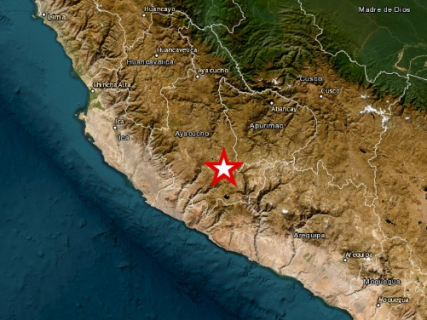
A magnitude 7.2 earthquake can be immediately associated with the risk of a tsunami, but the magnitude alone is not enough for a large wave to be generated. The earthquake recorded this Thursday in Peru had its epicenter under the continental territory, in the Andean region of Ayacucho, and not under the Pacific Ocean.
The Peruvian Navy ruled out a tsunami threat after the earthquake, as confirmed by Associated Press.
A strong earthquake does not necessarily imply a tsunami
For an earthquake to cause a significant tsunami, several conditions must coincide.
One of the main ones is that the movement occurs under the sea or very close to the coast and manages to displace a large mass of water sufficiently abruptly.
The IGP itself explains in its seismic information that earthquakes greater than magnitude 7 with an epicenter in the sea can generate tsunamis.
Therefore, two earthquakes with a similar magnitude can have completely different consequences depending on where their focus is located and how the rupture occurs.
The epicenter was inland in Peru
In the earthquake this Thursday, there is a decisive element: its epicenter was in Ayacucho, far from the ocean.
The IGP located it 35 kilometers north of Coracora and at a depth of 108 kilometers. The USGS used other parameters —magnitude 6.7 and 66 kilometers deep— and placed it 38 kilometers northwest of Upahuacho, but both measurements agree on the fundamental aspect for tsunami risk: it was a continental earthquake.
Therefore, there was no rupture of the ocean floor capable of vertically displacing a sufficient mass of water to generate a destructive tsunami.
Magnitude, depth, and location: what each data means
The magnitude measures the size of the earthquake and the energy released. It does not directly indicate how much damage it will cause in a specific city.
The depth indicates how far below the surface the focus or hypocenter is located. Generally speaking, shallow earthquakes can produce especially intense shaking near the epicenter, although the final effect depends on many other factors.
The location of the epicenter is fundamental when assessing a tsunami. A large earthquake occurring inland can cause landslides, collapses, and damage to buildings, but does not directly displace the seabed.
It also matters the type of rupture. Large tectonic tsunamis are usually related to movements capable of causing a significant vertical displacement of the ocean floor.
Peru has indeed suffered tsunamis caused by large earthquakes
The difference is noticeable when comparing the Ayacucho earthquake with some of the major historical earthquakes of Peru.
The earthquake of Lima and Callao in 1746, estimated at around magnitude 8.8, broke an extensive segment of the subduction zone and triggered a destructive tsunami. The great earthquake of southern Peru in 1868 also generated a tsunami.
The earthquake of Arequipa in 2001 and that of Pisco in 2007 are more recent examples of large seismic movements associated with tsunamis on the Peruvian coast. The IGP documented that the Pisco earthquake, with a magnitude of Mw 7.9, had its epicenter about 60 kilometers west of the city, in the ocean.
The earthquake this Thursday presents a different configuration: the origin was located inside the Andes.