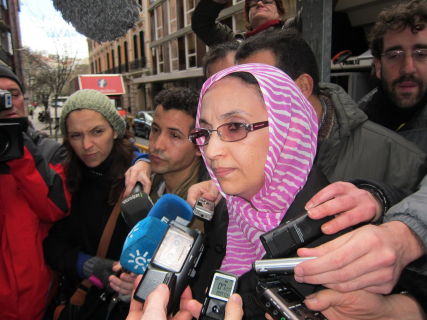

The Sahrawi activist and president of the Sahrawi Instance Against the Moroccan Occupation (ISACOM), Aminetou Haidar, has denounced the responsibility of the European Union and several Western countries in the human rights violations attributed to Morocco in Western Sahara, which, she maintains, allow the continued illegal plunder of the natural resources of what was a Spanish colony.
"This complicity of the EU with the occupying State of Morocco derives from political and economic alliances that reinforce the occupation and strengthen its repressive system, strengthening its economic and political capacities, while at the same time reinforcing the mechanisms of repression inflicted on the Sahrawi civilian population in the occupied areas," Haidar stated in an interview with the Swedish human rights organization Artikel2.
Haidar has described as "ironic" that the Sahrawi population remains in refugee camps and depends on increasingly scarce humanitarian aid, while "their occupied land is rich in natural resources that are exploited without benefiting its legitimate owners".
In this regard, she has pointed to the "continuous policy of isolation and repression that the Moroccan occupation authorities continue imposing on Sahrawi civilians who protest against the occupation". "Even small peaceful gatherings and demonstrations are prohibited and their participants are subjected to torture, harassment and false accusations," she denounced.
The human rights defender also recalled that she herself remained disappeared for four years, a period in which she was subjected to torture. She later spent seven months in prison, during which her family did not know whether she was still alive. Her release from prison returned her, she explained, to "a reality of siege, surveillance, interrogations and constant harassment".
Finally, Haidar has urged to "break the media blockade imposed on the occupied areas of Western Sahara" as a "shared responsibility that falls on the international community, civil society and individuals, given the crucial role that international voices play in denouncing the violations and keeping the Sahrawi cause present in the international debate".
A conflict pending since 1975
The former Spanish colony of Western Sahara was occupied by Morocco in 1975, despite the armed resistance of the Frente Polisario. Both sides faced each other in a war that lasted until 1991, when a ceasefire was agreed with the commitment to organize a self-determination referendum. However, disagreements over the preparation of the electoral roll and over the possible participation of Moroccan settlers have so far prevented the holding of that vote.