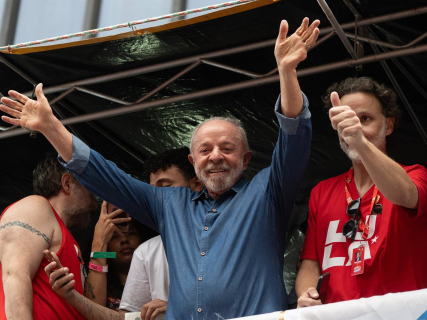
The Presidency of Brazil will be decided this Sunday between two candidates separated by a much smaller distance than what the first forecasts after the elections of October 4 suggested. Flávio Bolsonaro, son of former president Jair Bolsonaro, appears at the polls with the backing of a good part of the Brazilian right and the political advantage of having unexpectedly defeated Luiz Inácio Lula da Silva in the first round. The current head of state, who aspires to a fourth term, has managed to regain ground over the last three weeks and arrives at the vote with chances of reelection.
The right-wing candidate obtained 47.03% of the votes in the first round, compared to 45.16% of the leader of the Workers' Party (PT). Only 2.2 million votes separated both candidates in a country with more than 150 million voters, a difference that gave Bolsonaro the initiative to negotiate new support and forced Lula to rethink his campaign.
Since then, the senator from Rio de Janeiro has incorporated the support of several center-right formations into his candidacy, while Lula has turned to labor organizations, social movements, and progressive sectors to expand his electoral base. Both have traveled through the main states of the country, starred in televised confrontations, and turned the streets of São Paulo into one of the main showcases of their mobilization capacity.
From electoral surprise to technical tie
Flávio Bolsonaro's victory on the first Sunday of October altered the calculations of a campaign in which Lula relied on asserting his status as president and the electoral weight of his political trajectory. The candidate of the Liberal Party (PL), 45 years old, managed to gather practically half of the valid votes in his first presidential candidacy, benefiting from the loyalty of his father's electorate and the discontent of a part of Brazilians with the government's management.
The first polls after the voting pointed to a more comfortable lead for the conservative candidate, with estimates attributing him between 52% and 53% of the valid votes. The distance has progressively narrowed and Datafolha has recorded this week a tie of 50% for each candidate, after Lula recovered two points compared to the previous measurement.
The polls before the second round
| Institute | Fieldwork | Flávio Bolsonaro | Lula |
|---|---|---|---|
| Datafolha | October 20-22 | 50% | 50% |
| Gerp | October 19-21 | 53% | 47% |
| AtlasIntel | October 13-18 | 51.1% | 48.9% |
| Veritá | October 15-19 | 50.7% | 49.3% |
| Futura | October 19-20 | 51.1% | 48.9% |
| Vox Brasil | October 15-17 | 49% | 51% |
Source: polling institutes and collections of electoral surveys. Percentages on valid votes. The margins of error and methodologies vary by institute. Some figures are presented rounded.
The differences between the main studies show a close competition, although not all institutes agree on the distance separating the candidates. Bolsonaro retains his strongest support in the south and southeast of Brazil, as well as among evangelical voters, while Lula achieves his best results in the northeastern states and among lower-income sectors.
With the main electoral blocks practically defined, the campaign teams have concentrated their efforts on the undecided and those who abstained on October 4.
The right closes ranks with Bolsonaro
After winning the first round, the senator from Rio de Janeiro dedicated a good part of his efforts to expanding the political agreements that could facilitate both his electoral victory and the formation of a stable Government. Several right-wing and center-right parties have joined his orbit, in a succession of adhesions that can be interpreted as the first outline of a future coalition with the potential to control both chambers of Congress.
Flávio Bolsonaro has defended during the campaign proposals to toughen security policy, reduce economic barriers, and tighten relations with the United States. He has also claimed the trajectory of his father, convicted for his participation in the coup attempt following the 2022 elections.
The last major show of strength from his supporters took place last Sunday on Avenida Paulista in São Paulo, where tens of thousands of supporters participated in a rally of the so-called "Bloco do 22". Before the crowd, Bolsonaro promised to appoint four Supreme Court justices opposed to abortion and the legalization of drugs, while presenting his father as a reference for his future Government.
Lula seeks the votes of abstainers
The Brazilian president has tried to counteract the agreements of his opponent through a mobilization of social organizations and progressive voters, especially in large cities. The rallies in defense of his reelection have gathered tens of thousands of people and have turned Paulista Avenue, where Bolsonaro's supporters have also demonstrated, into one of the most contested stages of the campaign.
Aware of the difficulty of attracting more conservative voters, Lula has directed a good part of his appeals to the approximately 33 million citizens who did not go to the polls in the first round. The leader of the PT believes that greater participation among popular sectors and young people can be decisive in compensating for his rival's initial advantage.
The electoral mobilization has been joined by a battery of governmental decisions with significant economic consequences. More than twenty million families have begun to receive a 15% increase in the Bolsa Família benefit, while the Executive has promoted measures to alleviate personal debts, reduce fuel taxation, and expand public aid. The set of initiatives has sparked criticism for its budgetary cost, in a country whose public debt could reach 82% of GDP.
The president has also presented his management as a guarantee for the continuity of redistributive policies and the protection of workers, one of the main arguments with which he intends to win back disenchanted voters. Bolsonaro has promised to preserve social aid, although the differences between the two extend to its financing, economic priorities, and state intervention.
Corruption and personal attacks in the face-to-face
The first televised confrontation between the two candidates, held on Sunday, October 18, on the Band network, was dominated by cross accusations of corruption and reproaches about their respective political trajectories. Lula demanded explanations from his opponent regarding his alleged relationships with banker Daniel Vorcaro, while Bolsonaro resorted to the investigations affecting the president's son and a pension fraud scandal.
During the meeting, the senator walked repeatedly behind Lula while he was speaking, taking advantage of the freedom of movement allowed by the organization. The president even rejected the physical proximity of his rival and called him "militant", alluding to his alleged ties with paramilitary groups in Rio de Janeiro. Bolsonaro responded with allusions to the judicial background of the president, whose conviction for corruption was annulled by the Brazilian Justice.
On economic matters, Lula defended the increases in the minimum wage and the redistributive policies of his previous governments, while the conservative candidate promised to intensify the pursuit of organized crime, classify the main gangs as narcoterrorist organizations, and build more than half a million prison places. They also disagreed on Brazil's relations with the United States and the international affinities of bolsonarism, especially with Donald Trump and Javier Milei.
The confrontation continued in the following days, to the point that both candidates agreed before the Superior Electoral Tribunal to authorize the reciprocal lifting of their banking, tax, and telephone secrets, including those of family members. The initiative arose after Lula publicly challenged Bolsonaro to make his accounts transparent.
The amnesty for Jair Bolsonaro and the majorities in Congress
Flávio Bolsonaro has promised to promote an amnesty that could benefit his father if he manages to reach the Presidency, after the former president was sentenced to 27 years in prison for his participation in the coup conspiracy following the 2022 elections. Jair Bolsonaro, who remains under house arrest for health reasons, retains considerable influence among right-wing voters.
If he achieves victory, the PL candidate would have a considerably more favorable parliamentary position than the one Lula found upon returning to power in 2023. According to calculations gathered by Reuters, his party and allied formations could gather more than 280 deputies and up to 50 senators, enough to have ordinary majorities in both chambers and negotiate broader reforms.
The president has appealed to the memory of the events that followed his victory in 2022 to warn of the consequences of returning power to bolsonarism. His supporters believe that re-election would allow for the preservation of social policies and the institutional orientation of his Government, while his opponents demand a change of course in light of the cost of living, insecurity, and the deterioration of public accounts.
With a rejection rate close to 48% for both candidates, according to Datafolha, the election will largely depend on voters who have not yet made a definitive decision and on participation in the territories where each one retains the largest electoral reserves.
Since the restoration of democracy, no candidate who finished second in the first round has managed to turn it around in the final vote. Lula needs to break that precedent to continue in the Palácio do Planalto. Bolsonaro aims to confirm the result that surprised Brazil three weeks ago and return his family to the head of State.