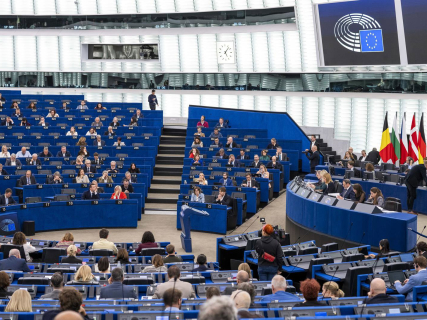

The plenary of the European Parliament has requested this week to strengthen the use of the cohesion funds of the European Union to tackle the housing access crisis, improve basic public services, and address depopulation, with the aim of guaranteeing the "right to stay" of citizens in the cities and areas where they wish to develop their life project.
This request is included in a resolution approved by the Eurochamber meeting in Strasbourg (France), which passed with 601 votes in favor, 20 against, and 36 abstentions. In the text, the MEPs ask the European Commission to make the "right to stay" one of the pillars of future community cohesion policy, so that people can live, work, and plan their future in the places they consider home.
Extremadura is among the European regions particularly affected by population loss. According to the latest projection from the National Institute of Statistics (INE), if current demographic trends continue, the autonomous community would lose 4.54% of its inhabitants in the next 15 years, which would mean 47,868 fewer people and leave the population at 1,007,474 residents.
By provinces, the INE predicts that Badajoz will reduce its population by 4.83%, while Cáceres would do so by 4.03%. According to these projections, in 2040 there would be 6,406 births registered in Extremadura, 5.7% less than in 2026, while deaths would increase by 9.05%.
As a consequence, the vegetative balance of Extremadura (the difference between births and deaths) would continue to be negative, due to the continued decline in birth rates and the increase in deaths. The INE estimates that in 2040 this balance would reach -6,505 people.
Debate in the Eurochamber on the next European budget
During the debate on the initiative in the hemicycle, the MEPs have demanded that this principle be incorporated into the next Multiannual Financial Framework (MFF) of the EU for 2028-2034, so that European funds help finance affordable and sustainable housing, quality jobs, essential public services, transportation, healthcare, and connectivity, especially in those cities and territories affected by demographic decline and depopulation.
The proposal is presented in the midst of debate among member states about the design of the community budget for the next seven years and about the distribution of resources allocated to the European Regional Development Fund (ERDF), the Cohesion Fund, and other national and regional cooperation programs, as the European Parliament has recalled in a statement.
In this context, the Eurochamber demands that local and regional authorities have a more relevant role in defining the "investment priorities" and in the preparation of programs funded with cohesion funds, in addition to facilitating access to these aids by reducing "administrative burdens," particularly for small and medium-sized cities.
More resources for housing, climate, and urban resilience
One of the central objectives of the resolution is to strengthen the capacity of European cities to face the "housing crisis," financing projects for "affordable, sustainable, and energy-efficient" housing, including public and social housing, the rehabilitation of buildings, the regeneration of neighborhoods, and the reuse of "vacant or abandoned" properties.
At the same time, the MEPs advocate for increasing investment aimed at improving the "climate resilience" of urban areas against extreme weather events and rising temperatures, through infrastructure adapted to climate change and "nature-based solutions."
The Eurochamber also proposes using cohesion funds to strengthen the "preparedness and resilience" of cities in the face of emergencies and crises, although it warns that spending related to security should not be done "at the expense" of resources aimed at the economic and social development of cities and regions.
In the field of tourism, the MEPs insist on the need to promote a "sustainable" model that allows maintaining local economic activity without deteriorating the "quality of life" of residents, respecting the particularities of each territory and the competencies of national, regional, and local administrations.
"Solid roots" and opportunities to stay
The speaker of the report, the Italian MEP Denis Nesci, from the group of the Italian Prime Minister, Giorgia Meloni, European Conservatives and Reformists (ECR), has argued that cities must provide their inhabitants with "solid roots and real opportunities to build their future."
"The right to stay means ensuring that students, young professionals, and families can find affordable housing, reliable transportation, and essential public services wherever they choose to live," Nesci has pointed out, who has called for "predictable" cohesion funding after 2027 and easier access to European aid to build "more connected, safe, and resilient" cities.