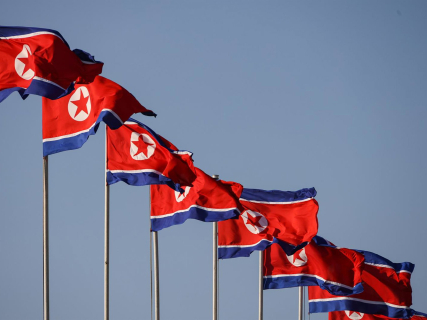

The authorities of North Korea have once again criticized this Wednesday the joint military exercises carried out by the United States and South Korea, despite the "substantial" reduction communicated earlier this week by the U.S. president, Donald Trump, considering that they pose a direct threat to regional stability and security.
These maneuvers, called 'Ulchi Freedom Shield', will last for eleven days and represent an "immediate and manifest threat" to North Korea, as they "exacerbate tensions on the peninsula and lead it towards war," they have warned, according to information released by the North Korean state agency KCNA.
According to Pyongyang, the training is oriented "increasingly" towards "improving the allies' ability to wage real war and incorporating technologies such as artificial intelligence, the use of drones, and cyber capabilities." For this reason, the regime has emphasized that it will exercise its right to "legitimate defense" to "completely neutralize" what it defines as "military threats."
Kim Yo Jong, influential sister of North Korean leader Kim Jong Un, has avoided commenting on the extent of the reduction of the exercises announced by Trump, insisting that for Pyongyang they are "completely irrelevant."
"The fact that the scale or duration of the training is reduced does not change the nature of the military exercises, which are provocative and aggressive," she added in a statement released by KCNA, in which she emphasized that Seoul and Washington have developed maneuvers of this type "only this year" from February to July.
The deputy director of the department of the Central Committee of the Workers' Party of Korea (WPK) has thus downplayed Trump's gesture, estimating that this reduction "compensates" for the exercises already carried out in 2026.
"If the U.S. side calculates that the measures it has taken this time are a kind of 'goodwill measures', it will not get the response it desires," she pointed out.
Kim has also stated that she is unaware of the details of the communications between her brother and the president of the United States: "The relationship between the two leaders is excellent. Everyone knows it, and I do not find it particularly surprising," she stated, before emphasizing that, even so, "the hostile policy of the United States towards North Korea has not changed."
These statements come just a few days after the U.S. president ordered a reduction in the involvement of his troops in the maneuvers, taking into account the good rapport he maintains with Kim Jong Un. From Seoul, the president of South Korea, Lee Jae Myung, has also expressed his willingness to promote a diplomatic rapprochement with the North Korean leader to ease tensions on the peninsula.
South Korea and the United States continue to organize annual exercises aimed at strengthening their joint defense capability. The most recent one started on Monday with the participation of thousands of military personnel from both countries.
Since 1994, Seoul has maintained operational control of its Armed Forces in peacetime. However, in the event of a large-scale armed conflict on the Korean peninsula, South Korean and U.S. forces would integrate into a unified command under the leadership of Washington, the Combined Forces Command.
This scheme originates from the Korean War, when Seoul ceded operational command to a UN force then led by the United States. In the late 1970s, this control was transferred to the Joint Forces Command of South Korea and the United States.
The complete transfer of command over the South Korean Armed Forces is conditioned on the country meeting several requirements, primarily of an operational and technological nature, including the development of advanced missile defense systems.