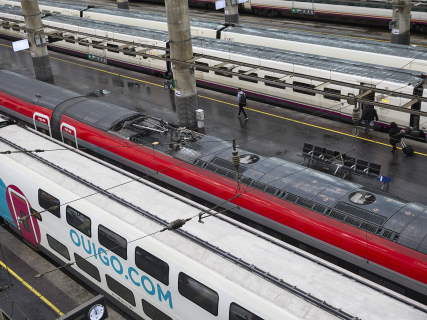

The Spaniards have already gotten used to the liberalization of high speed. However, since in 2020 Renfe ceased its monopoly on passenger commercial services, the frictions between operators have not stopped being the order of the day.
This week, the dispute has infiltrated the workshops of the Spanish network. The National Commission of Markets and Competition (CNMC) has forced Renfe to open certain railway maintenance facilities to its competitors, and there lies the origin of the conflict.
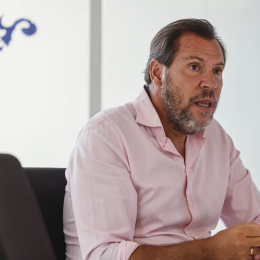
The Minister of Transport, Óscar Puente, has accused Iryo and Ouigo in an interview of "parasitizing" Renfe's industrial infrastructure and the CNMC of forcing the Spanish public company to put its facilities at the service of its competitors. However, behind the clash lies a somewhat more complex issue about how the former railway monopoly should really provide the necessary means for new operators to compete.
The CNMC's version, however, introduces several nuances. Neither Iryo nor Ouigo are using Renfe's facilities for free and there is also no general obligation for the Spanish company to maintain any train of its competitors. Regulation comes into play when Renfe decides to offer certain services to the market and when access to its facilities becomes necessary to avoid discriminatory treatment.
What the CNMC really forces Renfe to do with Iryo
The conflict affects, on one hand, Iryo and the heavy maintenance of its trains. The CNMC resolved on July 31 that Renfe must allow entry into its La Sagra base so that Hitachi Rail, responsible for the maintenance of Iryo's trains, can disassemble and assemble the bogies of 19 convoys. It is not Renfe that will carry out those operations: they will be done in a self-service regime using the facility.
Competition actually rejected part of Iryo's claims. It did not force Renfe to allow the entirety of the "R2" heavy maintenance operations to be carried out in its facilities nor to perform the maintenance of the bogies in Valladolid. The obligation was limited to the disassembly and assembly of those elements in La Sagra, because the regulator considered that for that operation Iryo lacked an available alternative.
There is another piece of information that explains a good part of the conflict. According to the resolution itself, Renfe Mantenimiento is the only owner of heavy maintenance workshops for high-speed trains in Spain. Iryo could build its own facility or resort to workshops of Trenitalia outside of Spain, but decided to organize these interventions here after negotiating for a year and a half with Renfe.
Featured story
Traveling on AVE this summer costs up to 52% less than in 2019, according to Trainline
2 minutes
The CNMC considers that negotiating process to be decisive. Renfe had submitted offers, conducted compatibility tests, and practically finalized the contracts. On January 27, it was still proposing to adapt the agreement from 20 to 19 trains and it was not until February 19 that it communicated its refusal. For Competition, withdrawing a few weeks before starting the work left Iryo with insufficient time to seek another solution and could cause the immobilization of a significant part of its fleet.
Why Renfe cannot freely decide to whom it lends its workshops
At this point, the less visible part of the liberalization appears. The Railway Sector Law includes heavy maintenance among the so-called auxiliary services. The operator of a facility is not obliged to offer them to the market, but the regulation establishes that if it decides to lend them to a railway company, it must do so in a non-discriminatory manner to others that request them.
The law also contains a specific provision for the Spanish public group: Renfe Fabricación y Mantenimiento must provide its services in a "transparent, objective, and non-discriminatory" manner. It is on this framework that the CNMC builds its intervention.
Therefore, the CNMC considers that access occurs under economic and operational conditions, and in Iryo's file it orders to respect the conditions that Renfe itself had previously offered. The specific amounts are declared confidential in the resolution.
The case of Ouigo is different
The situation of Ouigo is not identical. The French company claims that since 2020 it has signed annual contracts to access Renfe's workshops in Cerro Negro-Santa Catalina, Can Tunis, and Fuencarral, where it carries out maintenance operations with its own suppliers.
The conflict arose when Renfe reduced in 2025 the capacity granted considering that Ouigo was performing certain heavy maintenance tasks in facilities enabled for light maintenance. Ouigo went to the CNMC and requested to temporarily maintain access while the dispute was resolved.
In January, Competition did not have to impose that provisional measure because Renfe committed to ensuring Ouigo's access on the same terms while the procedure was processed. The public documentation from the CNMC has not yet recorded a definitive resolution regarding the substance of that conflict.
The "false liberalization" of Puente
From the perspective of the traveler, the data from the CNMC shows that the entry of competition has indeed profoundly changed the market, as Puente himself acknowledges in the interview. In 2025, commercial high-speed reached 44.5 million travelers and, since the liberalization, prices have been reduced by approximately half on the Madrid-Valencia route and around 40% on other major corridors.
However, the minister argues that the cost is reflected in the companies' accounts. According to the figures he provided in his interview with Europa Press, it has gone from a Renfe that earned about 150 million euros to three operators that together lose 230 million, something he attributes to prices that are too low for the market.
He also uses the French case as a comparison. Puente asserts that Renfe brings to Spain the trains with which it provides service in France to carry out their maintenance here and argues that Ouigo and Iryo should invest in their own facilities or do something equivalent. "What cannot be expected is for your competitor to be the one who maintains your trains," the minister goes on to say.
However, both countries apply, like Spain, the European rules that require ensuring equitable and non-discriminatory access to certain railway facilities. In France, the regulator controls access to maintenance centers, mostly owned by the historical operator SNCF, while in Italy a company that is denied access to a specialized high-speed workshop can appeal to the Transport Authority to determine if there is discrimination.
In any case, the exchange reflects one of the underlying tensions of railway liberalization regarding how to open the market to new operators without turning the infrastructures built by the former monopoly into a shared advantage with its competitors.