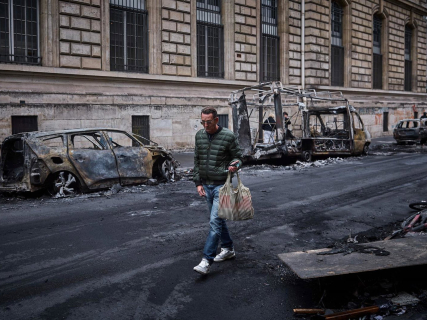

France is going through a new day of protests against the cost of living this Saturday, October 24, under a deployment of 70,000 police and gendarmes. The first reports describe a situation less violent than that of the previous weekend, although the charges in Marseille and the tensions recorded in other cities prevent speaking of a day without incidents. The device involves 10,000 more agents than those deployed on October 17.
The Minister of the Interior, Laurent Nuñez, communicated at 1:00 PM that 135 arrests had been made and that no significant incidents had occurred up to that moment. The balance was provisional and preceded the development of several of the main marches of the afternoon.
The initial reduction in violence does not equate to the end of the crisis. Students, unions, and yellow vests maintain their demands, while the restrictions on demonstrations have added a new reason for confrontation with the government of Emmanuel Macron.
135 arrests at noon and a warning about the balance
Nuñez counted 136 actions in public spaces at 1:00 PM, compared to the 264 recorded at the same hour the previous Saturday. This indicator describes mobilizations and actions in public space: it should not be interpreted as a figure of disturbances.
The minister also reported controls and searches in which objects susceptible to being used as weapons had been intervened, including fireworks mortars and pétanque balls.
The government had previously warned of the risk of new looting and confrontations. The authorities attribute part of that threat to violent groups that may act outside of the organizers, a necessary distinction to avoid confusing participants in the protests with those committing crimes.
Marseille records charges after a massive march
In Marseille, the prefecture estimated the participants in the demonstration at 17,000. Local information placed the procession arriving at the Porte d'Aix around 3:34 PM. The day also caused restrictions in transportation: the metro stations Réformés-Canebière, Jules-Guesde, and Saint-Charles ceased operations during part of the mobilization.
The riot police used tear gas to disperse protesters after more than two hours of peaceful protest. These episodes contrasted with the calm development of other processions.
In Paris, Le Nouvel Obs described in the afternoon a march without major altercations, while gathering tensions in Lyon and Nantes. The situation varied, therefore, between cities and did not allow summarizing the whole country with a single closed balance.
The prohibitions reach the courts
The Government's response has combined police reinforcement with restrictions on gatherings and changes in routes. The measures have provoked criticism from union and political organizations, as well as appeals to administrative justice.
In Bouches-du-Rhône, the administrative court of Marseille upheld part of the restrictions but suspended the prohibition of declared demonstrations in Gardanne, Istres, Martigues, Miramas, and Tarascon. The union march in Marseille had been exempted by a decision from the prefecture.
The ruling reminded that a limitation of the right to demonstrate must be adequate, necessary, and proportionate. It also differentiated between municipalities: the existence of a risk in certain places did not automatically justify the same prohibition in all others.
This conflict opens a second front for Macron. The Executive seeks to prevent another day of destruction, but the organizers question whether the restrictions also hinder peaceful protests.
The protest still has a social and educational origin
The security deployment has occupied a good part of the attention, but the mobilizations maintain an agenda that goes beyond public order. The deterioration of educational conditions, economic difficulties, and concern for the future bring together groups with different demands.
The joint presence of students, workers, and yellow vests explains both the breadth of the movement and the difficulty in finding a single political response. Reducing confrontations may alleviate immediate pressure on the authorities, but it does not alone resolve the claims that brought the protesters to the streets.
Participation also offers disputed figures. In Toulouse, La Dépêche reported in the afternoon 26,500 demonstrators according to the prefecture and 80,000 according to the CGT.
The yellow vests announce new protests for October 31
The yellow vests have called for another day of mobilization on Saturday, October 31, with gatherings and sit-ins in front of the National Assembly and town halls. The call includes the defense of civil liberties and the rejection of what its promoters consider an authoritarian drift of the Executive.
The next challenge for the Government will be to turn a potential reduction of the disturbances into an opportunity for dialogue. Security can allow cities to regain activity and for the marches to take place without violence; the exit from the crisis will also require responses to its causes.
For now, the available balance allows for talking about a less violent day in its early hours.