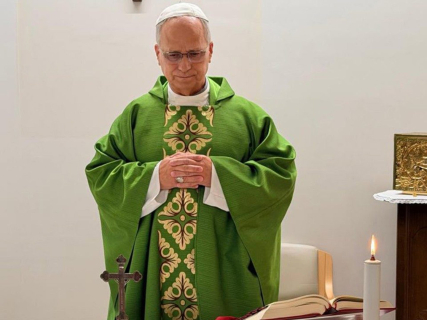
Leo XIV breaks with Vatican tradition and will vote in the United States elections

The Pontiff has sent his ballot by mail to Chicago to participate in the United States legislative elections of November 3. The Holy See defends his decision as an exercise of democratic responsibility, although it represents an unprecedented precedent for a head of the Catholic Church

fotonoticia 20261016224634 1920

fotonoticia 20261016224634 1920

Add DEMÓCRATA to Google

Ask FREN

Published

Last updated

4 minutes

Most read

Elecciones 29N · Encuestas

La media de las encuestas

Media a 27 de octubre de 2026 · 15 institutos

  • PP31,0 %
  • PSOE27,3 %
  • Vox18,9 %
  • Frente Amplio6,3 %
  • Podemos2,9 %
  • ERC2,3 %
010203040ene 2024jul 2024ene 2025jul 2025ene 2026jul 2026

Media del último estudio de cada instituto en 30 días y su evolución semanal desde el 23J. Partidos con al menos un 2 %.

Todas las encuestas

Elecciones generales del 29 de noviembre · Demócrata

Pope Leo XIV has exercised his right to vote in the United States midterm elections, scheduled for next November 3, becoming the first pontiff on record to take part in an election while serving as head of the Catholic Church. The Holy See confirmed this Friday that Robert Francis Prevost, born in Chicago and with U.S. citizenship, has sent his ballot by mail to his electoral district in Illinois.

The decision breaks with a tradition of electoral abstention by contemporary popes and raises an exceptional circumstance from the institutional point of view. Leo XIV is simultaneously head of the Vatican City State and a citizen of the United States, a country in which he retains his right to suffrage and whose Congressional composition will be partially decided at the polls next Tuesday.

"The Holy Father expresses his conviction regarding the right and duty of citizens to participate in democratic processes," the Vatican said in a statement released after several U.S. media outlets reported that the Pontiff had requested the necessary documentation to vote by mail.

The Holy See has sought to present his electoral participation as a continuation of his personal habits, and not as a pronouncement on U.S. politics. The meaning of his vote has not been made public, nor is there any information that would allow his ballot to be attributed to any specific candidacy or party.

The Vatican confirms that the Pope has sent his ballot to Chicago

The Holy See Press Office has explained that Leo XIV has habitually exercised his electoral rights as a U.S. citizen and that his election as pontiff, in May 2025, has not interrupted that practice.

"Pope Leo XIV has exercised his right to vote as a citizen of the United States whenever he has had the opportunity. The Holy See Press Office confirms that, in line with this established practice of civic participation, the Pope has sent his vote by mail to Chicago," the official communication states.

The Vatican has also confirmed that Prevost participated in electoral processes during the years he lived in Peru, a country of which he also holds nationality and where he developed much of his religious career before taking on responsibilities in Rome.

The confirmation has come after the electoral authorities of Illinois revealed that the Pontiff had requested a ballot to vote by mail last October 3. The information was reported first by local U.S. media and later corroborated by the Holy See.

An electoral history that includes Republican and Democratic primaries

León XIV’s participation in U.S. electoral processes did not begin with his election as pope. According to the Illinois electoral records published by the Chicago Sun-Times, Robert Prevost voted in the general elections of 2012, 2014, 2018 and 2024, before becoming the highest representative of the Catholic Church.

His record also includes participation in primaries of both major U.S. parties. Specifically, he is listed as a voter in the Democratic primaries of 2008 and 2010 and the Republican primaries of 2012, 2014 and 2016.

These records do not allow his political orientation to be deduced or reveal which candidates he supported, since participation in a primary does not necessarily equate to a permanent identification with the party that organizes it.

The information known so far indicates that the Pope’s electoral documentation is linked to an address in New Lenox, Illinois, related to his brother John Prevost. Some U.S. media have suggested that a person in his circle may have intervened in the request or delivery of the ballot, although the Vatican has not specified these details.

An unprecedented precedent in the recent history of the Church

León XIV’s electoral participation introduces a novelty in the relationship between the papacy and the politics of the states of origin of its holders. Previous pontiffs, even those who maintained close ties with their native countries, did not publicly exercise the vote during their pontificate.

John Paul II did not vote in the elections in Poland, Benedict XVI did not do so in Germany, and Francis abstained from participating in the Argentine elections while he was at the head of the Catholic Church.

The precedent takes on special relevance because León XIV is not only a religious leader, but also the head of state of Vatican City, whose institutional independence constitutes one of the principles of the Holy See’s diplomatic relations.

The decision also recalls the complex history of the Church with electoral systems. In 1874, after Italian unification and the disappearance of the Papal States, Pius IX forbade Catholics from participating in the political elections of the new Italian state through the doctrine of non expedit. That situation evolved until the Lateran Pacts of 1929, which established the State of Vatican City and normalized relations with Italy.

Now, almost a century later, Leo XIV establishes a distinction between his institutional condition as pontiff and the individual exercise of his rights as an American citizen, without the Holy See having announced general changes in the Vatican’s norms or practices of political neutrality.

A vote amid political tension between Trump and the Vatican

The Pope’s participation also takes place in especially relevant U.S. elections for the balance of power during the presidency of Donald Trump. The November 3 elections will renew the entire House of Representatives and part of the Senate, in addition to numerous state and local offices.

Leo XIV’s decision takes on an additional political dimension because of his public differences with Trump, with whom he has had exchanges of criticism on different issues over recent months.

However, the Vatican has not linked the Pontiff’s vote to his disagreements with the American president, but rather to his conviction that democratic participation constitutes both a right and a civic responsibility.

The Holy See has also not revealed the content of the ballot, which remains protected by the secrecy of the vote. Leo XIV’s gesture thus inaugurates a precedent in the contemporary history of the papacy without it being possible to interpret it, in itself, as an electoral endorsement of any of the parties competing in the U.S. elections.

More key points, information and questions with FREN

AI-GENERATED CONTENT

What are the next steps in the parliamentary processing of a possible reform regarding the participation of religious leaders in electoral processes?

The next steps would be to specify the content of the reform, present a legislative initiative, and process it in the Congress and the Senate. There is no specific procedure for referring to religious leaders: the route would depend on whether the electoral rules are modified, fundamental rights are developed, or the Constitution is intended to be changed. The following describes that general path, without assigning a specific phase to an initiative you have not identified.

1. Define what participation is to be regulated

The first step would be to specify whether the proposal affects the presentation of candidacies, public support for parties, interventions during the campaign, or other behaviors. This definition is decisive to determine the norm that would need to be modified and to examine its compatibility with constitutional rights.

A reform of the general electoral regime would follow the procedure of an organic law. This route should not be confused with a constitutional reform: regulating a matter related to fundamental rights does not, by itself, imply modifying the Constitution.

2. Present the text and open its processing
  • If promoted by the Government: it would present a bill. The Board of the Congress would order its publication, open the amendment period, and refer it to the competent committee.
  • If promoted by a parliamentary group: it would present a bill proposal. Fifteen deputies can also do so. In this case, the Plenary must first approve its consideration, that is, accept that its processing begins.

In proposals, the Government can express its opinion and pronounce on the budgetary consequences provided by regulations. The Board decides on admission and the route; the Presidency and the Board of Spokespersons intervene in the scheduling of debates.

3. Negotiate amendments and approve it in the Congress

The ordinary period to submit amendments is fifteen working days, although it can be modified according to the Regulations. In a government bill, a return amendment approved by the Plenary would imply its rejection.

Then, a working group — a small group of committee members — would prepare a report. The committee would debate the articles and approve its report; subsequently, the Plenary would debate the text and the maintained amendments. The committee can also request advice and hearings.

If it has organic character, it requires an absolute majority of the Congress in a final vote on the whole. If it does not reach it, it returns to the committee for a new report within a month; if that majority is again lacking, it is rejected.

4. Pass to the Senate and resolve discrepancies

The Senate would examine the text and could approve it without changes, introduce amendments, or oppose a veto. If it modifies or vetoes an organic law, it returns to the Congress.

To lift the veto, the Congress would need in any case an absolute majority. If it accepts Senate amendments, the resulting text must pass another overall vote by absolute majority; if it does not obtain it, the initial text of the Congress is maintained and those amendments are rejected.

5. If a constitutional modification is proposed

The ordinary procedure requires three-fifths and contemplates a mixed commission to resolve discrepancies between chambers. There is an alternative route with an absolute majority of the Senate and two-thirds of the Congress.

If the reform affects the especially protected parts of the Constitution, the aggravated procedure is required: initial approval by two-thirds of both chambers, dissolution, elections, and ratification by the new Cortes, before approving the new text with the corresponding reinforced majorities. This route should not be presented as necessary without knowing the proposal.

In short, the first verifiable milestones would be the registered text, its qualification, and its debate schedule. The described rules can be consulted in the Congress Regulations, especially articles 109 to 132 and 146 to 147.

What are the competencies and functions of the Pope as head of state of the Vatican City according to international treaties?

The Pope, besides being the highest authority of the Catholic Church, is head of state of the Vatican City. This status is mainly defined in the Lateran Treaty of 1929 and in the practice of international law, which recognizes the Holy See — personified in the Pope — as a sovereign subject of international law. Although many legal systems refer to the “Vatican” as a state, legally it is the Holy See and the State of the Vatican City that act in close connection.

From the perspective of treaties and international practice, the main competencies and functions of the Pope as head of state can be grouped into four areas: internal sovereignty, international representation, capacity to conclude treaties, and guarantee functions (neutrality, mediation, and protection of the Church’s freedom).

1. Holder of sovereignty and state powers

The Lateran Treaty creates the State of the Vatican City to ensure the independence and sovereignty of the Pope. For state purposes:

  • The Pope is the holder of sovereignty of the State of the Vatican City; there is no constituent power separate from his person. The form of state is an elective monarchy, absolute in legislative, executive, and judicial powers.
  • As head of state, he holds the fullness of legislative, executive, and judicial powers in the Vatican. He can enact laws, approve fundamental norms (for example, the Fundamental Law of the State), appoint and dismiss governing bodies, and exercise clemency and pardon.
  • His state authority is aimed, according to the Lateran Treaty itself, at guaranteeing the independence of the Holy See from any other power, ensuring that it can freely carry out its spiritual mission worldwide.
2. International representation and diplomatic relations

The international community recognizes the Holy See (not only the Vatican State) as a subject of international law. In this configuration:

  • The Pope, as head of the Holy See and head of state of the Vatican City, is the supreme representative before other states and international organizations. The Secretariat of State acts in his name, performing functions analogous to those of a Ministry of Foreign Affairs.
  • According to established practice and bilateral agreements (concordats, framework agreements, etc.), the Holy See exchanges ambassadors (apostolic nuncios) with more than a hundred states. Nuncios are recognized as heads of diplomatic missions under the terms of the Vienna Convention on Diplomatic Relations.
  • The Pope can accredit representatives to international organizations (UN, European Union, and others) and receive diplomatic missions accredited to the Holy See. In many countries, the nuncio is dean of the diplomatic corps by tradition reflected in agreements and domestic law.
3. Capacity to conclude international treaties

From the perspective of international treaties:

  • The Holy See — in the person of the Pope or his delegates — has capacity to conclude international treaties (concordats, agreements on the status of the Church, education, civil recognition of canonical marriage, etc.).
  • These treaties are normally concluded between the Holy See and a state, although sometimes the international personality of the State of the Vatican City is also emphasized (for example, in technical or financial areas). In any case, the ultimate faculty to bind internationally rests with the Pope.
  • The Pope can ratify, denounce, or modify these agreements, either directly or through the Secretariat of State. International practice recognizes the Holy See as a party to multilateral treaties in areas such as human rights, humanitarian law, or culture.
4. Neutrality, mediation, and guarantees

The Lateran Treaty and international practice attribute to the Pope, as head of a peculiar micro-state, a series of guarantee functions:

  • The Vatican is a neutral and non-belligerent state. The Pope commits not to intervene in political disputes between states, which allows him to offer his territory and his figure as a place of mediation and arbitration, a function he has exercised on various historical occasions.
  • International agreements emphasize his mission to protect the freedom of the Church worldwide. In many concordats, the Holy See and the counterpart state recognize the proper scope of the Church’s spiritual mission and guarantees of religious freedom.
  • As head of state, the Pope enjoys personal immunity and inviolability from other state jurisdictions, in line with the status of heads of state under customary and conventional international law.

In summary, according to treaties and international practice, the Pope exercises a unique head of state role: he concentrates sovereignty and internal powers of the State of the Vatican City and, at the same time, embodies the Holy See as a subject of international law, capable of establishing diplomatic relations, concluding treaties, and playing a role of neutrality and mediation in the international community.

What has been the political and religious trajectory of Robert Francis Prevost before becoming Pope Leo XIV?

Before being elected Pope Leo XIV on May 8, 2025, Robert Francis Prevost developed a fundamentally religious, missionary, and ecclesiastical governance trajectory. He was not a professional politician nor did he hold civil public offices: his political influence came from his responsibilities within the Church, especially in Peru and the Vatican.

Education and Augustinian vocation

He was born in Chicago on September 14, 1955. In 1977 he obtained a degree in Mathematics from Villanova University and entered the novitiate of the Order of Saint Augustine. He professed his solemn vows on August 29, 1981, and was ordained a priest on June 19, 1982.

He studied theology at the Catholic Theological Union in Chicago and completed his training in Canon Law — the rules that govern the Church — at the Pontifical University of Saint Thomas Aquinas in Rome. There he obtained his licentiate in 1984 and doctorate in 1987, with a thesis on the authority of the local Augustinian prior. These milestones are recorded in the official Vatican biography.

Peru: mission, teaching, and episcopate

In 1985 he was sent to Chulucanas, in northern Peru, where he served as parish vicar and chancellor of the prelature. Later he worked in Trujillo as community superior, seminary formator, and professor of Canon Law. This first Peruvian stage lasted, with different responsibilities, until 1999.

His experience combined pastoral care, education, and ecclesiastical administration. Contact with popular communities and the Peruvian social reality was central to his trajectory; it was not merely an academic stay or institutional representation.

In November 2014, Francis appointed him apostolic administrator of Chiclayo, and he received episcopal ordination in December. In September 2015 he became bishop of that diocese. That year he acquired Peruvian citizenship, retaining the American one. He also temporarily administered the diocese of Callao between April 2020 and May 2021. His dual national belonging and prolonged Peruvian experience are noted by Religion News Service.

Worldwide leadership of the Augustinians

In 1999 he assumed the role of provincial superior of the Midwestern United States Augustinians. Two years later he was elected prior general of the order, a position he held for two terms, until 2013.

This responsibility allowed him to know communities on several continents, oversee religious formation, and gain international governance experience. Although it involved interaction with authorities, it was not equivalent to a state diplomatic career.

Rise to the Vatican and political dimension

In January 2023, Francis appointed him prefect of the Dicastery for Bishops and president of the Pontifical Commission for Latin America. The first body evaluates candidates and prepares proposals for numerous episcopal appointments, whose final decision corresponds to the pope. The appointment is documented by Vatican News. That same year he was made cardinal.

There lay his main political weight: he participated in decisions shaping the Church’s leadership and followed Latin American ecclesiastical and social affairs. There is no record of a partisan trajectory, nor that he had been a nuncio or professional diplomatic negotiator.

His relationship with Francis came from his visits to Argentina as Augustinian superior and was consolidated through the positions entrusted to him, as reconstructed by ABC. Overall, he reached the pontificate as a missionary, jurist, and international administrator, with decisive Latin American experience and authority in the Church’s internal governance.

Play

Test your knowledge with FREN!

How much do you know about this topic? Answer the following 3 questions.

What historical event has Pope Leo XIV been involved in regarding the United States elections?

Question 1 of 3

To which electoral district did Leo XIV send his ballot to vote?

Question 2 of 3

What has the Vatican declared about the voting intention of Pope Leo XIV?

Question 3 of 3