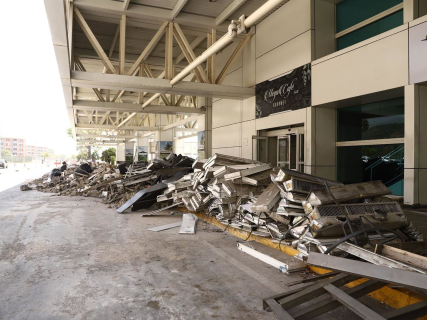

A magnitude 5.1 earthquake shook this Sunday, October 11, the region of Arequipa, in southern Peru. The movement occurred at 8:43 a.m., local time, and had its epicenter 16 kilometers southwest of the district of Quilca, in the province of Camaná, according to the National Seismological Center of the Geophysical Institute of Peru (IGP). The focus was located at 47 kilometers deep and the tremor reached an intensity of between III and IV in Quilca.
The movement was perceived as between mild and moderate by residents of the area, although the initial assessments have not reported any material damage or casualties. Authorities also ruled out that the earthquake had the capacity to generate a tsunami on the Peruvian coast, one of the first checks that are made when an earthquake occurs off the coast of a country especially exposed to this type of phenomenon.
Second earthquake in just over two hours
The tremor in Arequipa was not the only one recorded during the morning. Just over two hours earlier, at 6:36 a.m., the IGP had detected another movement of magnitude 4.5 in the region of Ica. In that case, the epicenter was located 27 kilometers southwest of San Juan de Marcona, in the province of Nasca, and only 16 kilometers deep.
The intensity recorded in San Juan de Marcona was between II and III, lower than that observed later in Arequipa. The succession of both earthquakes in such a short interval has drawn the attention of the population in the south of the country, although specialized agencies have not reported that there is currently an extraordinary relationship between both episodes beyond occurring in an area characterized by high seismic activity.
Why it shakes so much in southern Peru
Peru is located within the so-called Pacific Ring of Fire, one of the regions with the highest seismic and volcanic activity on the planet. Off its coasts, the Nazca plate is progressively subducting beneath the South American plate in a process known as subduction, accumulating tensions that are periodically released in the form of earthquakes.
This tectonic configuration explains that regions such as Ica and Arequipa frequently register seismic movements of different magnitudes. Most are moderate and do not cause damage, but Peruvian history also includes earthquakes of great destructive capacity, which is why authorities maintain permanent monitoring systems and emergency preparedness recommendations.
The memory of the Pisco earthquake of 2007
Ica was precisely one of the regions most affected by the Pisco earthquake of August 15, 2007, one of the most destructive in the recent history of the country. That movement reached a magnitude of 8.0 according to international measurements and 7.9 according to the IGP, with an epicenter off the coast and an approximate depth of 39 kilometers. The cities of Pisco, Chincha, and Ica were among the most affected areas.
The toll was around 600 dead, hundreds of thousands displaced, and tens of thousands of destroyed homes, according to data subsequently collected by Peruvian agencies. That disaster reinforced the importance of evacuation protocols and keeping the population prepared in a territory where earthquakes are a regular part of geological activity.
No tsunami alert after the Arequipa earthquake
In the case of this Sunday, the situation is very different. Despite the epicenter of the 5.1 magnitude earthquake being located off the coast, no tsunami alert has been activated and initial reports do not indicate significant damage. The Hydrography and Navigation Directorate of the Navy maintains surveillance over the Peruvian coastline and had not issued extraordinary notices related to the event.
The IGP regularly reminds that Peru is a highly seismic country and that it is not possible to predict when an earthquake will occur. Therefore, authorities recommend identifying safe zones both inside and outside homes in advance, having an emergency backpack, and only following the instructions of official agencies when a movement of greater intensity is registered.
This Sunday morning thus leaves two earthquakes in just over two hours in southern Peru, first in Ica and then in Arequipa. The strongest, with a magnitude of 5.1, could be clearly felt near Quilca, but so far it has not resulted in casualties, known damage, or tsunami risk.