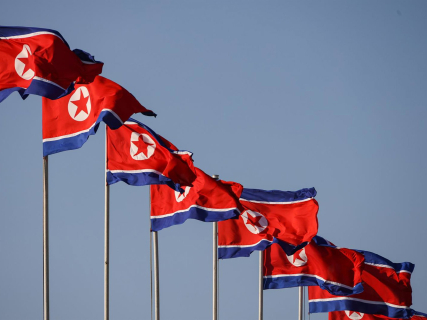

The North Korean authorities have charged this Wednesday against the joint military exercises of the United States and South Korea, despite the "substantial" reduction communicated at the beginning of the week by the U.S. president, Donald Trump, considering that they pose a direct threat to regional stability and security.
These maneuvers, dubbed 'Ulchi Freedom Shield', will last for eleven days and represent an "immediate and manifest threat" to North Korea, as they "exacerbate tensions on the peninsula and lead it towards war," they have pointed out, according to information disseminated by the state agency KCNA.
In the same vein, Pyongyang has emphasized that these exercises are oriented "increasingly" towards "improving the allies' capacity to wage real war and incorporating technologies such as artificial intelligence, the use of drones, and cyber capabilities." For this reason, the North Korean authorities have reiterated that they will exercise their right to "legitimate defense" to "completely neutralize" what they describe as "military threats."
The North Korean complaints come just a few days after Trump ordered to cut back the U.S. involvement in these maneuvers, appealing to the good rapport he claims to maintain with the North Korean leader, Kim Jong Un. From Seoul, the South Korean president, Lee Jae Myung, has also expressed his intention to promote diplomatic dialogue with Kim to reduce tension on the peninsula.
South Korea and the United States continue to organize annual maneuvers with the aim of strengthening their combined defense capability. The latest of these exercises was launched on Monday with the participation of thousands of military personnel from both countries.
Seoul has maintained operational control of its Armed Forces in peacetime since 1994. However, in the event of a large-scale armed conflict breaking out on the Korean peninsula, South Korean and U.S. forces would integrate into a joint command led by Washington, the Combined Forces Command.
This scheme is a direct legacy of the Korean War, when Seoul ceded operational command to a UN force led at that time by the United States. By the late 1970s, this control was transferred to the Joint Forces Command of South Korea and the United States.
The complete return of command over its Armed Forces is conditioned on South Korea meeting several requirements, mainly of an operational and technological nature, among them the development of advanced missile defense systems.