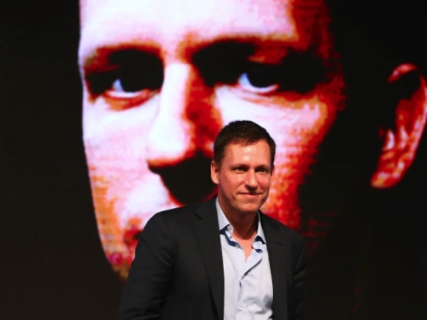

Peter Thiel has launched one of his most forceful public criticisms against the second Government of Donald Trump. The tech billionaire, co-founder of PayPal and Palantir and for years one of the figures who helped connect Silicon Valley with the Trumpist movement, believes that the U.S. Administration has taken the demand for loyalty too far when choosing some of its members. "The second Administration overcorrected the mistake of the first with all these loyalty tests," Thiel argues before summarizing his diagnosis with a particularly harsh phrase: it is made up of people "not very intelligent, but very loyal."
The statements appear in a conversation of more than an hour with Mathias Döpfner, CEO of Axel Springer, published on September 24 in the video podcast "MD MEETS" on the occasion of Thiel being awarded the Axel Springer Award 2026. The interview addresses artificial intelligence, Europe, democracy, and U.S. politics, but his comments on Trump, the midterm elections, and the Republican succession of 2028 have gained special relevance due to the role the investor has played over the last decade within the U.S. conservative ecosystem.
From supporting Trump to questioning the "loyalty tests"
Döpfner directly asks Thiel how he now values his support for Trump in 2016. The businessman avoids making a definitive assessment and responds that perhaps one should wait another ten years to judge the results, but immediately introduces a critique of the personnel selection of the two administrations. In his view, the first stage of Trump was marked by leaders opposed to each other and constant internal struggles; the second would have reacted to the problem in the opposite way, excessively prioritizing political loyalty. "You would wish they had appointed more competent people," he states.
It is worth specifying that Thiel did not specifically talk about Trump's cabinet, but about the whole Administration. The difference is relevant: his criticism is not limited to the secretaries who occupy the main federal departments, but to the model used to configure the president's political team. It also does not imply a complete break with Trump or with the Republican Party. In the same conversation, Thiel continues to defend that Trump's victory in 2016 responded to problems that, in his opinion, the American establishment had not been able to face, from economic stagnation to the consequences of globalization and interventions in the Middle East.
Thiel expects a good Democratic result in November
The businessman is now looking towards the 2026 midterm elections, which will be held in November and will renew the entire House of Representatives and part of the Senate. His personal forecast is that the Democrats will achieve a sufficiently good result to reach 2028 with the feeling that they can regain the White House regardless of who their candidate is. Thiel even raises the hypothetical scenario of a very broad Republican defeat in the midterms, although he does not claim that this result is guaranteed.
His reasoning is related, paradoxically, to a concern about the American left. Thiel argues that a good Democratic performance in November could reduce the party's internal resistance to a presidential candidacy coming from the Democratic Socialists of America (DSA). As he explains, if the Democrats come to consider that 2028 will be a favorable election regardless of the candidate, they might have less incentive to block a figure positioned further to the left. This is an analysis and a political forecast from Thiel, not an established outcome of the November elections nor a conclusion about who will win in 2028.
Thiel believes that the discontent that allowed Trump to impose himself within the Republican Party in 2016 could now reproduce itself in a different way among the Democrats. In his view, first the republicanism associated with the Bush family was exhausted, and now a similar wear could occur with the center-left establishment linked to Bill Clinton and Barack Obama. The businessman is concerned that this process will end up shifting the Democratic Party towards much more leftist positions, an evolution that he explicitly describes as negative.
The warning that directly affects JD Vance
Perhaps the politically most significant passage of the interview comes when Döpfner asks Thiel who would be the better Republican candidate in 2028: Vice President JD Vance or Secretary of State Marco Rubio. The answer avoids choosing a winner between the two. "I still support Vance," Thiel begins, but immediately adds that he fears it will be "very difficult" for either of them to win the presidency. For him, the decisive question is not who will lead the Republican candidacy, but who will end up prevailing within the Democratic Party.
The observation carries special weight due to the relationship between Thiel and Vance. Before entering politics, the current vice president worked at Mithril Capital, one of the funds backed by Thiel. The investor also encouraged Vance during the time he wrote "Hillbilly Elegy" and was one of the major financial backers of his leap into national politics. In the 2022 Ohio Senate elections, Thiel contributed 15 million dollars to a super PAC that supported his candidacy, an exceptional figure for a single Senate race.
That is why Thiel's words can be interpreted as a sign of caution regarding the Republican scenario of 2028, but not as a abandonment of Vance. The businessman himself makes sure to set that limit by reaffirming his personal support for the vice president. The idea circulating on social media that Vance's "political godfather" has decided to break with him goes beyond what he actually said in the interview: Thiel questions his chances in a future election, but continues to define himself as his supporter.
One of the men who helped build the first trumpism
Thiel does not speak from a completely external position. He was one of the highest-profile tech entrepreneurs who supported Trump when much of Silicon Valley backed Hillary Clinton in 2016. After the elections, he joined the executive committee of the presidential transition team, alongside names like Steve Bannon, Jared Kushner, Rebekah Mercer, and Steven Mnuchin. The official documentation of the transition confirms his presence in that body responsible for helping to prepare the new Administration.
His influence also extended to the search for profiles for political and technological positions. The Washington Post then reported that Thiel was gathering names of entrepreneurs and engineers who could join the new Executive, while STAT documented his involvement in evaluating candidates for scientific and health positions. His circle also ended up placing several profiles in Washington. That is why his current criticisms have an additional dimension: Thiel participated in building the first Administration that he now compares to the second.
This is not the first time Thiel distances himself from Trump
The disenchantment did not start now. In 2023, Thiel already said that he had made "many mistakes" in assessing Trump's first presidency and stated that that experience had been "more dangerous" and chaotic than he expected. He also then decided to stay out of funding the Republican presidential campaign of 2024, after having directly supported Trump in 2016.
His position, however, has never completely fit into a conventional break with Trumpism. Thiel continues to share with a large part of the American right criticisms of the political establishment, the functioning of certain institutions, and what he considers an economic and technological stagnation of the West. He also maintains a close relationship with Vance, one of the central figures of the current Government. What appears in "MD MEETS" is rather a critique from within the political space he helped to promote, especially regarding personnel selection and the electoral prospects of the Republicans.
An interview that complicates the reading of 2028
Thiel also does not offer an alternative candidacy nor announces that he will transfer his financial support to the Democratic Party. In fact, a good part of his analysis is dedicated precisely to warning about the rise of American socialist left, a possibility he considers concerning. His thesis is that the wear and tear can simultaneously affect both major parties: it first hit the Republican establishment with Trump and now could reach the Democratic establishment.
This nuance is fundamental to interpret the interview. Thiel is not announcing that he is leaving the Republican field nor that he is withdrawing his support for Vance, but he does verbalize doubts that contrast with his historical role as one of its main sponsors. He criticizes the composition of Trump’s second government, anticipates a good Democratic performance in the midterms, and considers the presidential scenario difficult for both Vance and Rubio.
With less than two months until the midterm elections, the words acquire relevance precisely because of who pronounces them: one of the businessmen who bet on Trump when his victory seemed unlikely, participated in his first presidential transition, and contributed millions to boost the political career of the current vice president. This time, his reading of the Republican scenario is considerably more cautious.