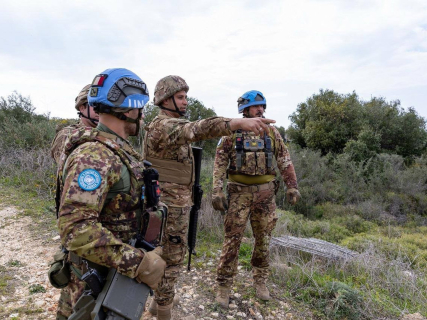

The foreign ministers of the European Union have given their approval for the creation of a new European mission in Lebanon aimed at strengthening the capabilities of its Armed Forces and internal security. The purpose is to improve border control and bolster the stability of the country, in a context marked by the anticipated withdrawal in 2027 of the United Nations Interim Force in Lebanon (UNIFIL).
The decision, adopted this Monday during the meeting of the Foreign Affairs Council (FAC) in Luxembourg, involves the formal launch of the European Union Support Mission in Lebanon (EUSML). This will have an initial mandate of three years and will include civilian and military components tasked with advising and training Lebanese security institutions.
"Europe is committed to the future of Lebanon. With this new mission, which represents a significant update of our security relations, we continue to support the country's institutions so that they fully regain their sovereignty and build lasting stability for the Lebanese people," highlighted the EU High Representative for Foreign Affairs, Kaja Kallas, after the approval of the mission.
Strengthening defense and security capabilities
In a statement, the Twenty-Seven specified that the objective of the mission will be to "strengthen the capabilities" of the Lebanese Armed Forces and the Internal Security Forces, as well as to "support" the governance of maritime security, in line with UN Security Council resolution 1701, which in 2006 ended the war between Israel and Hezbollah.
To this end, a military component is planned to provide advice and training to the Lebanese Army in areas such as surveillance and control of land borders, maritime security, intelligence, reconnaissance, combating smuggling, and operational coordination.
The civilian component will focus on "strengthening" the capabilities of the internal security forces through "specialized training" in areas such as cybercrime and combating smuggling, in addition to contributing to enhancing the security of port infrastructures, including the port of Beirut.
The MAUE Lebanon will also serve as a complement to the aid that the EU is already providing to the country through the European Peace Support Mechanism and will act in close coordination with the community institutions, the member states, the United Nations, and other international partners.
Despite the political agreement reached, the decision adopted this Monday does not yet imply the operational deployment of the mission. The Twenty-Seven must now complete the planning phase before approving a second decision that formally authorizes the start of activities on the ground.
Context: withdrawal of UNIFIL and role of the member states
The approval of this mission comes after the Lebanese authorities formally sent an invitation to Brussels to establish a European presence in the country, as confirmed by Kallas last Thursday during her visit to Beirut.
At that time, the head of European diplomacy emphasized that the new mission does not aim to replace UNIFIL, whose mandate expires in 2027, nor to limit its action exclusively to the south of the country, where the UN blue helmets are currently deployed.
It has not yet been specified which member states will participate in the mission. However, the Estonian leader already pointed out last week that the countries that have been contributing to the United Nations mission could also integrate into the future international EU force, provided there is the corresponding UN mandate and the approval of the national parliaments.