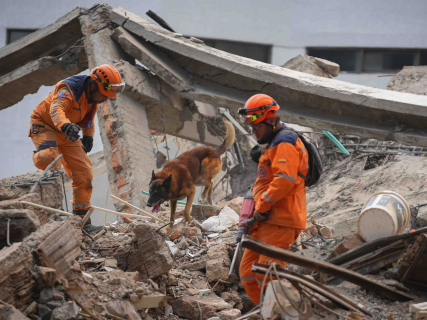

The National Unit for Disaster Risk Management (UNGRD) has communicated this Wednesday that the number of deceased persons has risen to 312 due to the 7.4 magnitude earthquake that shook the central and western area of Colombia a little over a week ago.
In its most recent report, the UNGRD has reduced the number of missing persons to 290, a significantly lower figure compared to the 426 reported the previous day. Additionally, the agency details that there are 4,611 injured and 358 people who have managed to be rescued.
More than 134,000 homes have suffered damage and another 4,600 have been completely destroyed by the earthquake, whose epicenter is located in San José del Palmar, in the department of Chocó, one of the most impoverished areas of the country, where the lack of infrastructure and the poor condition of the roads seriously complicate the delivery of humanitarian aid.
Although the most severe impact is concentrated in Chocó, the 'coffee axis' and the Valle del Cauca, whose capital, Cali, is among the most affected cities, the tremor has been felt in 470 municipalities across about fifteen departments, with more than 294,200 people affected.
The UNGRD specifies that the earthquake has caused damage to 335 health centers, more than 3,400 schools, and 4,000 community facilities, as well as in 430 sections of road, nearly a hundred aqueduct systems, 50 bridges, and five airports, among other key infrastructures.
On the other hand, the Colombian president, Abelardo de la Espriella, has disseminated on his social networks some of the measures adopted by the banking sector to alleviate the burden on affected households and businesses, including periods of interest waivers and payment suspensions of up to twelve months.
According to the president himself, these actions represent a volume close to 306 million euros, which are added to the contributions made by other private entities and are aimed at supporting those affected in Caldas, Chocó, Quindío, Risaralda, and Valle del Cauca.