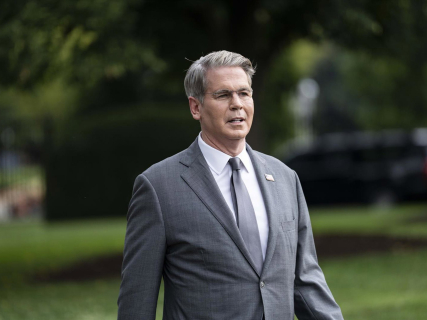

The Secretary of the Treasury of the United States, Scott Bessent, has called on all allied countries to take a position —"either you are with us or you are against us"— in the economic war against Iran announced the day before by the occupant of the White House, about which he has advanced that he will offer more details next Monday in a press conference.
"Either you are with us or you are against us," Bessent has reiterated in an excerpt from an interview granted to the American network CNBC, in which he has launched a series of warnings to Washington's partners without specifying which states are included in that category or pointing to any in particular.
In the same vein, the Treasury official has again addressed the allies: "You want this murderous regime to end. And if you insist on doing business with them, whether by transferring money, buying their oil, or first carrying out maritime transport, then the Treasury of the United States and the Government of the United States will use all their power and strength to force you," he has emphasized.
Immediately afterward, he has expanded this message to the entire international community, regardless of their closeness to Washington: "It is time for our allies and the rest of the world to make a decision," he has stressed.
When asked whether this warning includes China, the main economic rival of the United States, Bessent has toned down his response and introduced his answer by recalling that "many conversations are better had in private."
Even so, he has expressed his confidence that "everyone wants the Strait (of Hormuz) to reopen and energy prices to go down." "The Chinese get 50% of their energy from within, from the Gulf; so they would do themselves a great favor by joining the cause," he has argued.
HE PROMISES THAT THE COMBINATION OF BLOCKADE AND SANCTIONS "WILL WORK"
In parallel, Bessent has confirmed that next Monday he will hold a press conference to detail the economic war outlined by Trump, although he has already sketched part of the White House plan.
"We are going to crush the economy of this murderous regime, which will limit its ability to project power through its representatives," he has assured, before adding that "they will not be able to pay the military."
He also referred to "substantial inflation, both food inflation and general inflation, in Iran," and rejected the pessimistic forecasts of some analysts regarding the effectiveness of this strategy. Despite this, Bessent has defended that this approach "does work." "We have a combination. It's a double whammy. We have the blockade and we are going to impose the most severe sanctions in history," he has revealed, insisting that "this will work."
In fact, he has equated this strategy to the campaigns previously driven by the Trump Administration: "It worked in Venezuela when we imposed the blockade. It's working in Cuba right now. And it will work in Iran, and we are going to overthrow this regime," he has stated.
BESSENT DISMISSES LARGE-SCALE HOSTILITIES
This approach, as acknowledged by the Treasury Secretary himself, would imply ruling out an open large-scale war: "If we are exerting maximum economic pressure, then that means there probably won't be a large-scale kinetic restart," he has considered, although he has clarified that "this depends on the president's judgment" Trump.
Bessent made these statements after admitting "not being sure why oil has surged" in the stock market after the announcement of this economic war.
"I think the oil markets are misinterpreting the meaning of this economic pressure," he has indicated, defending that the United States has "control of the Strait" of Hormuz and that its forces can "continue extracting large amounts of energy" (hydrocarbons) from the area using "the southern lane."
Iranian authorities have repeatedly denied that there is a truly safe route to cross the Strait of Hormuz through that southern lane, located off the coast of Oman, an area where repeated incidents have occurred with cargo, merchant, and oil tankers, either due to mine explosions or projectile impacts.
However, the news portal Axios reported the day before that the United States Armed Forces have established a southern corridor through which between 15 and 20 oil tankers enter and exit the strait every night, transporting around 10 million barrels daily — about half the volume prior to the conflict — according to two U.S. officials.
"We have been controlling the southern lane of the Strait of Hormuz for two months now. The Islamic Revolutionary Guard can be a nuisance, but it does not control the strait. We do," declared one of these officials, who, according to the American media, is directly aware of the operation.