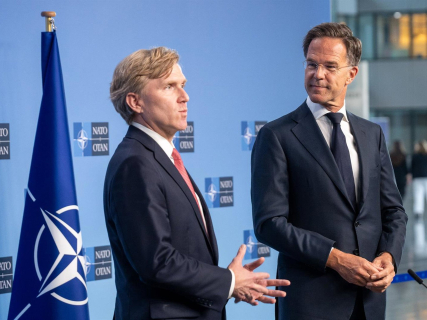

The Undersecretary of Defense of the United States for Political Affairs, Elbridge Colby, described this Thursday as "extraordinary" the progress of European partners to compensate for Washington's military readjustment on the continent, noting that "they are already assuming" the responsibility for their own conventional defense.
"Europe, which is obviously a very rich continent, can assume and is already assuming the main responsibility for its own conventional defense," said the Pentagon's 'number two' in statements to the press alongside NATO Secretary General Mark Rutte, after meeting with representatives of the 32 member states of the Alliance.
Colby insisted that "thanks" to U.S. President Donald Trump and the head of the Alliance, Europe has so far achieved "extraordinary progress" in taking charge of its protection following the U.S. military readjustment in Europe, a process he has redefined as "NATO 3.0."
During the day, the senior U.S. official participated in a meeting of the North Atlantic Council, which he attended, in his own words, with a "spirit of consultation and commitment" to his allies, listening to how they have increased total defense spending and how they are covering the gaps left by the military capability review of the Trump Administration.
In this context, he particularly highlighted the "extraordinary investments" of governments such as Poland, Germany, or the Netherlands, and expressed his expectation that "other" allies will join this effort in the coming months.
The Undersecretary of Defense also emphasized that Europe remains "a continent" with a "critical interest" for the United States, despite Washington also focusing part of its attention on the Western Hemisphere and other strategic areas such as the Indo-Pacific.
For his part, Rutte quantified that effort, indicating that by 2025 European allies and Canada will have allocated an additional $139 billion (about €120 billion) to defense compared to previous years, an increase that, he noted, "continues to go on" although "there is still much more to do."
The Secretary General also pointed out that "the same" trend of greater commitment is observed both in the development of new military capabilities and in the increasing presence of Europeans in leadership positions within NATO's command structure.