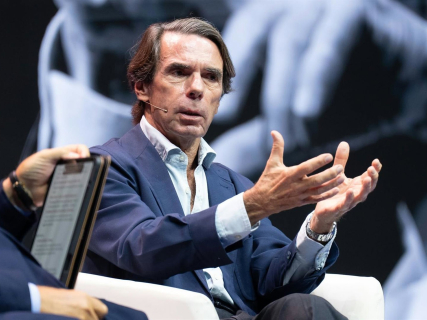

The former president of the Government and of the PP and today the highest responsible of the FAES Foundation, José María Aznar, has reiterated this Friday in Malta that a reform of the Constitution in Spain is "totally inevitable" if the continuity of the current Executive is prolonged. Without directly referring to President Pedro Sánchez or the Socialist Party, Aznar has also emphasized the relevance of the upcoming general elections on November 29, which he has referred to as the "most important elections since the beginning of the transition."
The former head of the Executive made these statements during the annual summit of the World Travel and Tourism Council (WTTC, for its initials in English), which is holding its 26th edition at the Mediterranean Conference Centre in Valletta, in front of around a thousand attendees, including more than a hundred high-ranking business and government officials from different countries. Aznar responded to a question posed by the president of the international organization, Manfredi Lefebvre d'Ovidio.
He admitted that, although he prefers not to address internal political issues when he is outside of Spain, on this occasion he would make an exception. He also indicated that he does not usually change his positions easily and has analyzed the current political situation of the country. In this context, he has stated that "over the last eight years, under this Government, a radical coalition of socialists, communists, separatists, and former terrorists has been created that does not believe in the constitutional system or in parliamentary monarchy; nor in the unity of the country."
"The populists want to establish a confederation of different republics," the former leader added, linking to the message he had already presented days earlier in Seville in the cycle "1936: the war we all lost," organized by the Cajasol Foundation. Likewise, he defended that, in his opinion, if Madrid has become a symbol of freedom it is due to the management of the regional Government, which would explain, as he pointed out, the supposed fixation of the central Executive with this region.
When addressing the international scenario, marked by increasing polarization, political fragmentation, and tensions linked to tariff measures, Aznar has focused on the relevance of direct contact between people versus the predominance of the digital realm. "Social networks can be a good complement, but they do not replace personal relationships," he indicated during the conversation, aimed at analyzing leadership in a context of accelerated changes.
Resilience of tourism in Europe
Among the institutional representatives present at the meeting, the European Commissioner for Sustainable Transport and Tourism, Apostolos Tzitzikostas, stood out, who described tourism as a strategic pillar for the European Union, both for its contribution to the economy and for its role in territorial cohesion. He specified that, in Greece, this industry accounts for around 25% of the Gross Domestic Product (GDP), while, in the EU as a whole, it generates around 20 million jobs and encompasses about five million companies directly or indirectly linked to tourism activity.
Tzitzikostas also emphasized that tourism represents 18% of service exports in several member states and that it contributes to energizing other areas such as transport, construction, or retail, boosting the development of rural and coastal areas.
Regarding the challenges facing the sector, the commissioner cited the lack of qualified profiles, the shortage of labor, the impact of climate change, and the uncertainty arising from geopolitical conflicts that affect travelers' confidence. Despite this, he stressed the industry's recovery capacity, recalling that last year was the best in history for international tourism, representing 10% of the global economy. He also announced that next week the first European Tourism Strategy will be presented.
Trudeau calls for more open borders and better dialogue between governments
The second day of the summit has been inaugurated with the intervention of former Canadian Prime Minister Justin Trudeau, who has questioned the current border restrictions imposed by the United States. According to what he has stated, these limitations have led many Canadian citizens to opt for other destinations, which would have caused a drop of up to 20% in the demand for flights operated by American airlines.
Trudeau has pointed out that numerous travelers feel uneasy when crossing the border for the first time, despite the fact that trade relations between both countries have remained strong in recent years. As a counterbalance, he has recalled the abolition of visas for Mexican citizens during his term and the relevance of this decision, an aspect that the CEO of the WTTC, the Mexican Gloria Guevara, who is in charge of conducting the colloquium, has also highlighted.
The former leader has noted that the success of the recent World Cup organized jointly by the United States, Canada, and Mexico shows that, to attract investments and income, a government must be receptive and open to the outside. He has also insisted on the importance of maintaining direct dealings between leaders. "Trade ties are very good, but personal ones matter more," he has emphasized.
In this line, he has valued meetings like the WTTC summit for facilitating informal contacts between public and private representatives. "I don't care if they are two world leaders or two competing companies," he has indicated, defending this type of dialogue space.
A good part of his intervention has revolved around this idea, highlighting that maintaining frequent conversations with other heads of state or government to address various issues or expedite administrative procedures is positive both professionally and personally. At the request of the moderator, Trudeau has recommended traveling to Montreal and has praised the hospitality of the Canadian population, beyond the image associated with the lakes, mountains, and snow characteristic of his country.
Role of Turespaña and responsible management of destinations
The Spanish delegation has been represented by the general director of Turespaña, Miguel Sanz. In his intervention, Sanz has emphasized that Spain does not intend to limit the arrival of tourists, but to demand from the competent administrations a more efficient management of the activity so that it benefits the receiving cities.
He detailed that the different profiles of tourist demand generate differentiated impacts on the destinations and has advocated for supporting private sector investments with the aim of evolving towards a more sustainable Spanish model in the economic, social, and environmental spheres.
In this sense, he has defended those actions that add value to the social and economic projects of local communities. "More than moving from a company-centered approach to a visitor-centered one, we are now facing a multipolar environment, a true ecosystem," he stated.
The participation of Turespaña has occurred in the panel of experts "Responsible management of destinations: the right type of growth," in which Aqeel Al-Shibani (Saudi Tourism Authority), Caroline Beteta (Visit California), and Carlo Micallef (Malta Tourism Authority), among other international speakers, have also participated.