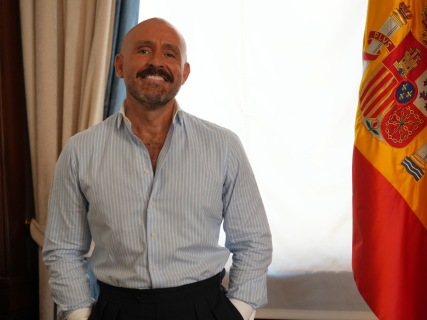
Jaime de los Santos (PP): "There is no bill more important than calling elections"

The deputy secretary of Education and Equality of the PP assures that his party "will never speak of intrafamily violence when what is being discussed is the violence exerted against women for the simple fact of being so" and insists that "not a single step will be taken back regarding the rights of the LGTBI collective".

ILUSTRACIONES TEMAS (95)

ILUSTRACIONES TEMAS (95)

Add DEMÓCRATA to Google

Ask FREN

Published

Last updated

8 minutes

Most read

Elecciones 29N · Encuestas

La media de las encuestas

Media a 21 de octubre de 2026 · 15 institutos

  • PP31,6 %
  • PSOE26,9 %
  • Vox18,7 %
  • Sumar6,3 %
  • Podemos3,1 %
  • ERC2,2 %
010203040ene 2024jul 2024ene 2025jul 2025ene 2026jul 2026

Media del último estudio de cada instituto en 30 días y su evolución semanal desde el 23J. Partidos con al menos un 2 %.

Todas las encuestas

Elecciones generales del 29 de noviembre · Demócrata

The Lázaro Dou room of Congress hosts all kinds of activities. It is the first point of contact for their Lordships when they land in Carrera de San Jerónimo after the elections, as it is where credentials are handed out, asset declarations are completed, and they acquire their full status as deputies. It is also common for committee meetings that do not attract the spotlight to take place there, or for it to host work meetings that go unnoticed as they are located in a little-trafficked corridor.

But on special occasions, its doors open with lights and reporters. As for this interview with Jaime de los Santos, deputy and deputy secretary of Education and Equality of the PP. The popular leader reviews the recently concluded legislative period in DEMÓCRATA and sets out his party's priorities on the road to the polls.

Question - Current events dictate, and last week you gave an interview in El País that caused a lot of stir. You showed yourself to be in favor of reforming the 'Trans Law' and requesting a "psychosocial report". Do you stand by your words?

Answer - Yes, because it is what the PP has been saying since the misnamed 'Trans Law' was passed, and it is even in our electoral program for July 23rd. I was one of the rapporteurs in the Senate and even then I spoke of the fraud of law that gender self-determination represents. It is a fiction that, among many other things, seeks to destroy the feminist construct, all those norms, laws... approved in the last 50 years to erase the endemic inequality that women suffered.

I would repeal it immediately to approve a new one that protects transgender people, but in no case at the expense of women's rights.

Q - We are in Congress and you are the rapporteur for the Copyright Law. What is the point of blockage at this moment?

A - This Government carries out actions based on headlines and on trying, in quotes, to set the streets on fire and to permanently find ways to corner the main opposition party. With any topic, with this Copyright Law or with the Law Against Conversion Therapies.

And if the laws do not see the light of day, it is because the Executive is not interested in governing, but in using its positions for many things, even to commit crimes, and to promote extremist debates that divide society.

Q - I insist on the Copyright Law, has the Government asked for your support?

R - You already know that with this Government any communication is practically a utopia, because anything that involves amending a law to improve it is an unacceptable shock to them. Why? Because they don't want to reach an agreement, because they don't want to legislate. They don't even count on that bloc of parties that made the legislature possible anymore.

They don't want to reach an agreement with the PP, because they are not interested in legislating in favor of citizens, and with their old partners at odds, they do nothing but look for ways to destroy the opposition and to put the entire democracy in check.

P - We are now entering the final stretch of the legislature. If it depended on your parliamentary group, in these remaining months, what initiatives would you like to accelerate?

R - The truth is that the Government doesn't want to govern; look, we've gone more than three years without new budgets. Therefore, the only thing my group would unblock right now is a call for elections to give Spaniards a voice and to form a new parliamentary makeup from which a new Executive will emerge that will erase all the abuses of the one we unfortunately continue to suffer.

At this moment, there is no bill from the government of Pedro Sánchez that is more important or more imminent than the immediate call for elections.

P - Bearing in mind, as you know, that the calling and dissolution of the Courts is an exclusive competence of the President, what would be the main areas you would like to work on in these remaining months?

R- The PP has always been open to listening to the proposals of those who truly seek to improve the lives of citizens, and since Sánchez arrived at Moncloa, that has taken a backseat. But if there is anyone in the Government of Spain who has an iota of responsibility left, they should seek us out to talk about what truly matters.

If there is anyone in the Government of Spain who has an iota of responsibility left, they should seek us out to talk about what truly matters

I have asked the Minister of Equality in every possible way to transpose the European Directive on trafficking. And the other day, from Los Gallardos (Almería), Feijóo spoke of a State Pact to curb something as tragic as fires. There have been many occasions when the PP has wanted to row along.

P - You mention the Trafficking Law or the State Pact, is there any other matter you would like to unblock in the coming months?

R - They have been demonstrating to us throughout this legislature that they do not want to reach any agreement and that each of the bills that are approved with an absolute majority in the Upper House, as soon as they arrive here, are simply put in a drawer, frozen or a 19th-century desk, to deny citizens their right to decide on their future.

P- And of those initiatives that have been blocked, which ones would you prioritize if it were up to you?

R - I insist, no matter how much you ask me and ask me again, I will not enter the utopia of a Spain that Sánchez has destroyed, which is that of rigorous, serious debate and the use of the Cortes Generales for what they were truly designed for, to approve laws in favor of citizens.
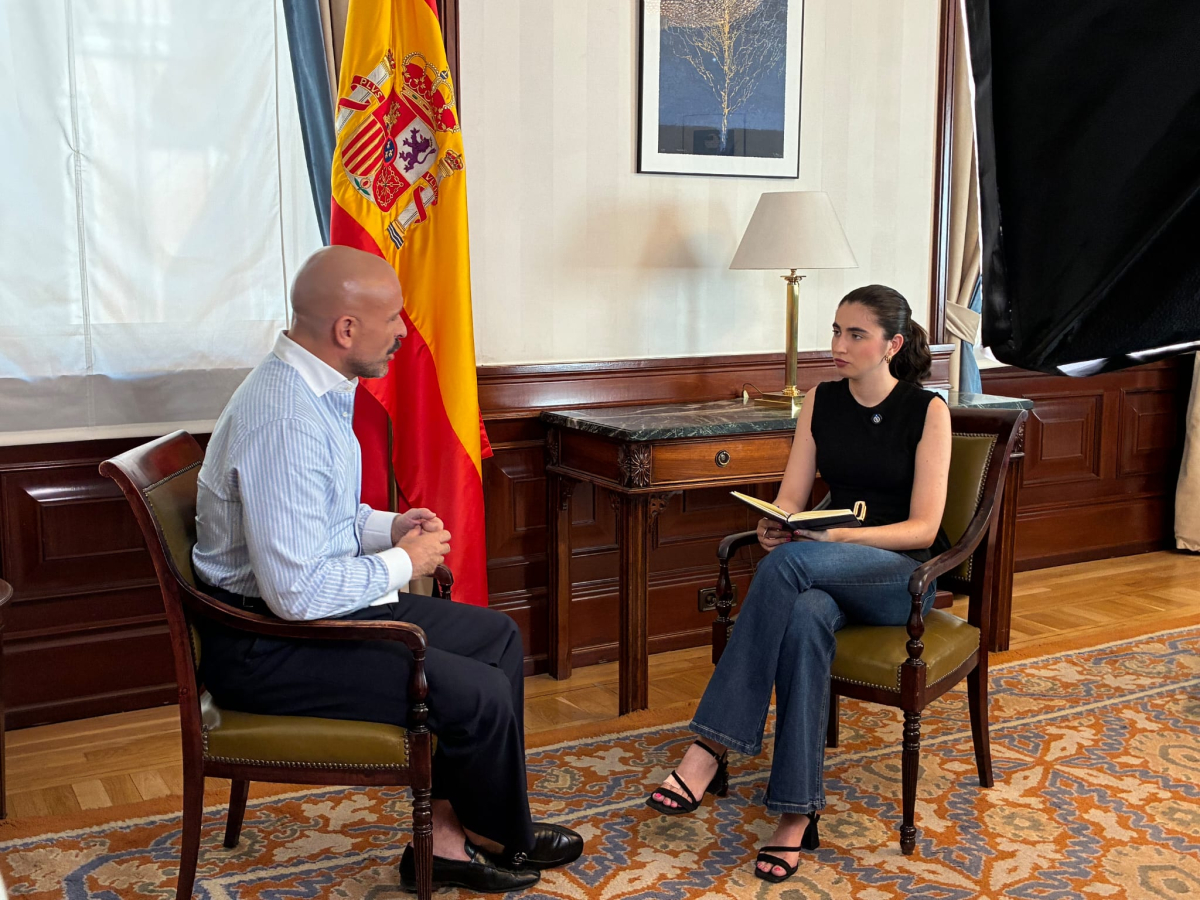
Jaime de los Santos during the interview | DEMÓCRATA
Jaime de los Santos during the interview | DEMÓCRATA -

P- The legislative period has just concluded, what is your assessment of your opposition work at the legislative and parliamentary level?

R - The opposition under our new spokesperson, Ester Muñoz, has been absolutely extraordinary, and she had the difficult task of succeeding such an immense politician as Miguel Tellado. Different styles, but the same forcefulness. And beyond the oversight of this government completely riddled with corruption, it has been proactive in all cases and with responsibility.

P - Is there any initiative you are particularly proud of?

R - The permanent denunciation of the failures in anti-abuse bracelets. It is unacceptable that in this country, 5,000 women victims of gender-based violence, who believed they were protected by the system, for whom a judge had imposed a protection measure like the bracelet, knew that they were not working. All due to an absolutely irresponsible tender designed by Irene Montero, and which Ana Redondo assumes as her own.

I also believe that an extraordinary job has been done in highlighting the negative consequences for the fight against gender-based violence of Félix Bolaños' new courts, where all crimes against women were mixed.

And we have stood firm against the government's constant attacks on what is represented by state-subsidized and private education, which, apart from going against initiative, is protected by European directives.

P - Juanma Moreno has been invested president of the Junta de Andalucía after an agreement with Vox, do you think it is possible to govern with this party without accepting part of its cultural and identity agenda?

R - I will only tell you to go through all the autonomous governments in which Vox already participated and which did not move an inch from the policies that are part of the PP's DNA.

But I'll tell you more, I will not tire of thanking Vox for making it possible with their vote in the first term of President Juanma Moreno to remove a PSOE from the Government of Andalusia that had convictions for corruption.

Furthermore, as a convinced democrat, I am not going to question the almost 3 million Spaniards who, according to polls, seem to lean towards Vox. Faced with this reality, I have two jobs: to see how I can improve as a representative so that when they have to choose a ballot, they choose mine, and to try with my policies to be the option that ensures prosperity.

P- Part of the criticism your party is receiving alludes to the fact that you have bought into Vox's discourse. What do you think about the talk of intrafamilial violence?

R - I think that whoever tries to pin that reality on the PP is lying. Machista violence is that which is exercised against women for the simple fact of being women, and intrafamilial violence is another matter, and there is a ruling from the Constitutional Court that also perfectly delimits one reality from the other.

The PP will never speak of intrafamilial violence when what is being discussed is the violence exercised against women for the simple fact of being women.

P - As Deputy Secretary of Equality of the PP, do you feel comfortable making agreements with a party like Vox, which has repeatedly denied homosexual marriage?

R- As Deputy Secretary of the PP, I feel extremely comfortable working alongside a man like Alberto Núñez Feijóo, who in 2006 ran against the law of equal marriage being brought before the Constitutional Court. I can assure you that not a single step back will be taken regarding the rights of the LGTBI collective, and there is the absolute majority of 2011, which in no case questioned the achievement that was equal marriage.

And if you ask Jaime de los Santos, I will say that he has always voted for the PP because it has compensated me. Because being gay is not only having relationships with another man, but taking the subway, taking the bus, paying taxes... It is simply one of my characteristics, but it is not 100% of my reality.

P - And what battles are you fighting from your deputy secretariat at a cultural and ideological level?

R - Well, all the bad consequences of the misnamed 'Trans Law' or the common PAU. It makes no sense that in a country like ours, where any young person can opt for a university in a territory other than their own, they still have to face an exam that is different depending on where they were born or where they are residing.

At the educational level, we also believe that we must recover that hour of reading that, until not so long ago, was mandatory, and that kept us in permanent connection with our language. It made us people who not only knew how to speak, but also write. On the other hand, we want to ensure that the new generations, who will live surrounded by technology, know how to handle it outstandingly but never going against traditional education.

P - 2027 is an election year. With the polls in hand, they will need Vox, but perhaps it won't be enough. Do they have the capacity to negotiate, on the one hand with Santiago Abascal's party, and in parallel with PNV or Junts, whose votes could end up being essential?

R- No, no, no, what the polls say today is that in that large bloc formed by PP and Vox, we would be close to 200 seats, therefore we would be 25 above what is needed for an absolute majority. Any party that aspires to reach the Government would want to do so with a sufficiently broad result to govern alone, and that is what the PP wants.

We live in a country where, until Sánchez arrived, agreements were not only necessary but essential because without them we would not have done that wonderful work that was the Transition. If Feijóo has demonstrated anything outstandingly, it is knowing how to extend a hand. Not only will he be an extraordinary president of the Government, but in those agreements he may be forced to reach, the only thing he will put forward is good politics.

In detail:

Current events do not rest and 30 seconds before starting the recording of this interview, the news breaks: the Badajoz Court imposes nine years of disqualification on Pedro Sánchez's brother for prevarication.

It is the press chief of the popular deputy who informs us, and is shocked, with the latest news. Jaime de los Santos, who already has an extensive political career and is seasoned in television talk shows, does not need much more for an initial reaction: "They said there was no crime... another lie from sanchismo. We already have another sentence that accounts for the way Pedro Sánchez and his people understand politics."

More key points, information and questions with FREN

AI-GENERATED CONTENT

What is the current parliamentary status of the reform of the 'Trans Law' in Spain?

As of July 2026, there is no reform of Law 4/2023 (“Trans Law”) currently under parliamentary processing as a law or organic law. The Government has not sent any bill to the Cortes to modify it, and in the XV Legislature there is no registered bill for reform or repeal that has reached the committee, report, or Plenary phase in either the Congress or the Senate. What do exist are non-legislative motions and resolutions from PP and Vox requesting changes or repeal, and, in parallel, initiatives to develop the law, such as the recent Interior protocol for foreign trans persons.

1. Regulatory status of Law 4/2023

Law 4/2023, of February 28, for the real and effective equality of trans people and to guarantee the rights of LGBTI persons, is fully in force with no reforms published in the Official State Gazette (BOE). The consolidated text can be consulted in the BOE itself and in the Congress dossier (Congress documentation), where no subsequent amending law appears.

According to the summary of executive initiatives, there is no record of any Council of Ministers agreement approving a draft or bill to reform Law 4/2023, nor is it included as such in the 2026 Annual Regulatory Plan or its full version (full PAN text).

2. Parliamentary initiatives related to the XV Legislature

In the General Courts there are initiatives politically linked to the Trans Law, but they are not reforms of the law itself:

  • Non-legislative motions from Vox in the Congress urging the repeal of Law 4/2023 (for example, the repeal PNL debated in the Equality Commission and cited in the parliamentary agenda collected by Demócrata). In the Senate, there is also a motion from the Mixed Group along those lines, but as a motion, not as a law.
  • Non-legislative motions from the PP to “suppress” or limit gender self-determination in the law, for example the PNL announced to suppress two articles of the Trans Law, explained by Demócrata, and another PNL in Congress to limit self-determination and ban burka and niqab (news and its extension [link]). These are political resolutions without direct normative effect.
  • The PP has also announced a bill to amend the Trans Law and the Sports Law regarding female competitions, according to its own note (PP statement), but in the consulted initiative registers there is no bill to amend Law 4/2023 that has started effective processing.

In parallel, there are PNLs of the opposite sign requesting to deploy or strengthen rights, such as Sumar’s on documentation for trans migrant persons, reported by Demócrata.

3. Government action: development, not reform

The Executive’s activity has so far been oriented towards development and implementation of the law, not its revision. A very recent example is the police protocol approved by Interior to allow the change of sex and name on documents issued to foreign persons, precisely applying article 50 of Law 4/2023. The Ministry of Interior details it in its official note (Interior note), and Demócrata covers it politically in this information.

State LGBTI and trans strategies have also been promoted from the competent Ministry, in development of the law itself, as summarized in fact sheets like that of Global Pact.

4. Political debate and absence of a “reform table”

The political climate is very polarized. The president of the PP, Alberto Núñez Feijóo, has reiterated that he would repeal the Trans Law if he comes to government, as reported by Demócrata and other media (Consalud). Vox openly demands its repeal and recurrently uses it in parliamentary debate (repeal PNL).

However, as of July 17, 2026, there is no formal negotiation of reform of Law 4/2023 between the Government and parliamentary majority that has resulted in a draft, bill, or proposal under processing. What exists is:

  • An intense political and media debate fueled by PNLs, parliamentary questions, and party statements (PP, Vox, Sumar, PNV, etc.).
  • Conflicts at the regional level (such as reforms of LGBTI laws in Madrid or the Valencian Community, analyzed by Demócrata and partly subject to Constitutional Court review), which affect the territorial application of the Trans Law principles but do not modify the state law.

In summary, the “reform of the Trans Law” today is a political and programmatic debate, not a legislative reform in progress: there is no amendment text in parliamentary phase and the law continues to be applied in its original 2023 version.

What specific changes do the non-legislative motions from PP and Vox propose regarding the Trans Law in this legislature? How is the Trans Law affecting regional legislations and what resources exist before the Constitutional Court? What official data exists on requests for registry changes of sex since the entry into force of Law 4/2023?

What are the powers and functions of the president of the Government regarding the convocation and dissolution of the Cortes according to the Spanish Constitution?

The Spanish Constitution regulates with considerable detail the convocation and dissolution of the Cortes Generales, and within that framework defines the role of the president of the Government. However, the available information does not include the specific articles nor the literal text of the applicable norms, so it is not possible to provide an article-by-article exposition with full precision. It can be explained, in general terms, how the figure of the president fits within these powers in a parliamentary system like Spain’s, and what types of limits usually exist on dissolution and early elections.

1. General role of the president of the Government in relation to the Cortes

In a parliamentary regime like Spain’s, the president of the Government is the central figure of the executive power and maintains a political confidence relationship with the Congress of Deputies. This relationship translates into the president, in practice, driving:

  • The convocation of general elections, proposing the dissolution of the Cortes and the election date.
  • The coordination of the political and legislative calendar, which conditions parliamentary sessions and the use of the legislature.
  • Dialogue with parliamentary groups, especially with the Congress, which is the chamber that grants and withdraws confidence to the Government.

The Constitution usually formally attributes to the head of State (the King) the competence to dissolve the Chambers and call elections, but does so at the proposal or with the countersignature of the president of the Government. This is where the president’s material competence lies: without his political initiative, dissolution and electoral convocation normally do not occur.

2. Functions in the convocation and dissolution of the Cortes

Although the detailed normative text is not available here article by article, in systems like Spain’s the president of the Government’s role can be summarized in three main functions:

  • Initiative of early dissolution: the president decides, for political reasons (loss of support, parliamentary deadlock, electoral strategy, etc.), to propose the dissolution of the Congress, the Senate, or both Chambers and thus early elections.
  • Determination of the proposed election date: this proposal includes an indicative date within the temporal margins set by the Constitution and the organic electoral law, so that minimum and maximum periods between dissolution and election day are respected.
  • Ordinary convocation of elections at the end of the legislature: when the legislature term expires without early dissolution, it is also the president’s responsibility to activate the political procedure for calling general elections.

From a formal point of view, these presidential decisions are usually concretized in a proposal submitted to the King and in the countersigning of the acts of the Head of State related to dissolution and convocation. The decision is materialized in a decree of dissolution and election call published in the official gazette.

3. Limits on the president’s powers

The power to propose dissolution of the Cortes and early elections is not absolute. The Constitution and laws usually incorporate various formal, temporal, and material limits, among which the following stand out generally:

  • Temporal limits: minimum periods are established between one dissolution and the next, and maximum durations of the Chambers. Also, deadlines are set between dissolution and the effective election date.
  • Situations in which dissolution is not possible: for example, in many parliamentary systems dissolution cannot be agreed while a specific intense political control procedure is underway (such as a motion of no confidence in process) or in certain exceptional states.
  • Automatic dissolutions or due to investiture failure: besides the “discretionary” dissolution at the president’s initiative, there is usually a “mandatory” dissolution if a president cannot be invested within a certain period. In those cases, dissolution no longer depends on the president’s political will but on constitutional logic itself.

In addition to these formal and temporal limits, there is political control: abusive or strategically questionable use of the dissolution power can have electoral or legitimacy costs, and the Congress itself can, in extreme situations, withdraw confidence from the president through a motion of no confidence.

4. Absence of normative detail in the available information

The consulted information does not include the literal text nor the numbering of the Spanish Constitution articles regulating these matters. Therefore, it is not possible to identify with certainty which specific provisions establish:

  • Who formally calls general elections and on whose proposal.
  • In which cases early dissolution of the Congress, Senate, or both Chambers is possible.
  • What exactly are the deadlines and temporal prohibitions framing these decisions.

For a strictly legal study, with exact reference to articles and current wording, it is essential to consult directly the text of the Spanish Constitution and electoral legislation, consulting their official version published in the Official State Gazette.

Which specific articles of the Constitution regulate the dissolution of the Cortes and the convocation of general elections? What specific temporal limits exist in Spain for the president of the Government to propose an early dissolution of the Cortes? How is the automatic dissolution of the Cortes articulated in case of a deadlock in the investiture of the president of the Government?

What political trajectory and previous positions has Jaime de los Santos held before becoming a deputy and vice secretary of the PP?

Jaime de los Santos became a deputy and vice secretary of the PP after a previous trajectory focused on communication, the Cabinet of the Presidency of the Government, and the regional government of the Community of Madrid. Before entering the Assembly of Madrid in 2019 and joining the national leadership of the PP, he was an advisor in Moncloa with Mariano Rajoy and successively held senior management positions in the culture area of the Madrid government: director general, deputy minister, and finally minister of Culture, Tourism, and Sports. Only from 2022 did he begin to assume top-level organizational responsibilities in the Popular Party. His political career, therefore, was first built from technical and institutional trust positions, and later from parliamentary representation and party leadership.

Previous stage: communication and private sector

With a degree in Art History, De los Santos initially developed his career in communication and creativity. Various sources indicate that he worked as press chief and creative director in the private sector for several years, an experience that gave him a profile closely linked to managing public image and messages before making the leap to institutional politics. This stage did not translate into formal political positions but did provide professional background that later proved key for his projection in Moncloa and the Community of Madrid.

Entry into the Presidency of the Government (Moncloa)

His entry into the State administration occurred in 2012, when he joined the Cabinet of the Presidency of the Government under Mariano Rajoy. According to the biography summarized in the Demócrata profile and the Popular Party’s file, he held the position of technical advisor or advisory member in the Presidency of the Government.

Various biographical reports collected by national media and the PP itself describe that, in that stage, he performed advisory tasks in the Moncloa core, working very close to the president’s personal environment. This phase (approximately 2012–2015) shaped his first relevant political responsibility, although technical and trust-based, not elected.

Positions in the Government of the Community of Madrid

His jump to the Madrid regional government marked a change in scale in his public exposure. From 2015 he joined the Government of the Community of Madrid, first with Cristina Cifuentes and later with Ángel Garrido, in the culture and tourism area. The information consolidated by the Popular Party and the newspaper Demócrata allows tracing the following sequence:

  • Director General of Cultural Promotion (2015–2016 approx.): responsible for cultural promotion policy in the Community of Madrid, promoting activities, circuits, and institutional support for creators and cultural entities.
  • Deputy Minister of Culture and Tourism / Director of the Office of Culture and Tourism (2016–2017): moved to a higher political rank within the ministry, coordinating both cultural and tourism aspects. This step placed him on the front line of the regional political structure.
  • Minister of Culture, Tourism, and Sports (2017–2019): culminated this trajectory with his appointment as regional minister, a prominent responsibility that gave him public visibility and political weight. The newspaper Demócrata summarizes that “between 2017 and 2019 he was Minister of Culture, Tourism, and Sports of the Community of Madrid,” before moving to the Senate and then to the Congress, according to the piece on the new PP leadership (new PP leadership).

This regional stage is fundamental: without having yet passed through the polls, De los Santos managed significant budgets and designed policies in three strategic areas (culture, tourism, and sports), consolidating his profile as a manager and his internal network within the Madrid PP.

First organizational steps in the PP before the vice secretariat

Until his arrival at the national leadership, no significant organizational positions in the Popular Party (neither in Madrid PP nor nationally) are recorded in the consulted sources. His weight within the party was built mainly from his role in PP governments and not so much from classic organic militancy (executive committees, territorial leaderships, etc.).

The turning point occurred in 2022, already with Alberto Núñez Feijóo at the head of Génova. The PP file (PP structure) and several chronicles collected in the Demócrata profile indicate that that year he was appointed executive secretary (or national) of Culture of the PP. It was the first major organizational position he assumed, responsible for coordinating the party’s position on cultural matters and articulating the relationship with the sector.

In Demócrata’s information about the renewal of the popular leadership, it is recalled that since May 2022 he held the Executive Secretariat of Culture and it is highlighted that this step was the immediate precedent to his appointment as vice secretary of Education and Equality: “also, since May 2022 he held the Executive Secretariat of Culture of the PP” (new PP leadership).

Before becoming a regional deputy and vice secretary: summary

In summary, before becoming a deputy in the Assembly of Madrid (2019 elections) and before being elevated to the national vice secretariat of the PP, Jaime de los Santos’s trajectory consists of three blocks:

  • A professional stage in communication and creativity, without political positions but with experience in managing public image.
  • His passage through the Cabinet of the Presidency of the Government with Mariano Rajoy as technical advisor, which introduced him to the high State administration.
  • A rapid rise in the Government of the Community of Madrid: director general of Cultural Promotion, deputy minister, and finally minister of Culture, Tourism, and Sports.

Only from 2019 did he become an elected representative (regional deputy and then senator and national deputy) and, from 2022, he began to accumulate organizational power within the PP until his appointment as vice secretary of Education and Equality, as both the Popular Party and the newspaper Demócrata record in their biographical profiles.

At what exact moment did he stop being Minister of Culture in Madrid and become a deputy of the Assembly? What role did Jaime de los Santos play in the regional Senate before reaching Congress? How does his profile and trajectory compare with other current vice secretaries of the PP?

Play

Test your knowledge with FREN!

How much do you know about this topic? Answer the following 3 questions.

What position does Jaime de los Santos take regarding the 'Trans Law'?

Question 1 of 3

According to Jaime de los Santos, what is the most important priority at this moment for his parliamentary group?

Question 2 of 3

What does the PP denounce regarding the anti-abuse bracelet system according to Jaime de los Santos?

Question 3 of 3