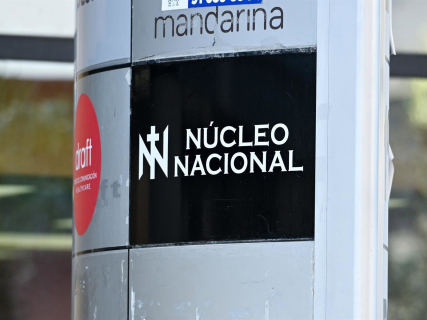

The National Nucleus used an Asturian neo-Nazi group investigated for organizing "hunts" against immigrants in order to recruit and select new members for its organization. It is about White Boys, a collective dismantled in 2025 to which the National Police attribute a series of violent actions in Asturias, including assaults targeting foreign people, clashes at trade union demonstrations, and activities related to the manufacture of incendiary weapons.
Thus emerges from the judicial case file to which El País has had access, which reveals the existence of connections between the two organizations and the role played by members of White Boys in the recruitment processes of the National Nucleus. The investigators have identified conversations in private WhatsApp groups in which the members of the Asturian collective interviewed potential candidates to check their ideological affinity before allowing them to join.
The revelations are known after the National Police arrested last Friday, 6 November, 14 members of the National Nucleus, including several of its main leaders, in an operation carried out in Madrid, Asturias, Guadalajara, Valladolid, Pontevedra, Burgos and Alicante. The investigation, led by a court in Gijón, examines possible crimes of incitement to hatred, unlawful association and illegal possession of weapons.
White Boys: the Asturian neo-Nazi group linked to 11 "hunts" against immigrants
The police investigation places White Boys at the center of an ultraright-wing violence network that operated in different towns in Asturias. According to the judicial documentation published by El País, the investigators attribute to the collective 14 harassment actions and 11 so-called "hunts", mainly directed against immigrant people.
The group carried out its activity in municipalities such as Gijón, Oviedo, Avilés and Castrillón, where its members also appear linked in inquiries into the acquisition of bladed weapons, the sale of drugs and the manufacture of Molotov cocktails.
In addition to the assaults being investigated, White Boys took part in actions against union mobilizations and used symbolism related to Nazism and white supremacy. Among its references were the numbers 14 and 88, commonly used in neo-Nazi circles as codes for ideological identification.
The Police also detected the involvement of minors in the group. According to the investigation, some of these young people were recruited by a veteran militant of the far-right from Asturias, identified in the case file as J. Ruiz, known by the alias of "El jefe", who had been involved with various far-right political organizations.
The group was dismantled during 2025, but the documentation incorporated into the proceedings now makes it possible to reconstruct its relationships with Núcleo Nacional and the role it played in its recruitment mechanisms.
Thus they selected the new members of Núcleo Nacional via WhatsApp
One of the most relevant elements of the investigation is the existence of private conversations that show how White Boys took part in the selection of candidates to join Núcleo Nacional.
According to the documentation examined by El País, members of the Asturian group used a WhatsApp chat to interview the candidates and check their ideological positions. In the conversations, dated September 2024, the applicants had to answer questions related to Nazism and justify their interest in being part of the organization.
The people responsible for the selection process also showed concern about the possibility that police agents or people opposed to their approaches would infiltrate. For this reason, they demanded answers that they considered sufficiently committed to the group’s ideology and warned those interested about the consequences of participating without sharing their objectives.
The investigation also includes messages in which members of White Boys reacted in a hostile manner when the answers of an applicant did not meet their expectations. These conversations reflect that the Asturian group was not limited to participating in Núcleo Nacional mobilizations, but that it intervened in its internal recruitment processes.
For the investigators, this relationship constitutes one of the elements that makes it possible to analyze the connections between different neo-Nazi organizations and their ability to attract new sympathizers, including young people who come into contact with these movements through social networks and private messaging groups.
The Police detained 14 members of Núcleo Nacional in seven provinces
The revelations about White Boys arrive just three days after the police operation developed against National Nucleus on Friday, 6 November.
The operation was coordinated by the General Information Department of the National Police and resulted in 14 arrests and ten searches in different locations across Spain. Among the properties inspected is the organization’s headquarters in Madrid, as well as other premises and residences linked to those under investigation.
Among those detained were Iván Rico, one of the group’s main spokespeople; Isabel Peralta, a figure previously linked to Bastión Frontal; and Enrique Lemus, a leader associated with the political project promoted by the organization.
During the searches, the officers seized documentation, material related to Núcleo Nacional and prohibited weapons, including brass knuckles and electric pistols. The investigation also examines the possible involvement of the suspects in activities that constitute crimes of hate and criminal association.
The judicial actions began following some altercations recorded in February 2026 in Gijón, when a gathering of Núcleo Nacional in the vicinity of the La Inmaculada school ended with incidents in which several students reported having suffered assaults.
The protest had been called against the removal of a monument linked to the Francoist dictatorship. Those events led to proceedings that later culminated in the police operation carried out last Friday.
Ten detainees are released with precautionary measures
After the arrests, the Examining Court number 1 of Gijón ordered this Sunday, 8 November the provisional release of ten of the individuals under investigation, in accordance with the position of the Public Prosecutor’s Office.
The judicial decision does not involve the dismissal of the procedure or the withdrawal of the charges. The ten individuals under investigation must appear weekly before the court, hand over their passports, and remain in Spanish territory, since they are prohibited from leaving the country while the investigation continues.
The magistrate considers that the facts examined could constitute crimes of incitement to hatred, criminal association, and unlawful possession of weapons, although this is a provisional classification that may be modified during the investigation.
Regarding the firearms seized, judicial sources have indicated that a large part of the people under investigation had the corresponding licenses for certain firearms. However, during the searches, objects whose possession is prohibited were also found, which forms part of the proceedings opened.
The other four arrested individuals were brought before the courts in the judicial districts where they were detained. The investigation remains open and there is no ruling that has determined the criminal responsibility of those involved.
Núcleo Nacional, from the protests at Ferraz to its registration as a political party
Núcleo Nacional began to gain notoriety during the protests against the amnesty law held in November 2023, especially at the gatherings in front of the PSOE headquarters on the Madrilenian street of Ferraz.
Since then, its members have participated in different far-right mobilizations and have been the subject of police investigations related to public disorder and possible hate crimes.
In February 2026, the organization took a new step by registering as a political party under the name Noviembre Nacional, headquartered in Valladolid. At the same time, it maintained a mobilization and recruitment structure for supporters through social networks, in-person meetings, and activities organized by its members.
Moreover, the operation from last Friday took place a day before a demonstration called by the group in Madrid, which was ultimately canceled after the arrests of its main leaders.
The judicial documentation now known adds a new element to the investigation into its functioning: the connection with local-level neo-Nazi organizations that, according to police findings, combined ideological recruitment activities with episodes of violence against immigrants and other groups.
Investigators will have to determine the scope of these connections and whether the actions attributed to the different groups may constitute organized activity that is susceptible to criminal liability. For the moment, the proceeding remains in the investigation phase, while Justice analyzes the evidence gathered and the individual participation of each person under investigation.