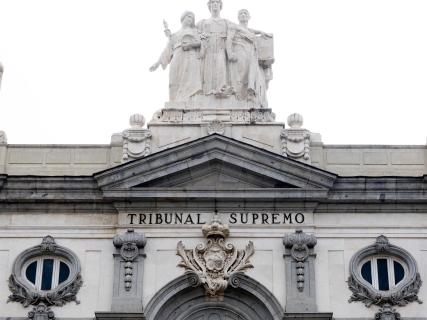

The Supreme Court has rejected immediately suspending the right to vote of the adult children of those who obtained Spanish nationality through the so-called “grandchildren law”, a decision which, for the time being, avoids expanding the electoral restrictions previously agreed upon for more than 163,000 Spanish citizens resident abroad. The Administrative-Contentious Chamber has ruled out adopting the measure by the urgent procedure and without hearing the parties, as Iustitia Europa had requested, although it has opened a period for submissions to determine whether it is appropriate to extend the precautionary measures before the general elections of next November 29.
The decision comes amid a legal controversy over the application of the 2022 Democratic Memory Law, which made it possible to access Spanish nationality for certain descendants of Spanish people who emigrated or were exiled. The Supreme Court had already agreed in September to provisionally suspend the electoral effects of certain entries in the Electoral Register of Absentee Residents (CERA), a measure that it confirmed on October 12. Now, Vox and Iustitia Europa seek to extend that restriction to the children of those affected, by considering that their access to nationality derives from the prior recognition of the nationality of their parents.
The Supreme Court rejects the immediate suspension, but keeps the procedure open
The controversy centers on the citizens who acquired Spanish nationality through the section 1.b of the eighth additional provision of the Democratic Memory Law, known administratively as Annex III. This scenario allows adult children of persons who previously obtained the status of Spaniards under historical memory legislation to access nationality.
Iustitia Europa asked the Supreme Court to extend to these descendants the precautionary suspension of the right to vote that already affects certain naturalized persons registered in the external census. The organization argued that the measure should be adopted urgently, without the need to previously hear the other parties that have appeared.
However, the judges rejected applying the suspension through that exceptional procedure and decided to open a three-day period for the parties to submit their allegations. The court also made Saturdays, Sundays and public holidays during November available to speed up processing, given the proximity of the elections.
This decision does not involve a definitive ruling on the extension of the restrictions. The rejection affects the immediate adoption of the most urgent interim measures, while the request to extend the suspension through the ordinary interim measures procedure was left pending a new decision.
Almost 190,000 naturalized people could be affected by the extension
The request by Vox and Iustitia Europa affects a potentially large group. According to the data provided by the Ministry of Foreign Affairs and collected in the proceedings, 189,678 people are listed in the foreign electoral register after obtaining nationality through the provision contemplated in Annex III.
However, this figure does not correspond exclusively to the children of people naturalized under the 2022 law. It also includes descendants of those who obtained Spanish nationality through the Law of Historical Memory of 2007, whose files do not form part of the original controversy examined by the Supreme Court.
This difference has been one of the main arguments of the State Legal Service for opposing a new suspension. The Government’s legal services argue that there is no complete nominal relationship that would make it possible to immediately identify the affected descendants and link each file with the specific route through which their parents obtained Spanish nationality.
For this reason, the Executive considers that extending the restrictions to the entire group could affect people whose legal situation is not connected to the files initially called into question.
The State Legal Service warns that the measure could affect the scrutiny of 29N
The Government has opposed the request by Vox and Iustitia Europa by considering that a new large-scale suspension would introduce significant legal and administrative difficulties only a few weeks before the elections.
In its allegations, the State Attorney’s Office warns that the measure could generate "insecurity" for the affected citizens and for the development of the electoral process itself. The legal services consider that requiring a new review of tens of thousands of files within such a short timeframe would be materially complicated and could interfere with voting and counting procedures.
The Administration points out that identifying the first naturalized individuals affected by the precautionary measures required prolonged work by the Spanish consulates. Repeating that review on an even larger group, while the electoral calendar is already underway, would pose new difficulties.
In addition, the Executive maintains that there is no final judgment that has declared irregular the nationality of the affected citizens, and therefore questions that the restrictions on the exercise of suffrage could be automatically extended to their descendants.
In response to these arguments, Vox argues that the children whose nationality derives from parents subject to precautionary suspension should be subject to the same regime until their situation is proven. Iustitia Europa has also raised that votes may be received and kept separately, without incorporating them into the scrutiny until the verifications are completed.
What happens to the more than 163,000 Spaniards whose vote has already been suspended
The decision regarding the children of naturalized individuals must be distinguished from the precautionary measures that the Supreme Court has already adopted with respect to their parents.
On the past 12 October, the High Court confirmed the suspension of the electoral effects of certain registrations in the CERA made under the protection of the "grandchildren law", considering it necessary to verify that they met the requirements required to access nationality through that route.
Subsequently, the Government provided a list of 163,355 people affected by the measure, of whom the consulates had initially certified that 901 met the documentary requirements required by the court in order to be exempted from the suspension.
The judicial decision establishes that they may retain the right to vote those citizens who documentarily prove that they are descendants of Spaniards who suffered exile in the circumstances provided for by the Law on Democratic Memory, without relying solely on the presumption of exile set out in the 2022 administrative instruction.
It is important to note that the suspension affects the electoral effects of certain registrations and does not entail the automatic withdrawal of Spanish nationality. The affected individuals continue to be Spanish citizens, although their participation in elections is conditioned by the precautionary measures and the exceptions established by the courts.
Naturalized people under the "grandchildren law" who live in Spain maintain the vote
The Supreme Court has also rejected expanding restrictions to citizens naturalized under the Law of Democratic Memory who currently reside in Spain and are registered in the Electoral Census of Residents (CER), as well as to their children.
In this case, the justices consider that the request falls outside the scope of the judicial proceeding, which is focused on the registrations in the census of Spanish residents abroad.
The difference is relevant because two citizens who obtained nationality through a similar route may find themselves in different electoral situations depending on their census registration. While certain residents abroad are affected by the precautionary suspension, those listed in the census of residents in Spain are not included in that same measure.
In light of this decision, Iustitia Europa has also gone to the Junta Electoral Central to request that the situation of the corresponding registrations of naturalized residents in Spanish territory be examined.
What is the "grandchildren law" and why has it reached the Supreme Court
The so-called "grandchildren law" forms part of Law 20/2022, on Democratic Memory, and establishes mechanisms so that certain descendants of Spaniards can access nationality of origin.
Among its beneficiaries are children and grandchildren of Spaniards who lost or renounced their nationality as a consequence of exile. The legislation also contemplates other cases related to the transmission of nationality to descendants of people who may have been able to recover it through the historical memory rules.
The judicial dispute arose from the interpretation and application of these provisions, especially after an instruction from the Ministry of Justice established a presumption of exile for those who left Spain between 1936 and 1955.
Vox and Iustitia Europa questioned before the Justice the electoral consequences of that interpretation, considering that it could allow the incorporation into the external census of people without the individual documentation necessary to prove certain requirements.
For its part, the Government defends the legality of the naturalizations and maintains that recognition of Spanish nationality must be accompanied by the exercise of the corresponding rights, including voting, unless there is a legal cause that allows limiting it.
The debate remains open a few weeks before the general elections on November 29, with a precautionary suspension already in force for part of the naturalized residents abroad and an additional procedure regarding the electoral situation of their children. The final resolution on this expansion will be decisive to know whether the restrictions affect new groups before the vote.