
Pedro Sánchez and his wife wrap up their summer vacation with a four-day stay in Andorra.

The president travels with Begoña Gómez to the Principality to close August after his stay in La Mareta. The couple repeats the destination of last summer, when he practiced cycling under a strong security device.

4 minutes

Captura de pantalla 2026 08 26 092732

Captura de pantalla 2026 08 26 092732

Add DEMÓCRATA to Google

Ask FREN

Published

Last updated

4 minutes

Most read

Pedro Sánchez has changed Lanzarote for Andorra to enjoy the last days of August. After several weeks settled in La Mareta, the president of the Government will travel this Wednesday to the Principality along with Begoña Gómez, according to ABC. There they will meet again with a scenario they know well: the couple already chose Andorra last summer to rest and practice mountain biking.

The getaway comes after an August marked by the migration crisis in Ceuta, which has forced the Executive to mobilize a good part of its structure and has led this week to some of the most significant decisions since the massive entries at the end of July.

Sánchez has spent most of August in Lanzarote. From there he met by videoconference with the ministers involved in the Ceuta crisis on the 7th and 17th. These were his two main interventions during a vacation marked by the emergency in the autonomous city.

This Tuesday, the head of the Executive reappeared at the meeting of the Council of Ministers. Later, Moncloa released a photograph in which the president appears at the back of the table and without a tie. The image confirmed his presence on a day when the Government made important decisions, but Sánchez also did not appear yesterday before the media.

It was Fernando Grande-Marlaska, Ángel Víctor Torres, and Elma Saiz who explained the measures after the Council of Ministers meeting.

Twenty-four hours later, the president leaves Madrid again.

From La Mareta to Andorra

According to ABC, Sánchez and Gómez will presumably remain in Andorra until next Sunday, when August ends. The couple will return to stay at the Sport Hotel Hermitage & Spa de Soldeu, a five-star luxury establishment located at the foot of Grandvalira.

The plan has many similarities with last summer's. Also then Sánchez closed August in the Andorran mountains after spending a good part of his vacation in Lanzarote.

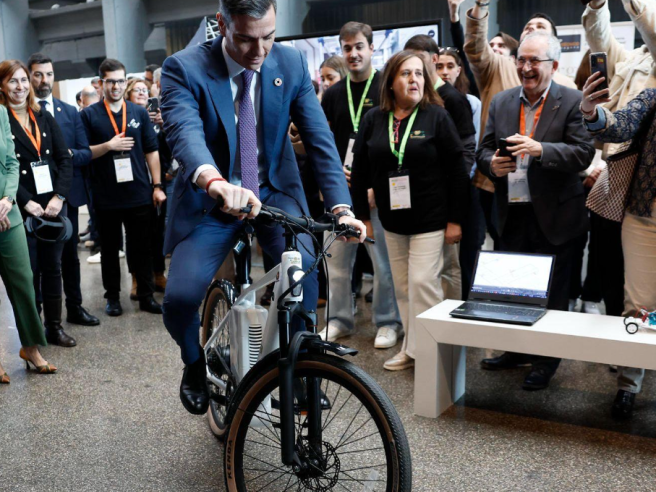
The bicycle explains a good part of the choice. Sánchez and Gómez share a passion for mountain biking and Andorra offers during the summer a wide network of routes and circuits, in addition to hosting some of the main international competitions in this discipline.
Captura de pantalla 2026 08 26 092813
Pedro Sánchez tests a bicycle powered by green hydrogen. Photo: DEMÓCRATA.

The precedent of last summer

Sánchez and Gómez were already in Andorra at the end of August 2025 and then chose the same hotel in Soldeu.

The private vacation ended up having public repercussions due to two circumstances: the significant security detail that accompanied the president and the protests that reached the vicinity of the establishment.

Different Spanish and Andorran media reported then on a wide presence of bodyguards during the couple's movements. The protection was also maintained during some of their sports outings, with agents accompanying them while they practiced cycling.

Spanish politics ended up reaching them even there. Three members of Hazte Oír traveled to Soldeu and displayed banners against Sánchez at several points, including the area near the hotel. The Andorran police later identified them near the border, although they were not sanctioned because the protest took place peacefully and without public order disturbances.

This summer Sánchez and Gómez return to the same destination and, according to ABC, also to the same establishment.
An August marked by Ceuta

The trip comes this time after a vacation politically conditioned by the Ceuta crisis.

Since the massive entries at the end of July, the Government has had to reinforce the police deployment, manage the reception and transfer of migrants, negotiate the European response, and face criticism for the information available before the crisis.

This Tuesday, the Government declared the situation of interest for National Security in Ceuta and designated the Minister of Territorial Policy, Ángel Víctor Torres, as the functional authority in charge of coordinating the actions.

Changes in Immigration and Asylum before closing the vacation

After the return from Pedro Sánchez's first vacation, the Executive approved yesterday in the first round a new Asylum Law and a reform of the Immigration Law to adapt Spanish regulations to the European Migration and Asylum Pact.

It should be noted that Spain supported the Pact, but had opted not to incorporate all the possibilities allowed by the new community framework into its legislation. The Ceuta crisis has now led the Interior Ministry to review that criterion and take advantage of instruments that it had initially decided not to use.

Among them are the triage at the border, accelerated procedures for certain requests for international protection, and mechanisms aimed at speeding up the returns of those who do not have the right to remain in Spain.

Marlaska justified the change by the need to respond to a "new migratory reality." The Minister of the Interior was precisely one of those responsible for explaining the decisions made this Tuesday. 
Andorra before September

The trip also has a particular schedule for Begoña Gómez. The president's wife has several legal fronts open that will resume activity after the August break. Her legal procedure has been open for more than two years and the trial does not start now, but September will return her matters to the courts.

The Provincial Court of Madrid corrected in July part of the procedure followed against Gómez for the alleged crimes of influence peddling and embezzlement and confirmed that the case must continue through the procedures provided for the jury court. Gómez maintains the presumption of innocence.


More key points, information and questions with FREN

AI-GENERATED CONTENT

What parliamentary status does the reform of the Immigration Law approved in the first round by the Government have?

As of today, the reform of the Immigration Law you refer to —the draft reform of Organic Law 4/2000 approved in the first round by the Council of Ministers on August 25, 2026does not yet have parliamentary status. It is in the pre-legislative phase within the Government and has not yet been sent to the Cortes Generales.

According to the information published by the newspaper Demócrata in the article "The Government gives the green light to the draft bills on asylum and immigration amid the response to the Ceuta crisis" , the Council of Ministers has approved:

  • A draft bill for a new asylum law.
  • A draft reform of the Immigration Law.

Both texts are expressly approved as draft bills, not as bills. The Government itself explains that:

  • These draft bills “must now go through the corresponding consultative bodies before returning to the Council of Ministers and being sent to the Cortes”.
  • Among these bodies are, among others, the General Council of the Judiciary, the Council of State, the Forum for the Social Integration of Immigrants, and the State Council of NGOs.

This means that, at the current moment:

  • The reform has not yet been transformed into a “Bill” approved by the Council of Ministers.
  • Consequently, it has not been registered in the Congress of Deputies, nor published in the Official Bulletin of the Cortes, nor does it have an initiative number (such as 121/0000X).
  • There is also no record that a period for amendments has been opened, nor that a committee or working group has been established on that specific text, nor that it is on the agenda of a Plenary or committee session.

From a technical point of view, therefore, its “parliamentary status” can be described as follows:

  • Phase: pre-parliamentary (draft bill).
  • Status: pending consultative reports and a second approval by the Council of Ministers as a bill.
  • Relation with the Cortes: still not sent to the Congress or Senate, so no parliamentary file is open.

It is important not to confuse this reform with other recent initiatives on immigration that have had or have parliamentary or regulatory processing:

  • The Bill to reform Article 35 of the Immigration Law regarding the distribution of unaccompanied migrant minors, which the Plenary of the Congress rejected to consider in July 2024, so that legislative route lapsed.
  • The Popular Legislative Initiative for an extraordinary regularization, which also modifies Organic Law 4/2000 and has followed its own independent parliamentary course.
  • The reforms of the Immigration Regulation by Royal Decree (for example, Royal Decree 1155/2024 and Royal Decree 316/2026), which are processed as executive regulatory norms and, therefore, do not go through the Cortes as bills.

In contrast, the reform you mention —the one approved in the first round on August 25, 2026— is at the previous stage: it is only a draft bill. Until the Council of Ministers approves it in a second round as a bill and sends it to the Congress, legally:

  • It has no initiative number or file in the Congress registry.
  • It does not appear in the “processing status” of legislative initiatives.
  • There can be no talk of amendment phase, committee, or Plenary, because none of those phases have yet opened.

If you want to follow its progress, the next key milestone will be the approval as a bill and its publication in the Official Bulletin of the Cortes Generales, at which point we can properly speak of parliamentary status (admission for processing, amendment period, etc.).

What are the powers and functions of the President of the Government according to the Spanish Constitution?

The 1978 Spanish Constitution establishes the President of the Government as the central figure of the executive power. His powers and functions are mainly distributed among articles 97, 98, 99, and 100, and are complemented by other provisions on the political responsibility of the Government (arts. 108 et seq.).

1. Direction of the Government and domestic and foreign policy

The core of the President's powers is set out in Article 97 CE: the Government directs domestic and foreign policy, the civil and military administration, and the defense of the State, and exercises executive functions and regulatory authority. Within this framework, the President is the one who sets the general political orientation of the Government and coordinates the actions of the different ministries.

In practice, this means that:

  • He defines the main lines of Government action (legislative priorities, economic, social, territorial, foreign policies, etc.).
  • He resolves coordination conflicts between ministers and decides on the distribution of matters among departments when there are overlaps.
  • He exercises political leadership that binds the entire Council of Ministers, which acts collegially but under his direction.

2. Appointment, dismissal, and organization of the Government

Article 98 CE establishes that the President directs the Government's action and coordinates the functions of the other members. From this derive several key powers:

  • Proposal for appointment and dismissal of ministers: the King appoints and dismisses ministers exclusively on the proposal of the President of the Government. In practice, it is the President who decides the composition of the Government.
  • Configuration of the governmental structure: he decides the creation, suppression, merger, or renaming of ministries and, with regulatory rank, can reorganize senior bodies of the General State Administration.
  • Convocation and presidency of the Council of Ministers: he sets the agenda, convenes and directs Council meetings, orders deliberations, and seeks the formation of the Government's collective will.

3. Relationship with the Crown and formation of the Government

The Constitution grants the President a central role in the practical articulation of the King's functions regarding the Government:

  • After the investiture process (art. 99 CE), the candidate who obtains the confidence of the Congress is appointed President of the Government by the King. From that moment, the President assumes the initiative in proposing ministers.
  • All acts of the King related to the Government (appointment and dismissal of the President and ministers, calling referendums, dissolution of the Chambers, etc.) require the countersignature of the President of the Government or, where appropriate, the competent ministers. This countersignature implies that political responsibility before the Cortes lies with the one who countersigns.

4. Political responsibility and relationship with the Cortes

The President embodies the Government's responsibility before the Congress of Deputies (art. 108 CE). This translates into several functions and powers:

  • He is the main political interlocutor of the Government before Parliament: he appears, answers questions, and challenges other parliamentary forces.
  • He can raise the question of confidence (art. 112 CE), submitting his program or a political declaration to the approval of the Congress. If he loses, the President must resign and a new investiture process opens.
  • He faces the possible motion of censure (art. 113 CE), which is always directed against the President. If a motion of censure succeeds, the President ceases and the alternative candidate is appointed President.

5. Dissolution of the Chambers and calling of elections

Article 115 CE recognizes the President of the Government's initiative to propose to the King the dissolution of the Congress, the Senate, or the Cortes Generales and the consequent calling of general elections, with certain limits:

  • It cannot be done while a motion of censure is in process.
  • Minimum periods must be respected since the previous dissolution.

Although formally the dissolution is decreed by the King, the political decision is the President's, who assumes responsibility before Parliament and the citizenry.

6. Normative function and administrative direction

As head of the Government, the President participates in the normative function through:

  • The Government's legislative initiative (bills approved by the Council of Ministers).
  • The approval of royal decrees and royal decree-laws, which are adopted collegially but always under his impetus and political responsibility.

Additionally, he directs the General State Administration as a whole, setting guidelines and priorities, and ensuring the execution of laws and approved public policies.

In summary, according to the Spanish Constitution, the President of the Government is the backbone of the executive power: he directs general policy, organizes and leads the Government, is politically accountable before the Congress, and articulates the relationship with the Crown and the Cortes Generales.

What requirements must a protest meet to be sanctioned in Andorra according to local regulations?

Based on the sources I have been able to consult, the specific text of Andorran regulations on meetings and demonstrations does not appear (nor a detailed development of the right of assembly in the Constitution of the Principality nor a specific law on meetings comparable to the Spanish one). Therefore, it is not possible to rigorously describe, article by article, the requirements a protest must meet to be sanctioned in Andorra. However, it is possible to explain what general requirements must always be met for any protest to be legally sanctionable and what elements are usually considered in comparable contexts.

1. Basic condition: fitting within an infraction or crime

Both in Andorra and in any other rule of law, the principle of sanctioning legality applies: a protest can only be sanctioned if the specific conduct of the participants:

  • Is described in a norm with sufficient rank (criminal law, security law, ordinance, etc.) as an administrative infraction or crime.
  • Meets all the objective and subjective elements of that type (what is done, with what intensity, with what intention, with what result).
  • Has been assessed and justified by the competent authority and, if applicable, by a judge.

That is, the mere fact of demonstrating is not enough to sanction: it must be accompanied by behaviors that the legal system has typified (damage, violence, serious disobedience, etc.) and the Administration cannot “invent” new infractions that are not foreseen.

2. Elements that usually make a protest sanctionable

Although we do not have the literal detail of Andorran regulations, in the European legal systems around it and in the general information found, several groups of behaviors can be identified that, when occurring within a protest, usually lead to sanctions:

  • Serious violence or threats: assaults on people (participants, passersby, journalists, police), throwing dangerous objects, serious threats. These types of acts tend to fit crimes against physical integrity, public order, or authority.
  • Damage to property: breaking street furniture, graffiti, burning containers, damage to vehicles or other property. These are usually sanctioned as crimes or infractions of property damage.
  • Serious disobedience or resistance to authority: repeatedly refusing to comply with legitimate orders (for example, to disperse or clear a critical point) or acting in an organized way to prevent police action, when such conduct is typified as an infraction or crime.
  • Very serious disturbances of order or security: prolonged and unjustified cuts of essential infrastructures, blockades that prevent the functioning of critical services, or tumultuous situations that exceed what is admissible in a peaceful protest.
  • Non-compliance with formal obligations, if local regulations require prior communication or authorization in certain cases (for example, due to size, schedule, route, or use of especially sensitive spaces). In some countries, demonstrating without meeting these requirements can lead to sanctions when serious disturbances or security risks are also generated.

3. Prior communication, schedules, and locations

European rules on assembly and demonstration usually distinguish between:

  • Formal limitations: notifying the protest in advance, respecting a route or schedule, not invading specially protected areas (for security, institutional functioning, etc.).
  • Substantive limitations: prohibition of violence, respect for other rights (transit, work, physical integrity), prohibition of certain messages if they constitute direct incitement to serious crimes.

Where prior notification is required, lack of notification alone does not always make the protest sanctionable, but it does increase the risk that it will be considered infringing when other elements are added (intense impact on traffic, refusal to follow police instructions, etc.).

4. What can and cannot be stated about Andorra

With the available information:

  • It is not possible to identify the specific articles of the Andorran Constitution, Penal Code, or any possible public security law that regulate the right of assembly or typify conduct in protests.
  • It is clear that, to sanction, Andorran authorities must rely on already approved legal types (criminal or administrative) and justify why the conduct exceeds the peaceful exercise of the right of assembly or expression.

If you need to apply this to a specific case in Andorra (a specific protest, a possible fine, etc.), the prudent course is:

  • Consult directly the official texts in force (Constitution, Penal Code, qualified laws on security or public order) published by Andorran institutions.
  • Obtain advice from a lawyer in the Principality, who can verify the exact fit of the facts within local regulations.

Play

Test your knowledge with FREN!

How much do you know about this topic? Answer the following 3 questions.

To which destination have Pedro Sánchez and Begoña Gómez traveled to end their summer holidays of 2024?

Question 1 of 3

What main reason do Pedro Sánchez and Begoña Gómez share for choosing Andorra as their holiday destination?

Question 2 of 3

What legal reforms did the Spanish Government approve after the Ceuta migration crisis?

Question 3 of 3

Hola, soy Fren. ¿Cómo te ayudo?