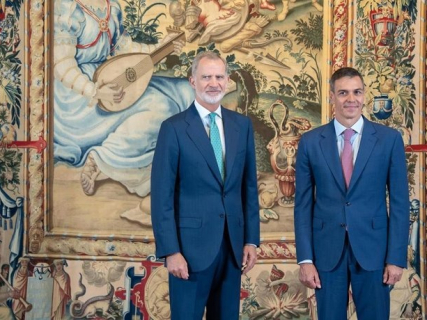
Pedro Sánchez meets with the King at Zarzuela amid the Ceuta crisis

The president of the Government and Felipe VI have held this Monday one of their usual meetings hours after Sánchez defended that there are "sufficient arguments and reasons" for a visit of the monarch to Ceuta, according to the digital newspaper The Objective.

1 minute

WhatsApp Image 2026 08 31 at 21.35.53

WhatsApp Image 2026 08 31 at 21.35.53

Add DEMÓCRATA to Google

Ask FREN

Published

Last updated

1 minute

Most read

The president of the Government, Pedro Sánchez, has met this Monday with King Felipe VI at the Palace of Zarzuela, hours after the head of the Executive publicly announced that the monarch will visit Ceuta and Melilla, without specifying when the trip will take place, as The Objective has reported.

The meeting takes place, therefore, after Sánchez has publicly referred to a possible visit of the King to the autonomous cities during his first public appearance after the holidays.

More key points, information and questions with FREN

AI-GENERATED CONTENT

What is the legal procedure for the King of Spain to visit an autonomous city like Ceuta?

There is no “special procedure” in the strict sense for the King to visit an autonomous city like Ceuta: the general framework of the Constitution regarding the Head of State and the basic rule that all his acts are countersigned by the Government apply. From there, the visit is arranged through political and administrative decisions by the Government and the Household of H.M. the King, coordinated with the authorities of the autonomous city and the State (Government Delegation, Interior, Defense, etc.).

From a legal point of view, the key points are:

  • Spanish Constitution: the King is Head of State (art. 56 CE) and exercises his functions always countersigned by the Government or, where appropriate, by the president of the Government or the competent ministers (art. 64 CE). This includes major official acts and trips with institutional content.
  • Government Responsibility: art. 64 CE attributes political responsibility for the King's acts to those who countersign them. Therefore, it is the Government that decides, promotes, and politically assumes official visits, including to Ceuta or Melilla.
  • Unity of the State: Ceuta is an autonomous city but is fully part of Spanish territory. No special authorization different from that governing visits to autonomous communities or peninsular provinces is required; what matters is institutional coordination.
1. Political decision and visit scheduling

In practice, the initiative for an official visit may arise:

  • From the Household of H.M. the King itself, in its annual activity planning.
  • From the Government (Presidency of the Government or involved ministries), proposing or inviting the King to attend a specific event (anniversary, inauguration, commemoration, etc.).
  • From a formal invitation from the autonomous city (Presidency of the City of Ceuta), which is channeled through the Royal Household and the Government.

In any case, the final decision is made jointly between the Government and the Royal Household, since the King's agenda is approved with the Executive's approval, which is politically responsible for it.

2. Formal instruments and type of act

For a working visit, inauguration, or institutional meeting, a specific Royal Decree is usually not necessary; it suffices to:

  • Include the event in the official agenda of the Royal Household, which is made public.
  • Internal resolutions, official letters, and communications between ministries (Presidency, Interior, Defense, Foreign Affairs if there is an international dimension) and the Royal Household.

Only in very specific cases (for example, appointment of a King's representative, granting extraordinary military honors, or changes in State ceremonial) might royal decrees or other general norms intervene; but the mere visit as such is managed administratively and protocol-wise.

3. Role of the different State bodies
  • Presidency of the Government and Ministry of the Presidency: politically coordinate the visit, validate the agenda, institutional messages, and, if applicable, speeches. Through the General Secretariat of the Presidency and the State Protocol Office, the basic ceremonial elements are set (receptions, honors, precedences).
  • Household of H.M. the King: organizes the King's specific agenda in the city (meetings, routes, public acts), the immediate logistics of the Head of State, and the operational relationship with the Government, the autonomous city, and other bodies.
  • Ministry of the Interior: through the Government Delegation in Ceuta and the State Security Forces and Corps, designs the citizen security device, access, protection perimeters, and coordination with local police.
  • Ministry of Defense (if applicable): organizes military honors (honor guards, salutes, formations) when the visit foresees it and coordinates movements when military means intervene (ships, military aircraft, etc.).
  • Government Delegation in Ceuta: acts as the direct representation of the State in the territory and is a key actor in coordination with the Autonomous City and security and emergency services.
  • Autonomous City of Ceuta and City Council: participate in organizing local institutional acts (receptions, solemn plenaries, visits to facilities), as well as in the protocol and urban security device (local police, civil protection).
4. Coordination of protocol and security

Once the visit is decided, mixed working teams are formed:

  • Protocol: routes, order of interventions, list of authorities receiving the King, location of flags and symbols, use of honors, invitations, and press accreditation criteria are agreed upon.
  • Security: a specific plan is developed that integrates the King's personal security, security of spaces, access control, and emergency devices. The Royal Guard, National Police, Civil Guard, local police, and, if applicable, military units participate.

This entire framework is based on internal instructions, State protocol manuals, and security plans, not on a singular law for Ceuta, since the same scheme that applies to any other part of Spanish territory is applied.

What are the powers and functions of the president of the Government in relation to the organization of institutional visits by the King?

In the Spanish constitutional order, institutional visits by the King (especially abroad, but also within Spain) take place in a context where the King always acts subject to the political direction of the Government. This means that the president of the Government has a decisive role, although many functions are exercised jointly or coordinated with other bodies (Household of H.M. the King, Ministry of Foreign Affairs, Ministry of the Presidency, and protocol services).

Basic constitutional framework

The Constitution establishes three key ideas:

  • The King is Head of State (art. 56 CE) and “arbitrates and moderates the regular functioning of institutions,” as well as representing Spain in international relations.
  • The King's acts require countersignature (art. 64 CE): they are countersigned by the president of the Government or, where appropriate, by the competent ministers. Countersigning implies that political responsibility lies with the countersigner, not the King.
  • The Government is responsible for directing domestic and foreign policy (art. 97 CE). The president of the Government sets the general political line and coordinates the Executive's action.

Applied to institutional visits, this means that the King's presence at an official act or trip, and its political content, are conditioned by the Government's will and responsibility, articulated mainly through the president.

Powers of the president of the Government

Although there is no specific “closed list” in the Constitution about the King's official trips, several functions of the president of the Government emerge from the norms and constitutional practice:

  • Definition of the political strategy of visits: the president of the Government, as director of foreign policy and relations with other State powers, decides what role the King has in that strategy. For example, whether a State visit should prioritize economic, political, cultural, or international image objectives.
  • Political decision on the timing of the visit: the convenience of the King making a State visit or presiding over certain acts (both inside and outside Spain) is evaluated by the Government. The president of the Government has the final political word on whether a visit proceeds, is postponed, or is oriented differently.
  • Countersigning the King's acts: formal acts associated with the visit (politically charged speeches, signing treaties or documents, institutional messages) require countersignature. The president of the Government can countersign directly or delegate to the corresponding minister but remains the overall political responsible.
  • Interministerial coordination: the president directs the entire Executive, so he orders and coordinates the actions of:
    • The Ministry of Foreign Affairs, which designs the international program, political contacts, and diplomatic content.
    • The Ministry of the Presidency and protocol services, which coordinate agenda, ceremonies, and organizational aspects with the Royal Household.
    • Other sectoral ministries involved (Economy, Industry, Culture, Defense, etc.), depending on the visit's content.
  • Political relationship with the Royal Household: the material organization of the King's day-to-day (agenda, immediate logistics, communication) corresponds to the Household of H.M. the King. However, the general line of the institutional agenda aligns with the Government's orientation. In practice, stable coordination mechanisms are articulated between Moncloa and Zarzuela, under the president's political authority.
  • Control of the internal institutional dimension: in visits within Spain, the president of the Government influences which acts the King presides over, how relations with autonomous communities and other institutions are articulated, and how the King's presence is balanced with that of the Government itself in sensitive events.

Limits and nature of these functions

It is worth emphasizing that the King has a margin of initiative and proposal, and the Royal Household presents agenda suggestions. But any visit with political or diplomatic relevance is integrated into the Government's general strategy, which assumes responsibility before the Cortes and public opinion.

Therefore, the president of the Government does not “order” the King in a hierarchical administrative sense, but determines, through countersigning and general policy direction, the framework in which the Head of State's institutional visits are organized and developed, ensuring their coherence with the Executive's objectives and the principle of political responsibility.

What results did the Socialist Party and the Popular Party obtain in the last general elections in Ceuta?

I cannot provide you with the exact figures of votes, percentages, and seats obtained by the Socialist Party (PSOE) and the Popular Party (PP) in the Ceuta constituency in the last general elections to the Congress (July 23, 2023), because in the sources consulted in this search there is no specific breakdown for Ceuta. The news and documents retrieved focus on other general topics (investitures, parliamentary groups, regulations, etc.) and do not include tables of electoral results by constituency.

In other words: within the accessible material in this research (political press and parliamentary analyses), no scrutiny record or summary of results has been found that details, for Ceuta, how many votes and what percentage each party obtained, nor which formation won the seat at stake. To avoid inventing numerical data or attributing seats without documentary basis, I must limit myself to pointing out this absence of concrete information.

Still, it is possible to clarify the institutional framework in which those results occurred and guide you on where to consult them reliably:

  • In Spanish general elections, Ceuta is a single-member constituency for the Congress of Deputies. This means that in each election to the Congress, a single deputy is elected for Ceuta.
  • All parties presenting candidacies in Ceuta compete for that single seat. The allocation system is the same as in other constituencies (D’Hondt system), but since there is only one deputy, the practical result is that the most voted list obtains it.
  • Official results – including votes, percentages, and seat allocation – are published in the official scrutiny data of the general elections, managed by the State electoral administration.

In the press information consulted for this answer, some general references to the July 23, 2023 elections appear, but at the national level, not broken down by Ceuta. For example, an analysis by the newspaper Demócrata on voting evolution indicated that the PSOE obtained 31.7 % support nationwide in those elections, a figure cited as a general reference on the socialist result at the national level. However, that national figure does not allow inferring the specific behavior in the autonomous city, where the size of the electorate, party competition, and local dynamics may differ significantly from the country average.

To answer precisely what you ask – that is, “what results did the Socialist Party and the Popular Party obtain in Ceuta in the last general elections” – three types of data would be needed:

  • Absolute votes obtained by the PSOE in Ceuta.
  • Absolute votes obtained by the PP in Ceuta.
  • Percentage of votes of each over the total valid votes cast in the constituency, and official confirmation if either obtained the seat.

These data are usually collected in the general scrutiny record and in the electoral results databases that the Administration maintains for all general calls. Since in the search only political press was scanned and no link or document including Ceuta's detail was found, I cannot reconstruct them even approximately without speculation.

If you need the exact figures, the safest way is to go directly to the official sources of electoral results (the general elections results portal of the General State Administration or, where appropriate, the information published by the Government Delegation in Ceuta). In those repositories, you can filter by call (July 23, 2023), type of election (Congress of Deputies), and constituency (Ceuta), and you will obtain:

  • Votes and percentage of the PSOE in Ceuta.
  • Votes and percentage of the PP in Ceuta.
  • Confirmation of which candidacy won the single seat of the constituency.

I regret not being able to go further with concrete numerical data based on the information available in this search. If you want, I can help you interpret those results once you have them (for example, analyzing the difference between PSOE and PP, comparison with previous elections, or Ceuta's weight in the national total).

Play

Test your knowledge with FREN!

How much do you know about this topic? Answer the following 3 questions.

Where did the meeting between Pedro Sánchez and King Felipe VI mentioned in the news take place?

Question 1 of 3

What criticism did Pedro Sánchez make of Felipe VI regarding Ceuta and Melilla?

Question 2 of 3

How long has Felipe VI been on the throne according to the correction indicated in the news?

Question 3 of 3

Hola, soy Fren. ¿Cómo te ayudo?