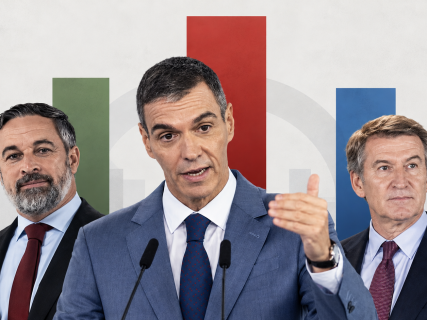
The digital power by La Moncloa: Sánchez dominates on networks while Abascal surpasses Feijóo

The president of the Government heads the ranking of political influence on social networks with 93.2 points, followed by the leader of Vox, who occupies the third position with 86.2, and the president of the PP, seventh with 77.7. The three face the pre-campaign of 29N with a digital presence that reflects different ways of communicating their political messages.

3 minutes

Montaje editorial de políticos europeos

Montaje editorial de políticos europeos

Add DEMÓCRATA to Google

Ask FREN

Published

Last updated

3 minutes

Most read

The race towards the general elections on November 29 is also taking place on social media, where the main candidates for the Presidency of the Government compete to convey their proposals, mobilize their supporters, and gain visibility during the pre-campaign. In this area, Pedro Sánchez occupies the first position in the general ranking of Poder Digital, with 93.2 points, ahead of Santiago Abascal and Alberto Núñez Feijóo.

This is reported by Poder Digital, the application developed by Vinces, which analyzes the influence of political representatives on X, Instagram, and LinkedIn through an index from 0 to 100. The tool, available on DEMÓCRATA, allows comparing the ability of leaders to connect with their audiences and participate in public conversation.

The ranking places Sánchez seven points above Abascal and 15.5 ahead of Feijóo, while the distance between the leaders of Vox and PP reaches 8.5 points. These differences correspond to the digital influence index and do not represent vote estimates or forecasts about electoral results.

Pedro Sánchez maintains digital leadership with housing and early elections at the center of his messages

The President of the Government arrives at the pre-campaign with 93.2 points and the first position in the general ranking, in a week marked by his decision to advance the elections to November 29 and by the new approval of the housing decrees that had been rejected in Congress.

The housing has occupied a prominent place in its recent communication. Before the parliamentary vote on October 2, Sánchez published a message on Instagram in which he demanded the support of the groups for the measures of the Executive and framed the debate in terms of protection for tenants against the economic interests of the real estate sector.

After announcing the elections, the socialist leader has kept this issue among his main political arguments. In his appearance on October 6, he defended the recovery of the decrees and linked the electoral call with the lack of parliamentary support to push forward the housing measures. The intervention could also be followed through social networks and digital broadcasting platforms.

Santiago Abascal occupies the third position and focuses his messages on confrontation with the Government

The president of Vox is in the third position of the general ranking, with 86.2 points, seven less than Sánchez and 8.5 above Feijóo. His recent political activity has been marked by criticism of the Executive and by the debate over the guarantees of voting by mail in the elections of November 29.

A position that has also been expressed by Isabel Díaz Ayuso and that has provoked a controversy with the PSOE and within the PP itself. The socialists have demanded that Feijóo disavow those statements, while the popular party has opted to request additional guarantees from the Central Electoral Board.

This Friday, the leader of Vox has used his social networks to announce that he will not attend the military parade on October 12 in Madrid for the second consecutive year. Instead, he will travel to Ceuta and has refused to share the authorities' platform with the Government, which he has labeled as "mafioso".

Feijóo, seventh with 77.7 points, reinforces his communication about the 29N

Alberto Núñez Feijóo occupies the seventh position in the overall ranking with 77.7 points, behind his two main rivals in this comparison. The president of the PP has concentrated a good part of his recent interventions on the electoral advance, the criticisms of the Government's management, and the preparation of the campaign.

After Sánchez's announcement, Feijóo presented the elections as an opportunity for political change and placed among his arguments housing, security, and the corruption accusations against the Executive. During his visit to Ceuta, he also announced that the PP would request the Central Electoral Board additional measures to reinforce the guarantees of voting by mail.

The latest news of its electoral strategy arrived this Friday, when the PP confirmed that it accepts a face to face with Pedro Sánchez on November 16, in addition to other formats of television debate. The announcement incorporates a new issue into the party's communication during the pre-campaign.

Despite occupying a lower position than Sánchez and Abascal in Poder Digital, Feijóo remains among the ten most influential leaders in the ranking. The difference between their scores does not allow, by itself, to conclude that he publishes less, has fewer followers, or generates fewer interactions, since each of those variables would need to be analyzed separately.

In the coming weeks, the campaign will allow observing how their messages evolve and whether political events alter their respective positions in a ranking that, for now, is led by Pedro Sánchez.

More key points, information and questions with FREN

AI-GENERATED CONTENT

What is the current status of the parliamentary processing of the new housing decrees mentioned by Pedro Sánchez?

We have ample info; now answer in HTML 500-700 words.

As of October 9, 2026, the “new housing decrees” referred to by Pedro Sánchez are two royal decree-laws approved by the Council of Ministers on October 6 and published in the BOE on October 7. Both are in force since their publication, but their parliamentary process is only in the initial phase: they have not yet been subjected to a validation vote and must be debated in the Permanent Deputation of the Congress, since the Cortes are dissolved due to the call for elections on November 29.

The regulations are:

  • Royal Decree-Law 28/2026, of October 6, adopting urgent measures to strengthen the stability of contracts for habitual residence leases (BOE-A-2026-20822).
  • Royal Decree-Law 29/2026, of October 6, adopting urgent measures for the protection of the social function of housing and the expansion of affordable housing supply (BOE-A-2026-20823).
1. Competent body and deadlines

According to the Constitution (art. 86.2), every royal decree-law must be validated or repealed by the Congress of Deputies within a maximum period of 30 days from its promulgation. In this case:

  • Both decree-laws have been approved by the Council of Ministers and published in the BOE, so they are provisionally in force.
  • The dissolution of the Cortes means that the debate and vote will not take place in an ordinary Plenary session, but in the Permanent Deputation of the Congress, which assumes this competence during the electoral period. This is indicated both by Moncloa and the parliamentary reports collected by Demócrata.
  • The 30-day period is counted from their promulgation; as of October 9, no date has yet been set for the Permanent Deputation session for their validation, but it must be held before that deadline expires.
2. Current status of each decree-law

a) Royal Decree-Law 28/2026 (rental stability)

  • Status: approved by the Council of Ministers on October 6 and published in the BOE on October 7. It comes into force upon that publication.
  • Parliamentary processing:
    • It appears in the institutional database only with the phases of Council of Ministers Agreement and publication in the BOE.
    • No record yet of validation debate either in Plenary or Permanent Deputation, nor agreement to process it as a bill.
  • Material scope: deeply modifies the Urban Leases Law to provide greater stability to habitual residence contracts (successive renewals, longer notices, tenant compensation regime, etc.), recovering and adjusting measures from the repealed Royal Decree-Law 27/2026.

b) Royal Decree-Law 29/2026 (social function and affordable supply)

  • Status: likewise approved on October 6 and published on October 7; it has been in force since that date.
  • Parliamentary processing:
    • Also appears only with the phases of Council of Ministers Agreement and publication in the BOE.
    • Similarly, no agreement yet from Congress on its validation or repeal, nor decision to further process it as a bill.
  • Material scope: concentrates the bulk of economic and fiscal housing measures: “Tu Casa” financing of up to €50,000 interest-free for first homes, guarantees for industrialized construction, support for social housing suppliers, limits on speculative purchases by funds, regulation of seasonal and room rentals, measures on tourist apartments, etc.
3. Relation to previous decrees 26/2026 and 27/2026

The new texts replace two previous housing decree-laws that did reach the Plenary of the Congress and were rejected:

  • Royal Decree-Law 26/2026, of September 29, on protection of the social function of housing and expansion of affordable supply:
    • Publication in BOE: September 30 (BOE-A-2026-20266).
    • The Congress, in its session of October 2, agreed to its repeal; the Cortes Bulletin explicitly publishes that the Chamber decided to repeal it.
  • Royal Decree-Law 27/2026, of September 29, on stability of habitual residence lease contracts:
    • Publication in BOE: October 1 (BOE-A-2026-20385).
    • That same October 2, the Plenary of the Congress also agreed to its repeal, also published in the Congress Bulletin.

The new RDLs 28/2026 and 29/2026 “maintain the essence” of those repealed texts, with some relevant modifications (closed budget allocation for the loan line, adjustments in the definition of funds and anti-eviction guarantees, among others), but their parliamentary processing has not yet formally begun: they are pending debate and validation vote in the Permanent Deputation and, therefore, no decision on possible conversion into bills.

Can you detail what specific measures are included in Royal Decree-Law 28/2026 on the stability of rental contracts? What main changes does Royal Decree-Law 29/2026 introduce compared to the repealed Royal Decree-Law 26/2026? How does the map of expected parliamentary support and opposition look regarding the validation of these new housing decrees?

What are the powers and functions of the President of the Government of Spain according to the Constitution?

The President of the Government of Spain is the highest authority of the executive power and a key figure in the parliamentary system designed by the 1978 Constitution. His powers and functions derive mainly from articles 97, 98, 99, 100, and 108 to 116 of the Constitution, and are complemented by other regulations (for example, the Government Law). Below is a summary of the most relevant, focused strictly on the constitutional level.

1. Direction of Government action (art. 97 CE)

The core function of the president is to direct the action of the Government and coordinate the work of the other ministers. This implies:

  • Defining the general lines of policy of the Government (internal, external, economic, social, defense, etc.).
  • Establishing the priorities of the government agenda and ensuring that all ministries act coherently with them.
  • Arbitrating and resolving conflicts between ministries when their competences overlap or clash.
  • Promoting the drafting of bills, royal decree-laws, and royal legislative decrees that the Government presents or approves.
2. Direction of internal and external policy, command of civil and military administration (art. 97 CE)

The Constitution establishes that the Government directs internal and external policy, the civil and military Administration, and the defense of the State. As head of the Government, the president:

  • Sets the major orientations of internal policy (public order, economic policy, public services, relations with autonomous communities, etc.).
  • Defines the strategy of external policy and leads Spain’s position in the European Union and international organizations, although formally the Head of State is the King.
  • Exercises, through the Government as a whole, the direction of the Administration (ministries, public bodies) and coordination with territorial administrations.
  • Assumes a central role in the direction of defense policy, within the framework also established by other regulations and always under the control of the Cortes Generales.
3. Relationship with the Cortes Generales: confidence, responsibility, and dissolution (arts. 99, 108, 112–115 CE)

The President of the Government is, by design, a parliamentarily responsible authority. His main functions in this sphere are:

  • Obtaining the confidence of the Congress: he is invested following the procedure of article 99 CE, in which the King proposes a candidate and the Congress grants or denies confidence by vote.
  • Political responsibility: the Government as a whole is jointly responsible before the Congress (art. 108 CE). The president embodies that responsibility and answers interpellations, questions, general policy debates, etc.
  • Vote of confidence (art. 112 CE): he may raise it before the Congress to endorse his program or a general policy declaration. If lost, the entire Government must resign.
  • Participation in the motion of censure (art. 113 CE): although the initiative is parliamentary, the motion always proposes an alternative candidate for president; if it succeeds, the president ceases.
  • Power to propose the dissolution of the Chambers (art. 115 CE): he may propose to the King the dissolution of the Congress, the Senate, or both Chambers, which entails calling general elections, with the temporal limitations provided in the Constitution.
4. Appointment, dismissal, and organization of the Government (art. 98 CE)

The president has broad capacity to configure the Executive:

  • Proposes to the King the appointment and dismissal of ministers, who are formally appointed and removed by the monarch.
  • May reorganize the Government structure, creating, suppressing, or modifying ministries and distributing competences among them (in practice, through Government regulations).
  • Decides the permanence or reshuffle of his ministerial team, giving him strong internal political control.
5. Normative functions and legislative promotion

Although the Constitution attributes normative powers to the Government as a collegiate body, the president, as its highest responsible, exercises effective leadership over:

  • The initiative for the Government to present bills before the Cortes Generales.
  • The political decision to resort to royal decree-laws in cases of extraordinary and urgent need, whose approval corresponds to the Council of Ministers but is promoted and defended by the president.
  • The approval of regulations (Government royal decrees) that develop laws, setting their orientation and scope.
6. Representation and countersignature

The President of the Government:

  • Is the highest representation of the executive power and, politically, the central figure of institutional life.
  • Participates in the countersignature of certain acts of the King (for example, the proposal and appointment of ministers, the dissolution of the Cortes, or the calling of elections), insofar as these acts are political responsibilities of the Government.
7. Dismissal of the president

Constitutionally, the president ceases by:

  • Holding general elections and constitution of a new Congress (the Government remains in caretaker status).
  • Loss of a vote of confidence.
  • Approval of a motion of censure that invests another candidate.
  • Resignation or death.

In all these cases, the Constitution provides for a situation of caretaker Government, with limited powers, until the new president takes office.

Can you explain with examples how the President of the Government exercises the power to dissolve the Cortes Generales? What differences exist between the functions of the President of the Government and those of the King according to the Spanish Constitution? How is the investiture procedure of the President of the Government regulated in detail and what majorities are required?

What results did the Popular Party obtain in the last general elections held in Spain?

In the last general elections held in Spain, on July 23, 2023 (23-J), the Popular Party (PP) was the most voted force nationwide. According to data gathered from consulted sources, the PP obtained approximately 33.1 % of the votes and 137 of the 350 seats in the Congress of Deputies, positioning itself as the first party in votes and seats, although far from an absolute majority (176 seats).

Basic data of the PP result on 23-J 2023

Based on electoral analysis information and poll aggregators that reconstruct the official 2023 result, the performance of the Popular Party can be summarized as follows:

  • Statewide vote percentage: around 33.1 % of the votes cast for the Congress.
  • Seats in Congress: 137 deputies out of a total of 350.
  • Relative position: first party in the Congress ahead of the PSOE and other forces.
  • Distance to absolute majority: it was 39 seats short of the 176 needed to control the Lower House alone.

These numbers are systematically used as a reference in subsequent analyses published by media such as the newspaper Demócrata or comparative summaries of state polls. For example, several later opinion studies recall that the PP “” and compare with their current estimates.

Comparison with other parties in those elections

To better understand the scope of the PP result, it is useful to place it in relation to other nationwide parties and main territorial forces. According to the same result summaries:

  • The PSOE came in second place, with around 31.7 % of the votes and 121 seats. That is, the PP led the socialists by just over one point and 16 deputies.
  • Vox obtained approximately 12.4 % and 33 seats, well below the PP in both votes and representation.
  • The Sumar candidacy achieved around 12.3 % and 31 seats, positioning itself as the fourth force in the Chamber.
  • Among nationalist and regionalist parties, notable were:
    • ERC and Junts, with 7 seats each.
    • EH Bildu, with 6 deputies.
    • PNV, with 5 representatives.
    • BNG, Coalición Canaria, and UPN, with 1 seat each.

In that landscape, the PP clearly led the right-wing bloc and was the first parliamentary force, but did not reach a sufficient majority to govern alone. The PP–Vox sum reached 170 seats (137 + 33), also below the 176 required for an absolute majority, something that subsequent analyses repeatedly highlight.

Political significance of the result for the PP

The available data allow several political conclusions about the PP result in those last general elections:

  • Victory in votes and seats, but without automatic governing capacity. The PP won the 2023 general elections numerically, but the distribution of other seats made it very difficult to form an alternative investiture majority to the bloc that ended up renewing Pedro Sánchez’s presidency.
  • Reference for the subsequent cycle. Much of the 2024, 2025, and 2026 polls use as a comparison point that mark of 33.1 % and 137 seats, indicating whether the PP would be above or below its own 23-J result.
  • Reconfiguration of the party system. The combination of a clearly first PP, a relatively close PSOE, and weaker third and fourth forces (Vox and Sumar) than in previous stages marked the start of the XV Legislature, with a very fragmented Congress but polarized around the two major parties.

In summary, in the last general elections held in Spain (July 23, 2023) the Popular Party obtained approximately one third of the votes (33.1 %) and 137 seats, making it the first force in the Congress, although obliged to seek alliances to transform that result into a governing majority.

Play

Test your knowledge with FREN!

How much do you know about this topic? Answer the following 3 questions.

Who leads the digital influence ranking according to the Poder Digital tool?

Question 1 of 3

What topic has Pedro Sánchez recently focused his communication on social media?

Question 2 of 3

What did the Popular Party announce regarding the electoral debates?

Question 3 of 3