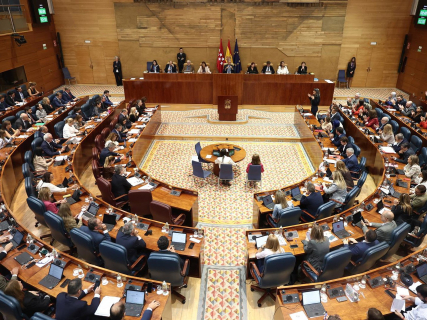

The strike in public Education and the housing situation share the focus of the Plenary this Thursday in the Assembly of Madrid, in a session in which it is also expected that approval will be given to the creation of a study commission on the impact in the Community of the halt of the known as "grandchildren's law".
This Wednesday, thousands of teachers and students gathered at Puerta del Sol to demand "quality" education and reiterate the demands that have led unions and family associations to call for the strike: a salary increase of 600 euros per month, reduction of ratios, and the elimination of the current bilingualism model to "stop educational segregation".
The protests began early with a temporary blockade of Paseo de la Castellana and pickets at various universities. In these last ones, moments of tension occurred that led to police charges, questioned by the organizers and by left-wing parties. The Government Delegation has requested an investigation to clarify what happened.
The president of the Community of Madrid, Isabel Díaz Ayuso, described this Wednesday's strike as "political" and accused the organizers of not "respecting the rights of children, of students, nor the work".
In the same vein, the Minister of Education, Science and Universities, Mercedes Zarzalejo, stated that the latest union requests are "out of all logic and common sense".
The minister will appear this Thursday in the Plenary, at the request of Más Madrid, to explain the measures that the regional government plans to activate in order to "respond to the demands of the educational community that have led to calling a strike in public education". In a previous appearance before the media, she already advanced her position: "What we have to do is continue fulfilling the agreed, negotiated, and published agreement that is in force until 2028 and continue advancing in that professional career that the teachers have demanded and that we want to fulfill before the end of next year".
Housing returns to the center of political debate
Housing policy regains prominence in the Assembly, as it did after the eviction of Maricarmen three weeks ago. In this Plenary, it will be the subject of a question from Más Madrid to the regional president, focused on access to rental, and also of another question posed by the PP.
The Popular Group will emphasize the economic consequences for Madrid of the royal decree-laws approved by the central Government a week ago. This is the second package in just a month, after the first was rejected in Congress, which led to the electoral advance. After the dissolution of the Chamber, it will now be the Permanent Deputation that votes on the new decrees, with a different balance of power in which the support of Junts is no longer essential.
Ayuso already warned last week that her Government will use "all legal instruments" at its disposal to safeguard "private property" if the Permanent Deputation ultimately validates these decrees.
The agenda also includes a Bill from Más Madrid, which is expected to fall due to the absolute majority of the PP, to prevent the Social Housing Agency (AVS) from executing evictions on vulnerable people without "adequate alternative." A Non-Law Proposal from the PSOE will also be debated, proposing that all public housing, both current and future, have permanent protection, as well as an interpellation from Vox regarding the regional government's housing policy.
Control session and legislative agenda of the Plenary
The parliamentary day will begin with the control session for Ayuso. In addition to the questions about housing from Más Madrid and PP, Vox will question the impact of migration on public services, and the PSOE will focus on the institutional agenda of the president.
In the question round directed at the councilors, issues such as territorial inequality, the law on the unborn, advance payments, the situation of foreign students, the new vaccination campaign against Covid and flu, as well as the state of the cultural infrastructures of the region will be addressed.
Subsequently, the amendments to the entirety registered by Más Madrid and PSOE against the Draft Law on Digital Administration and Artificial Intelligence will be discussed, with which the regional Government aims to establish a regulatory framework for new technologies and data management.
The objective of this text, as explained by the regional Executive, is to establish a legal framework that allows "advancing in the digital transformation of the region" and to regulate the incorporation of new technologies into public services "in a safe and responsible manner."
Study commission on the "grandchildren's law" and final section of the Plenary
After the Bill by Más Madrid on evictions, the initiative by the PP to establish a study commission that analyzes the impact of the "grandchildren's law" on the electoral roll of the Community of Madrid will be debated.
The Madrid PP has been warning that a third of the registrations in the Electoral Census of Absent Residents (CERA) since October 2022 have been assigned to the Community of Madrid, which represents more than 132,000 new registrations and an "increase of almost 40% of the external vote." They also point out that in municipalities like Madarcos or Tres Cantos, this incorporation notably alters the census.
This Monday, the Supreme Court (TS) dismissed the Government's appeal requesting the lifting of the precautionary suspension of the "grandchildren's law" and determined that those naturalized through this route will not be able to vote in the general elections on November 29, unless they prove that their ancestors suffered exile.
In the final section of the Plenary, Vox's interpellation on housing, the appearance of Zarzalejo, and several PNLs will be addressed. In addition to the one related to housing presented by the PSOE, another socialist initiative will be debated that proposes to transform the Industrial Plan into a "true program of productive industrial policy, guaranteeing sufficient, executable, and linked multi-year budget programming to specific objectives, with an execution calendar, responsible parties, and monitoring mechanisms."