Live, follow the delivery of the Princess of Asturias Awards 2026

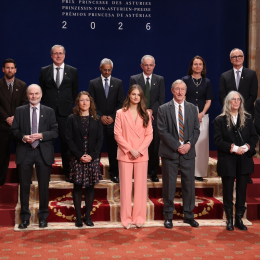
The Campoamor Theatre of Oviedo hosts the award ceremony, with Lionel Messi and Patti Smith among the winners and Princess Leonor as the protagonist. Follow the gala, the speeches, and all the details live.

https://www.youtube.com/embed/5YQhA8b3o6A

Add DEMÓCRATA to Google

Ask FREN

Published

1 minute

Most read

Elecciones 29N · Encuestas

La media de las encuestas

Media a 23 de octubre de 2026 · 15 institutos

  • PP31,4 %
  • PSOE26,9 %
  • Vox18,8 %
  • Sumar6,3 %
  • Podemos3,1 %
  • ERC2,2 %
010203040ene 2024jul 2024ene 2025jul 2025ene 2026jul 2026

Media del último estudio de cada instituto en 30 días y su evolución semanal desde el 23J. Partidos con al menos un 2 %.

Todas las encuestas

Elecciones generales del 29 de noviembre · Demócrata

Oviedo hosts this Friday, October 23, the awards ceremony of the Princess of Asturias Awards 2026, one of the most prominent cultural and institutional events of the year. The Campoamor Theatre gathers the awardees of this edition, among whom are Lionel Messi and Patti Smith, in an event presided over by the Kings and with special prominence of Princess Leonor starting at 18:30 hours.

The heir to the throne has participated during the morning in several institutional meetings, first alongside Infanta Sofía and then solo with the awardees, before the awards ceremony. Follow the gala live, the speeches, and all the highlighted moments of the Princess of Asturias Awards 2026.
More key points, information and questions with FREN

AI-GENERATED CONTENT

What selection process do the Princess of Asturias Awards follow to choose their laureates?

The Princess of Asturias Awards select their laureates through documented candidacies and the decision of eight independent juries, one per category. The Foundation organizes the call, verifies the proposals, and facilitates their study, but the choice corresponds to the juries. It is not a popular vote nor a decision of the Royal House.

1. Submission of candidacies

The process begins with the annual call. Proposals are submitted through the Foundation's official form, completed and signed, and may be accompanied by documents, bibliographic references, and audiovisual material that prove the merits of the proposed person, institution, or group.

The documentation can be sent through the online platform, after registration, by email, or by postal mail to the Foundation's headquarters in Oviedo. The deadline is set for each edition: in 2026, the general closing was March 5 at 23:59, Spanish time. Instructions are on the candidacy submission page.

2. Who can propose a candidate

According to the awards regulations, proposals can be submitted by:

  • Previous edition laureates.
  • Members of the juries, except for the category whose jury they belong to.
  • Spanish diplomatic representations abroad and foreign ones in Spain.
  • Persons and institutions of recognized prestige.
  • Other persons and institutions invited by the Foundation.

Former laureates and jury members have an exception to the general deadline: they can submit candidacies or endorsements up to six calendar days before the constitution of the corresponding jury, respecting the limitations established to avoid conflicts of interest.

3. Verification and preparation of proposals

The Foundation verifies that the candidacies meet the regulation requirements and prepares the necessary documentation for evaluation. This phase serves so that the juries can know and compare the claimed merits; it does not replace their decision.

Additionally, the Foundation actively disseminates the call among universities, research centers, academies, embassies, and other institutions from various countries. Its frequently asked questions explain the work of reception, selection, and documentation.

4. Evaluation by eight juries

There is a jury for each category: Arts; Communication and Humanities; Social Sciences; Sports; Scientific and Technical Research; Letters; International Cooperation; and Concord.

The Foundation appoints them annually according to the criteria approved by its Board of Trustees. They usually gather approximately between fifteen and twenty members, although the Concord jury is larger and composed of members of the Boards of Trustees. Each jury has a president and secretary, both with voice and vote, according to the Foundation's explanations.

The meetings are usually held in Oviedo during spring and early summer. The juries study the documentation, deliberate, and evaluate the candidacies according to the purpose of each award. The general principles establish their autonomy and independence of judgment: the Board of Trustees must refrain from interfering in that evaluation.

5. Voting and announcement of the decision

Each award is granted to a single candidacy by majority vote. This does not necessarily mean awarding only one person: a candidacy may include several people or correspond to an institution or group.

Voting is successive and, if a tie occurs, the president has the casting vote, as stated in the regulations in English. The decision is made public immediately after the meeting. In short, the Foundation manages the procedure; the jury of each category decides who receives the recognition.

What are the official competencies of the Princess of Asturias according to the Spanish Constitution?

The 1978 Spanish Constitution barely assigns specific functions to the Princess of Asturias as such. What it mainly does is define her position in the Crown as heir and establish some constitutional acts linked to that condition. Active competencies (sanctioning laws, calling elections, commanding the Armed Forces, etc.) correspond exclusively to the reigning King or Queen, not to the heir.

1. What exactly does the Constitution say about the Princess of Asturias

The core reference is in Article 57.2 of the Constitution:

"The heir Prince, from birth or from the event that originates the call, shall have the dignity of Prince of Asturias and the other titles traditionally linked to the successor of the Crown of Spain."

From this derive three key ideas:

  • The Princess of Asturias is, above all, the heir to the Throne, that is, the first in the line of succession unless circumstances change.
  • The Constitution grants her a dignity and a title with legal relevance (it is not just a protocol label).
  • The other historical titles of the heir (Girona, Viana, etc.) are based on this constitutional provision, although their specific regulation is developed in lower norms.

Beyond this, the Constitution does not list a set of “competencies” for the Princess of Asturias as it does for the King (Articles 62 and 63).

2. The oath before the Cortes Generales

The only active and concrete constitutional function of the heir is to take an oath before the Cortes Generales when reaching the age of majority or when about to succeed the King:

Article 61.2 establishes: "The heir Prince, upon reaching the age of majority, and the Regent or Regents, upon taking office, shall take the same oath [as the King] as well as the oath of fidelity to the King."

This oath implies:

  • Promising to faithfully perform future functions as Head of State when the time comes.
  • Upholding and ensuring the Constitution and laws are observed.
  • Respecting the rights of citizens and autonomous communities.
  • Swearing fidelity to the reigning King or Queen until succession occurs.

This act has a constitutional nature but does not yet imply exercising own powers: it formalizes her condition as a responsible heir before the constitutional order.

3. Role in the regency: eventual competence

The Princess of Asturias also appears in relation to the regency, which is the body that exercises the King's functions when he is a minor or incapacitated.

Article 59.2 foresees that if the King is a minor, the regency will be assumed by the King's father or mother, and failing that, the "closest adult relative next in line to the Crown." In practice, this can place the Princess of Asturias as a possible Regent in certain family combinations, provided she is of age.

Still, it is important to distinguish:

  • The functions of Regent (when effectively acting on behalf of the King), which do entail powers similar to those of the Head of State.
  • The condition of Princess of Asturias alone, which does not bring those powers unless the regency is formally constituted.

4. What the Constitution DOES NOT assign her

The Constitution does not grant the Princess of Asturias, as heir, political powers such as:

  • Sanctioning and promulgating laws.
  • Calling and dissolving the Cortes Generales.
  • Proposing a candidate for the Presidency of the Government.
  • Supreme command of the Armed Forces.
  • Issuing decrees and appointing or dismissing Government members.

All these competencies are reserved for the reigning King or Queen in Article 62. When the Princess acts today in representative acts (trips, speeches, institutional presence), she does so by commission or delegation, within the framework of ordinary norms and the functioning of the Royal House, not because the Constitution has assigned her a block of own competencies.

5. Summary

Strictly speaking, and adhering to the constitutional text, the “official competencies” of the Princess of Asturias are reduced to:

  • Being heir to the Crown and holder of the dignity of Princess of Asturias (Art. 57.2).
  • Taking the constitutional oath before the Cortes Generales upon reaching majority or assuming an eventual regency (Art. 61.2).
  • Eventually, being able to become Regent if the conditions foreseen in Articles 59 and 60 occur, at which point she would assume the King's functions while the regency lasts.

Outside these cases, the Constitution does not configure a “position” with own powers, but a succession position within the Crown that guarantees the institutional continuity of the Head of State.

What specific functions does the King have according to Articles 62 and 63 of the Constitution? How is the line of succession to the Spanish Crown organized and in what cases could it change? What is the difference between the constitutional functions and the representative functions that the Princess of Asturias exercises in practice?

What is Patti Smith's professional background and what have been her main international recognitions?

Patti Smith (Patricia Lee Smith, born in Chicago in 1946) is one of the most influential figures in rock and contemporary poetry. Her professional career lies at the intersection of music, literature, visual arts, and cultural activism, to the point of being known as the “godmother of punk” for her central role in the New York scene of the seventies.

After a childhood in New Jersey, Smith moved to New York in the late sixties. There she began her artistic career not as a musician, but as a poet and underground figure. She worked in bookstores, wrote poetry, and was linked to the circle of the legendary Chelsea Hotel and the city's artistic avant-garde. In this initial phase, her relationship with photographer Robert Mapplethorpe was key, with whom she maintained an intense creative and vital collaboration, later reflected in her famous memoir Just Kids.

In the early seventies, Patti Smith began offering poetry readings accompanied by improvised music, combining spoken word and rock. From this mix arose the sound that would make her recognizable: poetic lyrics, often with literary and mystical references, over a base of raw rock. In 1974 she began performing with guitarist Lenny Kaye, the core of what would become the Patti Smith Group.

Her first album, Horses (1975), produced by John Cale, is today considered one of the fundamental records in rock history. The cover, photographed by Mapplethorpe, and songs like “Gloria” or “Birdland” marked an aesthetic and musical break: it was roots rock, but radically contemporary, loaded with poetry and a strong stage presence. With this work, she consolidated herself in the CBGB club scene, the epicenter of the emerging New York punk.

She followed with albums like Radio Ethiopia (1976), Easter (1978) — which includes “Because the Night,” co-written with Bruce Springsteen and one of her biggest hits — and Wave (1979). At the end of the seventies, however, Patti Smith decided to partially withdraw from public life: she married musician Fred “Sonic” Smith and moved to Detroit, focusing on her family life, writing but with a much smaller presence in the music circuit.

After her husband's death in 1994, Smith gradually returned to public activity. In the nineties and 2000s she released new albums — such as Gone Again (1996), Peace and Noise (1997), Gung Ho (2000), and Trampin’ (2004) — and strengthened a more openly political facet, with performances and statements defending human rights, opposing certain wars, and supporting ecological and feminist causes. Her work also expanded in the literary field, with poetry collections and essays, and memoirs like Just Kids (2010) and M Train (2015), which consolidated her prestige as a writer.

Regarding international recognitions, Patti Smith accumulates a long list of awards and honors reflecting both her musical and literary relevance:

  • Influence in rock and punk: She is frequently cited as a key reference by generations of musicians. In 2007 she was inducted into the Rock and Roll Hall of Fame, one of the highest recognitions in the Anglo-Saxon music industry for a complete career.
  • Literary and cultural awards: Her book Just Kids, dedicated to her relationship with Robert Mapplethorpe and her formative years in New York, won the prestigious National Book Award in the United States in the nonfiction category, a prize that also established her as a top literary author.
  • European distinctions: Over the last decades, she has received numerous honorary doctorates and cultural awards at universities and festivals in Europe. Additionally, she has been recognized by governments and cultural entities from various countries for her contribution to the arts and freedom of expression.
  • Career recognitions: She has been invited to perform and participate in official ceremonies, tributes, and international events, from literary and musical festivals to acts linked to cultural and human rights organizations. These invitations reflect the broad respect her figure commands, transcending the borders of rock to become a symbol of creative independence.

Overall, Patti Smith's professional career is that of a total artist: poet, singer, songwriter, performer, storyteller, and cultural activist. Her legacy is measured not only in awards but in the aesthetic and ethical imprint she has left on popular music, literature, and the way of understanding the relationship between art and commitment.

Can you detail the history and impact of the album Horses on Patti Smith's career and the development of punk rock? What main themes do the memoirs Just Kids address and how do they complement Patti Smith's public image? How has Patti Smith influenced other female rock artists and what concrete examples illustrate that influence?

Play

Test your knowledge with FREN!

How much do you know about this topic? Answer the following 3 questions.

Where is the ceremony for the 2026 Princess of Asturias Awards held?

Question 1 of 3

Who are some of the awardees in the 2026 edition of the Princess of Asturias Awards?

Question 2 of 3

Who presides over the ceremony of the 2026 Princess of Asturias Awards?

Question 3 of 3