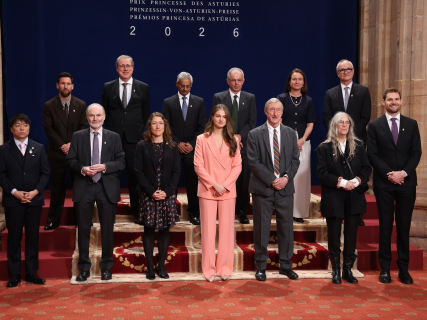
From Messi to Patti Smith: who is who among the winners of the Princess of Asturias 2026

The Argentine footballer, the American singer, the Japanese studio Studio Ghibli, and the astronaut Christina Koch are among the awardees of an edition that also recognizes advances in genetics, the defense of democracy, and the conservation of biodiversity.

EuropaPress 7863569 foto familia recepcion premiados princesa asturias 2026 hotel reconquista

EuropaPress 7863569 foto familia recepcion premiados princesa asturias 2026 hotel reconquista

Add DEMÓCRATA to Google

Ask FREN

Published

7 minutes

Most read

Elecciones 29N · Encuestas

La media de las encuestas

Media a 23 de octubre de 2026 · 15 institutos

  • PP31,4 %
  • PSOE26,9 %
  • Vox18,8 %
  • Sumar6,3 %
  • Podemos3,1 %
  • ERC2,2 %
010203040ene 2024jul 2024ene 2025jul 2025ene 2026jul 2026

Media del último estudio de cada instituto en 30 días y su evolución semanal desde el 23J. Partidos con al menos un 2 %.

Todas las encuestas

Elecciones generales del 29 de noviembre · Demócrata

The Princess of Asturias Awards 2026 bring together this Friday in Oviedo some of the most recognized figures in sports, culture, science, and international thought. From Leo Messi, world champion with Argentina, to Patti Smith, a reference of American rock and poetry, the eight awards of this edition distinguish very different trajectories, but linked to artistic creation, knowledge, and social contribution.

The award ceremony will take place at 18:30 hours in the Campoamor Theater, under the presidency of Kings Felipe VI and Letizia, accompanied by Princess Leonor and Infanta Sofía. The heir to the throne will be in charge of presenting the awards, in an edition that also honors historian Timothy Garton Ash, writer Julian Barnes, and astronaut Christina Koch.

The list of awardees includes eight categories and ten individuals recognized individually, in addition to two institutions or collective projects. These are the protagonists of the Princess of Asturias Awards 2026 and the reasons why they have been distinguished.

Leo Messi, Princess of Asturias Award for Sports

The Argentine footballer Lionel Messi (Rosario, 1987) receives the Princess of Asturias Award for Sports for a career that has made him one of the main figures in the history of football. The jury has recognized both his sports successes and his charitable activity in favor of education and children's health.

Messi has won eight Ballon d'Or awards and was one of the decisive figures in Argentina's victory at the 2022 World Cup in Qatar. His record also includes four Champions League titles with FC Barcelona, two Copa América titles with the Argentine national team, and national titles in Spain, France, and the United States.

After developing most of his career at Barcelona and later moving to Paris Saint-Germain, the forward signed with Inter Miami in 2023. His arrival in American football increased the international profile of the competition.

Beyond the playing fields, the jury has highlighted the work of the Leo Messi Foundation, focused on educational and health projects aimed at children and adolescents in vulnerable situations.

Patti Smith, Princess of Asturias Award for the Arts

Patti Smith (Chicago, 1946) is one of the artists who contributed to transforming popular music during the 1970s. Singer, songwriter, poet, and writer, her career connects rock with literature and American countercultural movements.

Her first album, Horses, released in 1975, is considered a fundamental work in the development of punk and alternative rock. Songs like Because the Night later expanded her international recognition.

The artist has also developed an important literary career. Her book Just Kids, published in 2010, reconstructs her youth in New York and her relationship with photographer Robert Mapplethorpe. The work received the National Book Award for nonfiction in the United States.

The jury has distinguished her ability to combine music, poetry, and critical thought, as well as her influence on several generations of artists.

Studio Ghibli, Communication and Humanities Award

The Japanese studio Studio Ghibli, founded in 1985 by Hayao Miyazaki, Isao Takahata, and Toshio Suzuki, receives the Princess of Asturias Award for Communication and Humanities for its contribution to animated cinema and its ability to convey ideas and emotions through stories aimed at audiences of different ages.

Among its most well-known productions are My Neighbor Totoro (1988), Princess Mononoke (1997), Spirited Away (2001), and Howl's Moving Castle (2004).

Spirited Away won the Oscar for Best Animated Feature in 2003, while The Boy and the Heron, also directed by Miyazaki, received the same recognition in 2024.

The studio's films address issues such as the relationship between humans and nature, the consequences of war, childhood, and coexistence. The jury has particularly valued its ability to turn animation into a tool for communication and knowledge.

Timothy Garton Ash, Social Sciences Award

Timothy Garton Ash (London, 1955) is a British historian, journalist, and essayist specialized in the contemporary history of Europe, democratic transitions, and freedom of expression.

His intellectual trajectory is closely linked to the events that transformed Europe during the last decades of the 20th century. He studied on the ground the political evolution of Central and Eastern European countries, especially during the decline of communist regimes and the fall of the Berlin Wall.

Professor of European Studies at the University of Oxford, he has published numerous essays on the relationships between democracy, freedom, and power. Among his works stand out The Fruits of Adversity, History of the Present, and Freedom of Speech.

The jury has recognized his contribution to the knowledge of European history and his defense of democratic values. His works also examine the risks posed by authoritarianism, populism, and restrictions on freedom of expression.

Julian Barnes, Princess of Asturias Award for Literature

The British writer Julian Barnes (Leicester, 1946) receives the Princess of Asturias Award for Literature for a literary work that explores memory, the passage of time, human relationships, and the construction of identity.

Barnes gained international recognition with novels such as The Parrot of Flaubert (1984), in which he combines fiction, biography, and literary reflection. He later published works such as England, England, Arthur & George, and The Sense of an Ending.

This last novel earned him the Booker Prize in 2011, one of the most important literary recognitions in the Anglo-Saxon sphere.

His writing is characterized by the use of irony, narrative experimentation, and reflection on the distance between memories and real events. The jury has highlighted his ability to address universal issues such as love, loss, and identity.

Christina Koch, Princess of Asturias Award for Concord

Christina Koch (Grand Rapids, Michigan, 1979) is an American engineer and NASA astronaut whose career is linked to space research and the expansion of human presence beyond Earth.

In 2019 she began a stay at the International Space Station that lasted for 328 days, thus establishing the record for continuous stay in space for a woman.

That same year she participated alongside Jessica Meir in the first spacewalk conducted exclusively by women, a significant event in the history of space exploration.

Koch was selected to be part of the Artemis II mission, designed to take a crew around the Moon and prepare for future expeditions to its surface.

The jury has recognized his career as an example of international scientific cooperation and overcoming barriers in space exploration. His selection for the Concordia Award also underscores the collective dimension of great scientific missions.

David Klenerman, Shankar Balasubramanian, and Pascal Mayer, Scientific and Technical Research Award

The Princess of Asturias Award for Scientific and Technical Research jointly distinguishes David Klenerman, Shankar Balasubramanian, and Pascal Mayer, researchers whose work has been fundamental for the development of new DNA sequencing technologies.

The scientists contributed to developing methods that allow reading large amounts of genetic information more quickly and economically than previous techniques.

Klenerman and Balasubramanian, linked to the University of Cambridge, participated in the development of technologies that led to sequencing systems widely used in laboratories around the world. Mayer made fundamental contributions to the massive DNA analysis procedures.

These advances have had direct consequences for biomedical research, the diagnosis of genetic diseases, the identification of alterations related to cancer, and the study of microorganisms.

They have also expanded the possibilities of personalized medicine by facilitating the analysis of the genetic characteristics of each patient.

The jury has recognized their contribution to a technological transformation that has profoundly modified scientific research and clinical practice.

Svalbard Global Seed Vault, International Cooperation Award

The Princess of Asturias Award for International Cooperation recognizes the Svalbard Global Seed Vault, a facility located in the Norwegian archipelago of the same name, within the Arctic Circle.

Inaugurated in 2008, its function is to conserve backup copies of seeds from genetic banks of different countries. The goal is to protect global agricultural diversity against wars, natural disasters, accidents, and other circumstances that may cause the disappearance of plant varieties.

The facility is excavated in a mountain and takes advantage of the low temperatures of the Arctic environment, along with refrigeration systems, to ensure adequate long-term conservation conditions.

The project works through cooperation between the Government of Norway, the Nordic Genetic Resource Center (NordGen), and the international organization Crop Trust.

Its importance lies in the fact that the genetic diversity of crops is essential for developing varieties capable of resisting diseases, pests, and changes in climatic conditions.

The jury has highlighted the international character of this initiative, which allows for the preservation of agricultural resources fundamental to the food security of future generations.

Eight awards to recognize culture, science, and cooperation

The 2026 edition brings together very different profiles: from a global football star to researchers who have transformed the study of the human genome, including writers, artists, and projects dedicated to conserving the agricultural heritage of the planet.

The Princess of Asturias Awards, created in 1981, reach this year their 46th edition. Each of the eight categories recognizes relevant contributions in fields that encompass the arts, humanities, sciences, sports, and international cooperation.

The ceremony this Friday will feature interventions by Patti Smith, Julian Barnes, Timothy Garton Ash, and Christina Koch, in addition to the institutional speeches by Princess Leonor and Felipe VI.

More key points, information and questions with FREN

AI-GENERATED CONTENT

What are the next steps in the selection and awarding process of the Princess of Asturias Awards after the 2026 ceremony?

After the 2026 ceremony, the next steps are to close the events of this edition and prepare the 2027 call: submission of candidacies, jury deliberations, announcement of winners, and a new awarding in October. It is important to distinguish the already announced schedule for the close of 2026 from the usual cycle of the next edition: the specific dates for 2027 have not yet been published in the sources consulted.

1. Closing the 2026 events

The main ceremony is scheduled for today, October 23, 2026, at 6:30 p.m., at the Campoamor Theater in Oviedo. Afterwards, the agenda will continue on Saturday, October 24, at 12:00 p.m., with the awarding of the Exemplary Town of Asturias Prize to the Santa Ana Fishermen's Brotherhood in Llanes. This event will close the institutional programming but is a different distinction from the eight international categories, according to the agenda published by Demócrata.

2. Call and submission of candidacies for 2027

The next milestone will be the publication by the Princess of Asturias Foundation of the call, the rules, and the form for the new edition. The usual pattern places this preparation between the end of the year and the beginning of the next. Until it is published, its deadlines should not be considered confirmed.

According to the awards regulations, candidates can be proposed by, among others, former laureates, academic and cultural institutions, universities, diplomatic representations, and persons or entities of recognized prestige. Jury members can also propose candidates, except for the award whose jury they belong to.

  • The proposal is submitted through the official form, accompanied by documentation that proves the merits: publications, bibliography, or audiovisual material.
  • The Foundation verifies the requirements and decides on admission. The identity of the candidacies is kept confidential.
  • As a reference, in 2026 the ordinary deadline ended on March 5 and the adhesion deadline on March 26. These dates are not automatically transferable to 2027.
  • There is an exception for former laureates and jury members: they can submit candidacies or endorsements up to six calendar days before the corresponding jury is constituted, respecting incompatibilities.
3. Deliberations and announcement of winners

Then the eight juries will meet: Arts; Communication and Humanities; Scientific and Technical Research; International Cooperation; Social Sciences; Sports; Letters; and Concord. Each deliberates for two consecutive days in Oviedo and communicates its decision at the end of the second day by reading the awarding act.

The 2026 precedent places this phase between late April and June: it began with Arts on April 28 and 29, and ended with Concord on June 16 and 17. The Foundation published that meeting schedule. For 2027, a similar sequence is expected, but not identical dates. To vote, jurors must attend all deliberative meetings from the start.

4. Preparation and awarding of the next edition

Once the winners are announced, the organization of their attendance, audiences, public meetings, and complementary events will follow. The annual awarding is usually held in October at the Campoamor Theater, with participation from the Royal Family and speeches by laureates and institutional representatives.

Practically speaking, the announcements to follow on the Foundation's website are three: opening of candidacies, jury schedule, and awarding date. The annual framework is defined; the specific 2027 agenda is not yet.

What competencies and functions does Princess Leonor have within the framework of the Princess of Asturias Awards according to Spanish legislation?

Princess Leonor performs honorary, representative, and protocol functions in the Princess of Asturias Awards, but she does not have her own public powers to decide who receives the awards nor to manage the Foundation. Her participation should be understood by distinguishing three levels: her constitutional status as heir, the Honorary Presidency of the Foundation, and the activities she assumes in each edition.

1. What Spanish legislation establishes

Article 57.2 of the Spanish Constitution recognizes the heir to the Crown the dignity of Prince or Princess of Asturias and the other titles traditionally linked to the successor. This status explains Leonor's institutional connection with awards that bear the name of that dignity, but does not grant her governing powers over them.

The Royal Decree 1368/1987, on titles, treatments, and honors of the Royal Family and Regents, develops that recognition: it establishes the dignity of Princess of Asturias, the treatment of Royal Highness, and the corresponding honors. It does not regulate the selection of laureates nor entrust the heir with the direction of the organizing entity.

Therefore, her institutional presence should not be confused with the exercise of administrative authority. Nor do the rules on her symbols, such as Royal Decree 979/2015, which creates her guidon and standard, confer competencies over the awards.

2. What the Honorary Presidency means

Leonor holds the Honorary Presidency of the Princess of Asturias Foundation. This is an institutional position within the Foundation, distinct from the effective presidency and the bodies responsible for its governance and management.

It is important to separate legislation and internal rules: the Foundation's statutes and the awards regulations govern its operation but do not equate to a law granting public powers to the Princess. Her honorary presidency expresses the link with the heir and contributes to the public projection of the scientific, cultural, social, and humanistic purposes of the institution.

3. What functions she performs and which she does not

In the awards programming, her role can be specified as:

  • Receiving the laureates in audiences and institutional meetings.
  • Participating in the ceremony of awarding and in acts related to the Foundation.
  • Delivering speeches recognizing the laureates and supporting the values they represent.
  • Intervening in the protocolary awarding of distinctions and giving institutional visibility to the awards.

These actions do not include personally choosing the laureates, imposing candidacies, modifying decisions, or assuming economic management by virtue of her honorary status. The awards regulations assign the evaluation and decision on candidacies to the juries; their presidents lead deliberations and voting, and their secretaries ensure compliance with the rules.

4. More prominence does not mean new legal competencies

The scope of her ceremonial participation can be expanded without changing this distribution. For example, Demócrata reports that on October 23, 2026, she received the laureates alone for the first time. This is an expansion of her representative activity, not a transfer of decision-making powers.

In short, Leonor institutionally represents and supports the awards; the juries decide the prizes and the Foundation's bodies govern the entity. The constitutional dignity, honorary presidency, and protocol prominence are related realities but legally different.

What has been Timothy Garton Ash's professional and political trajectory before receiving this award?

Before receiving the Princess of Asturias Award for Social Sciences 2026, Timothy Garton Ash had developed a career as a historian, journalist, and essayist of contemporary Europe. His political influence does not come from government positions or a partisan career, but from his work as a public intellectual: he has studied democratic transitions and participated in debates on freedom, authoritarianism, and European integration.

Education and experience in divided Europe

Born in London on July 12, 1955, he studied Modern History at Exeter College, Oxford, graduating in 1977. His research on German resistance against Hitler led him to Berlin, where he lived in both the western and eastern sectors. Contact with the two Germanys was decisive in directing his work towards the Cold War and the consequences of continental division, according to the Princess of Asturias Foundation.

From that experience arose his way of combining historical research, direct observation, and journalism: the "history of the present". His goal was to understand events as they happened, without giving up the historical context necessary to interpret them.

Journalism and study of democratic transitions

During the 1980s, he followed on the ground the crisis of communist regimes in Central and Eastern Europe. He paid special attention to dissident movements and the Polish Solidarity union. In 1983 he published The Polish Revolution: Solidarity, a work on opposition to the Polish regime that consolidated his profile as an analyst of those processes.

He worked as foreign affairs editor of The Spectator, European affairs columnist for The Times, and international columnist for The Independent; he also collaborated with The New York Review of Books. This activity allowed him to narrate the transformations that led to the revolutions of 1989 and the fall of the Berlin Wall. As Demócrata highlights, his trajectory is closely linked to those European changes.

Academic career and works

He began teaching at Oxford in 1986 and was Professor of European Studies from 2004. He also directed its Centre for European Studies and has been affiliated with St Antony’s College, where he is listed as emeritus professor. His career also includes being a senior fellow at Stanford's Hoover Institution.

Among his books are The Fruits of Adversity, The History of the Present, Freedom of Speech, and Europe: A Personal History. Overall, his work addresses the fall of communism, European construction, civil liberties, and threats to democracy. Simultaneously, he has maintained journalistic activity in The Guardian and through his newsletter The History of the Present.

Political commitment and previous recognitions

His commitment revolves around liberal democracy, human rights, freedom of expression, and European cooperation. Therefore, his "political trajectory" should be understood as intellectual and civic intervention, not as holding executive responsibilities.

In his recent analyses, he has advocated strengthening Europe's capacity to support Ukraine and reduce its strategic dependence on the United States. A 2025 interview also reported that he donated the 50,000 Canadian dollars from the Lionel Gelber Prize, awarded for Europe, to the purchase of drones for Ukraine.

Before the Asturian award, he had received, among others, the Somerset Maugham in 1984, the Orwell Prize for political writing in 2006, and the Charlemagne Prize in 2017. The Princess of Asturias Award thus recognizes a trajectory that combines historical knowledge, journalistic testimony, and public defense of democratic freedoms.

Play

Test your knowledge with FREN!

How much do you know about this topic? Answer the following 3 questions.

Who receives the Princess of Asturias Award for Sports in 2026?

Question 1 of 3

Why has the Japanese studio Studio Ghibli been awarded?

Question 2 of 3

What record did astronaut Christina Koch set during her stay on the International Space Station?

Question 3 of 3