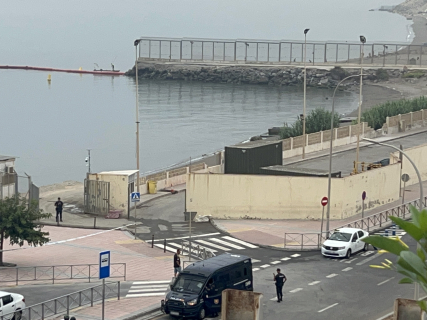

Four new spaces and 1,500 additional places. The response announced by the Government to assist migrants who remain in Ceuta incorporates a type of resource that can easily be confused with the Temporary Stay Centers for Immigrants (CETI) or the Internment Centers for Foreigners (CIE), despite the fact that there are important differences between them. They neither serve the same function, nor do they have the same legal regime, nor do they imply the same conditions of stay.
The purpose, the regime in which people remain, the duration of stay, and even the responsible Administration are different. The most important distinction is that a CIE implies deprivation of liberty and requires judicial authorization, while humanitarian reception resources operate on an open basis.
The difference becomes particularly relevant in Ceuta after the Minister of Inclusion, Social Security and Migration, Elma Saiz, announced this Monday the creation of four extraordinary spaces to increase the capacity to assist migrants remaining in the autonomous city by 1,500 places.
What are the new temporary centers in Ceuta?
The Government has defined them as "humanitarian attention devices, of a temporary and extraordinary nature". This is an important clarification as they are no longer new CIEs nor an ordinary expansion of the CETI in Ceuta.
This type of resource is contemplated within the Humanitarian Attention Program of the Ministry of Inclusion. The department itself distinguishes between the structural resources of the system and the so-called emergency reception service, which allows for the deployment of temporary and extraordinary devices when arrivals exceed the available places.
The objective is to provide an immediate response to basic needs such as accommodation and food, in addition to facilitating the necessary attention while the situation and the most appropriate resource for each person are determined.
In the case of Ceuta, the new devices will be located in the parking lot of the Loma Colmenar Embolsamiento, the equestrian facilities, the old football field of the Cavalry barracks, and the El Guano space. Three will be managed by the central Government and one by the Autonomous City, according to the information known this Monday.
How long can they remain open?
Here there is a fundamental difference regarding a CIE: one must not confuse the time during which the device remains operational with the time that a specific person stays in it.
The spaces announced for Ceuta have a temporary and extraordinary nature, but the Government has not announced a specific date for their closure at the moment. Its operation is linked to the emergency situation and the need to have additional places available.
The Humanitarian Care Program precisely contemplates these extraordinary devices to respond to arrivals of migrants or situations of overcrowding of ordinary resources.
Therefore, it cannot be stated that the four spaces in Ceuta will close after a specific number of days while the Executive does not determine its period of operation.
Nor should the limit of 60 days that exists for CIEs be applied to these devices. That period corresponds exclusively to the internment of foreigners authorized by judicial order, not to humanitarian reception.
What is a CETI?
The Temporary Stay Centers for Immigrants (CETI) are resources of the Administration aimed at providing care and services to migrant people in Ceuta and Melilla. They are part of the Humanitarian Care Program and provide, among other services, information and social intervention, health and psychological assistance, legal advice, translation and interpretation, and training activities.
Its function, therefore, is reception and temporary care, not internment as a precautionary measure linked to an expulsion.
Ceuta already has a CETI, so the four spaces now announced should be understood as extraordinary resources that expand the existing care capacity in the face of an exceptional situation, and not as four new CETIs.
What is a CIE and who can end up there?
A Center for the Internment of Foreigners (CIE) responds to a completely different logic. In these centers, certain foreign individuals can be interned to guarantee, in the legally provided cases, the execution of a return or expulsion measure. Internment implies a deprivation of liberty and requires judicial authorization.
Moreover, there is a precise time limit: a person cannot remain interned in a CIE for more than 60 days. The internment must last only the necessary time and must end earlier if the circumstances that justified it disappear.
The regulation also establishes that minors cannot enter a CIE. Unaccompanied foreign minors must be placed at the disposal of the competent public entities in the protection of minors.
Therefore, having entered Spain irregularly does not automatically mean being transferred to a CIE. The corresponding legal requirements must be met, and the measure must be authorized judicially.
And the reception centers?
There is still an additional category. The Spanish system has different reception and humanitarian care resources, among them the Emergency Reception and Referral Centers (CAED).
These operate in an open regime and receive, among other profiles, newly arrived individuals in vulnerable situations and potential beneficiaries of international protection. Basic needs are covered in them, and the situation of each person is analyzed before their possible referral to another resource.
As a reference, the Ministry indicates that the average stay in the CAED is around three months, although it does not constitute the limit applicable to all migratory resources nor can it be automatically transferred to the extraordinary devices announced in Ceuta.
Can Ceuta oppose the installation of temporary centers?
The answer depends, to a large extent, on who owns the land, what type of installation is to be enabled, and what administrative competencies are necessary to put it into operation. Ceuta can raise objections and exercise its competencies, but does not have a general veto over the State's migration policy.
The Constitution attributes to the State the exclusive competence in matters of nationality, immigration, emigration, foreign affairs, and the right of asylum. Therefore, it is up to the central Government to organize a good part of the resources intended to assist migrants arriving in Spanish territory.
This does not mean that the Autonomous City is left out. The material installation of a device can affect land, public services, urban planning, security, health, or competencies specific to Ceuta, and it is crucial to know the specific characteristics of each of the four announced spaces.
In this case, there is also a particularity: according to the information communicated about the device, three of the four spaces will be managed by the General Administration of the State and the fourth by the Autonomous City of Ceuta itself.
Can Ceuta prevent the opening of a state-managed center?
There is no automatic right for Ceuta to prohibit a state resource simply because it is intended for the reception of migrants. If the State acts within its competencies and legally disposes of the necessary space, the Autonomous City cannot assume a state competence in immigration matters to prevent the action.
A different issue is that a specific facility may require actions, authorizations, or services that fall within the competencies of Ceuta. In that case, administrative discrepancies may arise regarding the conditions under which the resource must be enabled.
A conflict could also arise if the City considers that the State has invaded any of its competencies or has violated the applicable regulations. The discrepancy would then have to be channeled through the corresponding administrative and judicial mechanisms.
Therefore, the issue is not resolved with a simple "Ceuta can veto them" or "the Government can install them wherever it wants". The State has competence over immigration and foreign affairs, but the material implementation of the centers must respect the distribution of competencies and the regulations applicable to each location.
In the four devices announced now, it will also be necessary to know what legal formula the Government will use to enable each space and which administration is the owner of the land to determine with prec
Where will each migrant who remains in Ceuta go?
There is no single answer. The resource to which a person is referred depends on their administrative situation, personal circumstances, possible vulnerabilities, their age, and, if applicable, whether they are requesting international protection.
The new spaces announced by the Government aim to alleviate the immediate pressure on Ceuta while these individual situations are processed and assessed. The opening of 1,500 additional places does not determine by itself what the final destination will be for those who are housed in them.
It also does not imply that those people will subsequently be interned in a CIE. For that, the corresponding procedure would have to exist and, when the law requires internment, a specific judicial authorization.
This is precisely the essential difference between the concepts that appear these days regarding the migratory crisis in Ceuta: temporarily hosting a person and depriving them of liberty to carry out an expulsion are legally distinct measures.