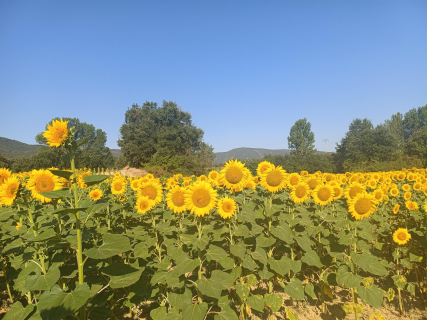

Asaja Córdoba has communicated this Friday that the sunflower campaign in the province "is progressing slowly and with delays, after the rains and storms recorded during spring delayed the start of the harvest by approximately two weeks" and that, "although the quality of the product has improved compared to the previous campaign, the yields obtained so far are not meeting the initially expected expectations."
Through a statement, the president of Asaja Córdoba, Fernando Adell, has detailed that "the differences between the various sowing dates are significant," since "the earlier sowings are yielding better results than those carried out later, with a great variability between farms and an average provincial yield currently around 1,200 kilos per hectare."
According to Adell, this year in Córdoba, 33,138 hectares of sunflower have been sown, compared to approximately 25,000 hectares in the 2025 campaign, which represents a notable increase in the area dedicated to this crop.
Regarding the varieties, he indicated that "the clear commitment of farmers to High Oleic sunflower continues, which represents approximately 80% of the sown area, compared to 20% corresponding to Linoleic sunflower." However, he warned that "the reduction in the price difference between both varieties is generating doubts among farmers when deciding what type of sunflower to sow in the upcoming campaigns."
One of the most favorable points of the campaign is the quality of the harvested sunflower. According to the report from the Agro-Food Laboratory Aproa, S.L. for Asaja Córdoba, "based on the 651 samples analyzed so far from the province, the sunflower seed harvested this campaign shows an improvement of 2.42 percentage points in oil yield compared to the previous campaign."
For Adell, this increase in quality is mainly due to "the rains recorded during the winter and the environmental characteristics of the sunflower itself, whose pivoting root system can reach up to two meters deep, allowing it to take advantage of nitrogen, which has been leached to deeper layers of the soil by the precipitation."
The agrarian organization emphasizes that this capacity of sunflower to utilize the available nitrogen and minimize its loss by leaching highlights "the important environmental benefit that this crop provides, especially in years with abundant rainfall."
For this reason, Asaja Córdoba has been "demanding for some time the implementation of a specific agro-environmental aid for sunflower," understanding that "the function that this crop performs in the conservation and improvement of soils and in the utilization of nutrients must be economically recognized."
However, the quality report also includes certain aspects to be corrected by the farmer, "especially the reduction of impurities during harvesting and the carrying out of the harvest when the grain presents the optimal level of permitted moisture."
Although quality has improved and the planted area has grown, Asaja Córdoba has pointed out that "sunflower continues to be a crop with very tight profitability for the farmer. However, current prices are better than those recorded in recent years."
In this regard, "the latest quotation from the reference market in Córdoba stands at 555 euros per ton for Linoleic sunflower 9-2-44 and at 560 euros per ton for High Oleic, compared to 480 euros per ton for Linoleic and 560 euros for High Oleic, which were recorded last year."
However, these amounts "must be related to production costs" and, "according to the Price and Market Observatory of the Junta de Andalucía, the reference production cost for the 2025 campaign was set at 654 euros per hectare."
Based on that cost and current prices, "the farmer needs to obtain approximately 1,178 kilos of sunflower per hectare to cover production costs, a figure that evidences the low profitability of the crop and explains the sector's concern about yields that, in numerous farms, are around 1,250 kilos per hectare and present high variability."
Adell considers it essential "that the double value of sunflower is taken into account, on one hand, as a crop that must provide sufficient profitability to the farmer and, on the other, as a beneficial tool for the environment and soil conservation."
The agrarian organization reiterates that sunflower, especially in campaigns with abundant rains like the current one, "demonstrates its ability to take advantage of the nitrogen available in the soil and prevent it from being lost through leaching, thus contributing to more sustainable agriculture." For this reason, it insists that "this environmental service be recognized through an agro-environmental aid that allows maintaining the crop and ensuring its continuity in the Córdoba farms."