
Pedro Sánchez opened the electoral campaign in the same appearance with which he announced the dissolution of the Cortes. He did so by presenting a favorable balance of his management and attributing the difficulties to an opposition that blocks social progress, before asking for a broader progressive majority and closing with the intention of winning again.
In that narrative, the election takes the form of a dichotomy between good and evil, since his Government represents the protection of the social majority and his adversaries embody the regression of rights in favor of the privileged. The appeal to the "right side of history" thus turns the vote into a moral dilemma, because it invites the citizen to also decide which values they want to defend.
This framing seeks to mobilize a disappointed left, whose discontent over housing could find an electoral outlet. Sánchez tries to transform the parliamentary blockade into an injustice against the majority and position himself on the side of those who protest, even if they have questioned his management. The promise to complete the pending reforms allows presenting a new legislature as reparation for that grievance.
Housing - if he can keep it at the center of the campaign, avoiding other topics, such as Ceuta or pending judicial cases - offers him a possibility to rebuild his relationship with disappointed voters. But there is also the interpretation of the mobilization because going out to the streets does not imply supporting the Government, especially when part of the protest precisely denounces the insufficiency of its actions. The call aims to overcome that distance, taking advantage of a mobilization that can restore political interest to those who had distanced themselves from it. To achieve this, Sánchez will have to convince them that another legislature will allow doing what this one has not achieved, without pretending that indignation erases the responsibilities of his management.

The rejection of PP, Vox, and Junts allows him to dispute the responsibility for the blockage, while the Standing Committee appears as the ace up Sánchez's sleeve. The Government plans to reapprove the housing decrees and submit them, after the dissolution of the Cortes, to that body, where it has a more favorable arithmetic to save the protection against evictions if it maintains the support. The operation allows presenting those measures almost as the first chapter of its electoral program and to keep housing at the center of the campaign, although it will still be obliged to demonstrate that they respond to social demand.
The chosen moment matters because, while housing occupies public conversation, Sánchez has more chances of keeping it at the center of the debate. Waiting carried the risk that this demand would lose visibility and that Ceuta would regain prominence, favoring the right's discourse. The call attempts to take advantage of the change of agenda, although the adversaries will also decide what is discussed during the campaign.
The date also forces the forces situated to his left to organize, as Sumar is preparing to present its front and its candidacy on October 17. The urgency may accelerate agreements that were still being postponed, but it may also aggravate differences that have not yet been resolved, so that the socialist improvement will only serve to govern if the whole manages to achieve sufficient representation.
Sánchez has regained the ability to decide the course of events and has forced his adversaries to submit their proposals to the judgment of the voters, assuming that prolonging the resistance could worsen his options. He has chosen to take risks while he has a social demand with which to try to rebuild support, although he still does not have a majority assured. The uncertainty remains how many of those who protest are willing to give him another chance. There are too many calculations. We will see if they all work out for him.
...about the firm:
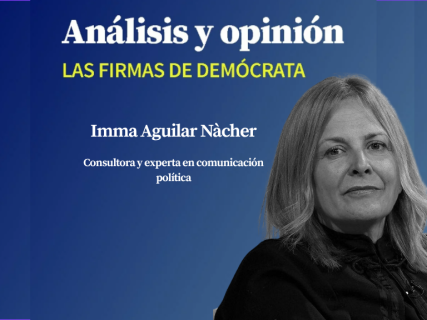
Imma Aguilar Nàcher is a consultant and advisor in political communication, electoral strategy, reputation, and institutional relations. She was the director of the Cabinet of the Minister of Science, Innovation, and Universities. She has advised governments, parties, companies, and public figures in Spain and Latin America, where she has participated in presidential campaigns.
She has also been the director of communication and coordinator of parliamentary groups in the Congress and the Senate. She is currently a professor of political campaigns and government communication at Spanish and Latin American universities. Her career combines institutional experience at the highest level, electoral strategy, university teaching, and a broad journalistic career in television.