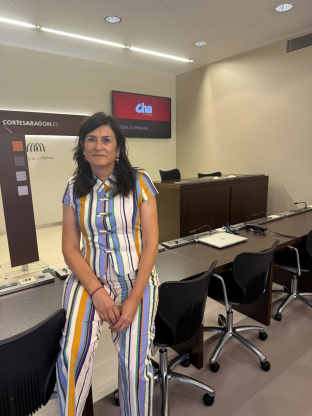

The CHA deputy in the Aragon Courts, Isabel Lasobras, has reproached the president of the regional Government, Jorge Azcón, coinciding with the start of the new school year, that "putting ideology and private interests before the health, well-being, and equal opportunities of the students" and maintaining a "harassment and demolition" of the Aragonese public school.
In an appearance before the media, Lasobras stated that the school year begins "with the same deficiencies with which the previous one ended: "administrative disorder, continued punishment of teachers, and a deliberate suffocation of the public network to favor the business of the concerted."
The Aragonese parliamentarian has denounced that Azcón's Executive is turning public classrooms into "a scenario of neglect and abandonment that the educational community does not deserve and cannot tolerate," a reality that, she emphasized, is aggravated by high temperatures and episodes of extreme heat, with classes exceeding 30 degrees that hinder the study and work conditions of students and teachers.
As an example, she cited the situation of students in the Official Language Schools, who this week are taking oral and written tests of more than four hours in classrooms that reach 35 degrees.
Lack of legal security in extracurricular activities
Lasobras has also questioned the "absolute lack of legal security" with which, according to CHA, the school year begins for teachers regarding extracurricular and complementary activities. She criticized that the Department of Education has opted for a transitional norm that, in her opinion, does not address the underlying problem and that, moreover, has not been debated in the Sectoral Table.
"They limit themselves to compiling what already exists, increase the bureaucratic burden on teachers, and encourage schools to hire private insurance, with the consequent extra cost for families," she lamented, while accusing the Government of shifting all responsibility to teachers and management teams.
This situation led, last school year, to 81 educational centers suspending these activities, which, she emphasized, again negatively impacts the Aragonese public school.
Meanwhile, he has denounced that the regional government resumes its commitment to the concerted Bachillerato, relying on the supposed "freedom of choice." During August, he has recalled, new steps have been taken to finance a non-compulsory educational stage with public money, despite the fact that there are vacant places in the public network, which generates, according to Lasobras, "an unprecedented territorial imbalance in Aragón."
"The concerted Bachillerato is a clear ideological commitment that attacks the public network, which is the only one that guarantees true equality of opportunities," he has defended, warning that in many towns of the Aragonese regions there is no genuine freedom of choice for families when there is no concerted offer and warning that this same privatizing dynamic also reaches education for ages 0 to 3 years.
Criticism of management and the situation of teachers
Lasobras has also warned of "a continuous disaster" in the administrative management of the Department of Education, with "serious failures" in the online registration platform for Bachillerato and "lack of control" in late enrollment, which "generates uncertainty for dozens of families just days before the start of classes."
For CHA, these facts highlight a "lack of planning and management capacity" that ultimately shifts the problems of the Administration to families, schools, and teaching staff.
He has described the situation of teachers in Alto Aragón as "especially concerning," where a high number of sanctioning files are recorded by the Educational Inspection. "The Department of Education cannot continue to ignore this persecution or the tension that is being generated in schools throughout Huesca," he has emphasized, demanding that what is happening be investigated "immediately" and that "the harassment and job insecurity" suffered by part of the teaching staff be put to an end.
The deputy has recalled that CHA has been denouncing this scenario for three years and has criticized that the Minister of Education continues to remain silent.
Rural school and school transport in the spotlight
Regarding rural schools, the CHA representative has described the decision of the PP Government to withdraw the figure of early childhood education technicians in classrooms with fewer than three students as "intolerable," as happens in municipalities like Arándiga or Tobed.
He added the removal of the school bus monitor that transports six children, up to three of them under three years old, on the route to Sástago, as well as the school transport problems affecting several areas of Aínsa.
"Abandoning our villages, leaving the smallest unprotected, and suffocating public school is not just poor management: it is turning our back on the future of Aragón," Lasobras stated, insisting that, for CHA, "the defense of rural school is inseparable from the fight against depopulation and the guarantee of quality public services throughout the Aragonese territory."
Finally, he ratified his party's commitment to the students, families, teachers, and the entire educational community. "The school year starts today and our commitment to save public education does too," Lasobras pointed out.
In this line, CHA has announced that it will maintain this defense both in institutions and in social mobilization and that it will continue to demand "a public education, of quality, with all guarantees and with equal opportunities for all students living in any corner of Aragón."