
A total of nine electoral coalitions have been registered with the Central Electoral Board (JEC) to participate in the general elections on the upcoming November 29. Of these, two are presenting only for Congress, three will do so only for the Senate, and the other four are of autonomous scope and compete for both chambers, according to the list of registrations formalized with the arbitral body.
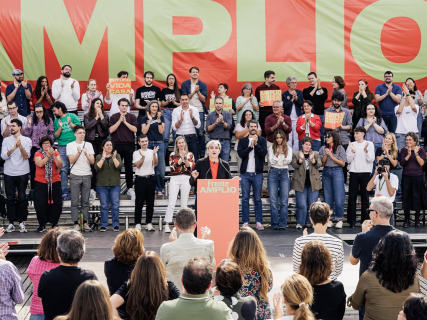
The most significant alliance for Congress is that of Frente Amplio, led by Ada Colau and Emilio Delgado, which ultimately did not reach a state agreement with Podemos. This candidacy will be offered throughout the national territory except in the Canary Islands, Balearic Islands, and the Valencian Community.
Specifically, to compete for Congress in the three Valencian provinces, the coalition called "Compromís: Front Valencià" has been registered, in which "Més-Compromís, Iniciativa del Poble Valencià, Verds Equo del País Valencià, Coalició Compromís, Podemos, Esquerra Unida del País Valencià, Esquerra Republicana del País Valencià and Recortes Cero" participate.
In the Canary Islands, the alternative left to the PSOE has also managed to register a joint candidacy that includes Podemos and will present itself for both Congress and the Senate. It is called "Unidad del Pueblo Canario" and is composed of "the purple formation, Nueva Canarias-Bloque Canarista, Podemos, Movimiento Sumar and Izquierda Unida Canaria."
Another list that will only compete in the elections of November 29 in the archipelago is the coalition formed by "Coalición Canaria and Municipalistas Primero Canarias." It will compete for Congress in the Canary Islands and for the Senate in the islands of Tenerife, Gran Canaria, Fuerteventura, Lanzarote, La Palma, and La Gomera.
On the other hand, Teruel Existe and Aragón Existe have formally re-established the coalition "Existe" to seek seats in Congress and the Senate for Aragón, replicating the formula of the previous general elections, in which they did not achieve representation.
As a new element, "Democracia 21," the new liberal party led by lawyer Míriam González Durántez, has registered with the JEC the coalition "Democracia para el siglo 21," along with "Ciudadanos-Partido de la Ciudadanía and Unión de Ciudadanos Independientes." This alliance will compete for both chambers, but limited to the constituencies of Madrid and Barcelona.
Three lists registered only for the Senate
Regarding the Senate, the JEC details three specific coalitions. The first is "Senado de Progreso", made up of "the PSOE, Izquierda Unida, Movimiento Sumar, Más Madrid, Coalició Compromís, Chunta Aragonesista, and Batzarre-Asamblea de Izquierdas", which will be presented in Andalusia, Aragon, Asturias, Cantabria, Castilla-La Mancha, Castilla y León, Extremadura, Galicia, Madrid, Navarre, Basque Country, Murcia, La Rioja, Valencian Community, Ceuta, and Melilla, that is, in all communities and autonomous cities except the Balearic Islands, Canary Islands, and Catalonia.
The coalition "Esquerra Republicana de Catalunya-Euskal Herria Bildu" has also been registered, formed by "ERC and EH Bildu", whose scope for the Upper Chamber covers Catalonia, Basque Country, and Navarre. The third is "Comuns-Front Ampli per la democràcia", which includes "Catalunya en Comú and Comuns", and which will be presented to the Senate in Catalonia.
The coalition announced for Congress in the Balearic Islands, which groups "MÉS per Mallorca, MÉS per Menorca, Ara Eivissa, Sumar, and Esquerra Unida", does not appear in this list. Since it is a single constituency, its registration has been processed before the corresponding Provincial Electoral Board.
The agreement between Podemos and ERC also does not appear as a coalition, since both forces will not run under shared initials, but rather members of the purple formation will integrate as independents in Esquerra's list for Barcelona. Thus, "the electoral cooperation pact announced by both parties, which will allow Irene Montero and Gabriel Rufián to campaign together, does not translate into the registration of an electoral coalition".
Next week, the JEC will meet to verify that all coalitions meet the formal requirements and proceed to their ratification. Following that, it will be time for the presentation of candidacies, which parties must register between October 21 and 26 before the respective Provincial Electoral Boards. The lists that are presented will be published in the Official State Gazette (BOE) on the 28th, while the proclaimed candidacies will be announced on November 3.