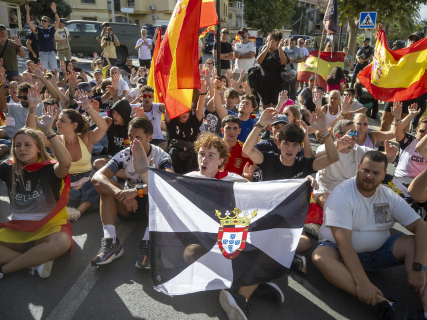
Concentrations for Ceuta: the political board of September 2 and the battle in the FEMP

The concentrations in Ceuta on September 2 already exceed 300 calls, but behind that territorial map another politician has appeared. The PP supports the call made by the president of the FEMP; PSOE, IU, Compromís, Comuns, Podemos, ERC, and Junts question whether it was decided without the agreement of the Federation's bodies, while the municipalities adopt different positions even when they are governed by the same party.

fotonoticia 20260829100650 1920

fotonoticia 20260829100650 1920

Add DEMÓCRATA to Google

Ask FREN

Published

Last updated

5 minutes

Most read

Elecciones 29N · Encuestas

La media de las encuestas

Media a 7 de noviembre de 2026 · 11 institutos

  • PP31,0 %
  • PSOE26,2 %
  • Vox19,5 %
  • Frente Amplio6,6 %
  • ERC2,4 %
  • SALF2,2 %
  • Podemos2,1 %
01020304050ene 2024jul 2024ene 2025jul 2025ene 2026jul 2026

Media del último estudio de cada instituto en 30 días y su evolución semanal desde el 23J. Partidos con al menos un 2 %.

Todas las encuestas

Elecciones generales del 29 de noviembre · Demócrata

More than 300 points spread across Spain are preparing gatherings for Ceuta on Wednesday, September 2. At first glance, the map seems simple: events in front of town halls, mostly at 8:00 PM, coinciding with Ceuta Day. Municipal politics has made it quite a bit more complex.

The call launched by the Spanish Federation of Municipalities and Provinces has opened a dispute over who made the decision, which bodies of the FEMP approved it and to what extent a gathering conceived as institutional support for Ceuta can be separated from the confrontation between parties over the management of the crisis.

The result is a map that cannot simply be drawn in blue, red, or green.

What the FEMP has really called for

The president of the FEMP and mayor of Jerez, María José García-Pelayo, announced on August 25 in Ceuta gatherings for Wednesday, September 2 at 8:00 PM at the doors of the town halls.

The Federation presented the initiative as a show of solidarity from local governments with the citizens of Ceuta after the crisis that began on July 30 and 31. García-Pelayo called again two days later for Spanish town halls to participate.

There are two figures that should not be mixed.

Spain has 8,132 town halls and the president of the FEMP invoked the solidarity of all of them. That does not mean that 8,132 gatherings are confirmed.

The citizen compilation Ceuta unites us currently counts 317 confirmed events in 46 provinces. This is a map created from calls sent and public sources, not from an official census of the FEMP.

PP supports the call

The Popular Party has embraced the call and numerous mayors and municipal groups have announced that they will participate.

In Elche, for example, PP and Vox have joined the planned gathering in the Plaza de Baix. The mayor, Pablo Ruz, has also called for an extraordinary plenary session on Ceuta for that day.

The mobilization has even taken on a European dimension. PP and Vox have announced support events for Ceuta in front of the European Parliament in Brussels, although through their own calls.

This introduces an important element: on September 2, there is not a single national demonstration directed from a common center. There is a call from the FEMP, municipal calls, party initiatives, and a citizen network that is building its own map.

PSOE and other groups question how the FEMP acted

The main fracture has occurred within the Federation itself. A statement released by Izquierda Unida on behalf of the Socialist groups, Izquierda Unida-Compromís-Comuns-Podemos, ERC, and Junts claims that the call was adopted unilaterally by García-Pelayo.

According to that text, other decisions announced during the visit to Ceuta, such as holding a Governing Board there or temporarily granting Juan Jesús Vivas a representation in the European Committee of the Regions. were also not agreed upon by the governing bodies of the FEMP.

In the statement, those groups claim the solidarity of local governments in the face of crises, but question the procedure used by the president.

The municipal map breaks the party map

What is happening in the municipalities precisely demonstrates that complexity. In Elche, PP and Vox support the call while the PSOE has questioned its lack of consensus. Compromís and Esquerra Unida have also reproached the local government for the political use of the crisis.

In Xàtiva, the City Council has explicitly decided to distance itself from the FEMP call. The council has adhered to the position of the groups that criticize the unilateral action of the president of the Federation, although it maintains its support for institutional solidarity with Ceuta.

In other municipalities governed by parties that have questioned the national procedure, concentrations are indeed announced.

This difference prevents mechanically transferring the position of a political group in the direction of the FEMP to all the mayors of those initials. Each corporation retains its ability to call, adhere, or not do so.

There are six provinces without registered events, but that does not equate to a rejection

The map of Ceuta unites us allows locating another provisional border. As of August 29, it does not record confirmed concentrations in Álava, Lugo, Ourense, Palencia, Segovia, and Soria. In the rest, at least one appears.

This data describes the map of calls known today. It does not allow us to affirm that those six provinces have decided "not to support" Ceuta.

There is no single provincial authority that has to accept or reject the mobilization, and events can appear in any of them before the 2nd. The absence of a specific municipality in a citizen compilation also does not prove that its corporation has made a political decision.

To elaborate a serious map of adhesions and rejections, it is necessary to distinguish three categories: municipalities that have expressly announced their participation, municipalities that have expressly communicated that they will not join, and localities for which there is still no verified public position.

The dispute also affects the message of the concentrations

The discussion does not end with who calls. The FEMP uses an institutional approach focused on solidarity with Ceuta and its citizens. The citizen network Ceuta nos une employs the slogan "In favor of the people of Ceuta and for our Unity."

In different municipalities, parties and organizations are incorporating their own messages about immigration, border security, Morocco, or the actions of the Government.

This makes it possible for two concentrations held at the same time and under the same reference of September 2 to have different political approaches.

It also explains the interest of some groups in marking distance between solidarity with the people of Ceuta and the partisan use they believe they see in some calls.

Ceuta will have its own mobilization

The autonomous city itself adds a fourth layer. The citizen protests that occurred during the last days of August have been temporarily postponed after several episodes of tension. Their organizers feared that new marches could be identified with violent acts or with ultra groups, although the Police had not detected a significant presence of these organizations.

The Provincial Federation of Neighborhood Associations and the Forum Ceuta Siglo XXI have set a large march for September 2.

This mobilization responds to the specific situation of the city and should not be confused with the institutional concentrations of the FEMP held in front of town halls in the Peninsula, Balearic Islands, and Canary Islands.

A September 2 with two maps

Four days before the concentrations, Spain therefore has two different maps. The territorial one already shows more than 300 events spread across 46 provinces. The political one is still open.

The PP institutionally supports the call. Vox participates in different municipalities and has also promoted its own events. The Socialist, IU-Compromís-Comuns-Podemos, ERC, and Junts groups within the FEMP question the procedure used to call it. Afterwards, each town hall is making its own decision.

Until the very day 2, towns will continue to be incorporated and new pronouncements will probably appear.

More key points, information and questions with FREN

AI-GENERATED CONTENT

What procedures must be carried out at the FEMP to officially approve an institutional call like the one for the gatherings for Ceuta?

At the FEMP, institutional declarations and “official” calls should be approved, according to the practice described in the press releases themselves and in the group statements, through its collegiate governing bodies (especially the Governing Board). In the specific case of the gatherings for Ceuta, the president acted on her own initiative, and precisely because of this, a dispute has arisen over whether or not those internal channels were respected.

1. Competent bodies within the FEMP

The FEMP is a federation of local entities that holds the institutional representation of municipalism before the State (fifth additional provision of the Law on the Bases of Local Regime, cited in several agreements published in the BOE). It has no regulatory capacity, but it can approve political agreements and declarations.

The documents consulted allow identifying three relevant levels:

  • FEMP Governing Board: central political management body. In practice, it is the one that approves institutional declarations. For example, regarding the DANA in Valencia, it is explained that the FEMP “has approved, at the proposal of the PSOE, an institutional declaration” after the Governing Board meeting (link), and the mayor of Valencia thanks “the unanimity to approve and move forward in the FEMP Governing Board an institutional declaration” (link).
  • Political groups within the FEMP: can submit proposals for institutional declarations (as the Socialist Group does in the case of the DANA). These proposals are submitted to the Governing Board, which negotiates the text and approves it – ideally by consensus –.
  • FEMP Presidency: can promote initiatives and speak on behalf of the Federation, but the socialists themselves in the Governing Board remind that certain decisions (for example, legal actions, or significant political positions) must be agreed upon by the governing bodies, the “only competent” for this, and not adopted unilaterally (link).

2. How should an institutional call be processed?

Based on that practice, the “canonical” channel would be:

  • Initiative: can come from the Presidency or from one or more political groups in the FEMP (as the PSOE did with the DANA).
  • Drafting a draft of an institutional declaration or call (explaining the political objective of the gesture, the date, the format – gatherings, moments of silence, etc. –).
  • Debate and approval in a collegiate body: usually the Governing Board, which is the space where the different political forces of municipalism are represented. When a clearly institutional profile is desired, unanimity or broad consensus is sought, and only then is it qualified as an “institutional declaration” of the FEMP.
  • Official communication to the town halls: once the text is approved, the FEMP disseminates it through:
    • Notes and statements on its website (for example, “The FEMP calls for gatherings in front of town halls…” of August 25, 2026: link).
    • Direct sending to the associated town halls, which then decide whether to join and how to materialize it.
  • Municipal adhesion: each town hall usually channels adhesion through its own local Governing Board, Plenary agreement or Mayor’s decision, and issues its press release (“The Zaragoza Town Hall joins the gathering in support of Ceuta promoted by the FEMP”, “Santa Cruz joins…”, etc.).

3. What has happened with the gatherings for Ceuta

In the case of Ceuta, the FEMP published an official note on August 25 stating that the president calls for gatherings in front of town halls on September 2 (link). Subsequently, another FEMP note indicates that the president “has encouraged” the town halls to join (link).

However, the groups of PSOE and IU-Compromís-Comuns-Podemos, ERC and Junts within the FEMP itself have denounced in various statements that this decision did not go through the governing bodies and was adopted unilaterally by the Presidency, which is at the center of the internal “battle” described in the analysis “Gatherings for Ceuta: the political board of September 2 and the battle in the FEMP”.

In other words: the “orthodox” procedures would be proposal → Governing Board → institutional declaration → communication to municipalities. In this specific case, the controversy arises because part of the FEMP maintains that this scheme was not followed and that the call was made directly from the Presidency, using the Federation’s brand and channels without a prior collegiate agreement.

What are the powers and functions of the FEMP president according to its statutes?

With the information available in the sources consulted in this iteration, the full text of the Statutes of the Spanish Federation of Municipalities and Provinces (FEMP) has not been located, nor the specific provision that regulates in detail the powers of the Presidency. The documents found refer to the FEMP and some of its bodies, but do not reproduce the statutory articles on the Presidency, so it is not possible to offer a closed enumeration of functions with specific articles without conjecture.

What can be reliably extracted from the sources is, on the one hand, the general governance framework of the FEMP and, on the other, some clues about the balance of powers between the Presidency and the collegiate bodies:

1. Governing bodies and structural role of the Presidency

A note from the Murcia City Council about the functioning of the FEMP describes the Governing Board as the body responsible for executing the agreements of the Plenary and the Territorial Council. It points out that:

  • The Governing Board is made up of the Presidency, two Vice Presidencies, and twenty-two members.
  • It performs strategic functions such as:
    • Representation of local entities in different bodies.
    • Defense of municipal interests.
    • Administration of the Federation’s assets.
    • Approval of FEMP actions.

Although this note is not the Statute and speaks of the Governing Board as a whole, it does allow stating that, statutorily, the Presidency is part of the FEMP’s core management and is inserted in a collegiate body to which the major decisions of representation, management, and defense of municipalism interests are attributed. The Statute, therefore, does not seem to configure an isolated Presidency, but one integrated into a framework of bodies that must support the most sensitive decisions.

2. Limits to the Presidency derived from the Statutes

A statement from the Socialist Group in the FEMP (09/26/2025) criticizes that the president had filed an appeal before the National Court “without the agreement of the Governing Board and outside the Statutes”, and adds that:

“The president of the FEMP does not hold the competence to file a legal action, she must (…) report to the Federation’s governing bodies.”

This text does not cite the specific article, but it makes clear that, according to the Statutes:

  • Filing legal actions is not an exclusive competence of the Presidency.
  • The Presidency must act in accordance with the collegiate governing bodies (at least the Governing Board) and report relevant decisions to them.

That is, the Statutes seem to design a Presidency with a relevant representative and managerial role, but subject to the control and agreements of the collegiate bodies, especially when it comes to institutionally or legally sensitive actions.

3. Recommendation to know exact articles and competences

Since in this search the PDF or consolidated text of the FEMP Statutes has not appeared and none of the sources offers the article regulating the functions of the Presidency, it is not possible, rigorously, to detail:

  • The specific article or articles dedicated to the Presidency.
  • The exhaustive list of its statutory competences (calling bodies, presiding over sessions, holding the legal representation of the Federation, signing agreements, etc.), although many of them are predictable by analogy with other organizations.

To answer your question exactly — with literal citation of articles — it is necessary to go directly to the current statutory text, which is usually available:

  • On the FEMP institutional website itself, in the “Statutes” or “Governing Bodies” section.
  • In agreements of the FEMP Plenary (XII Ordinary Plenary of September 21, 2019), where the currently valid Statutes were approved, as stated in the FEMP–Red.es agreement published in the BOE BOE-A-2025-13327.

In summary, what can be stated based on documentary evidence is that the FEMP Presidency:

  • Is part of the Governing Board, which executes the agreements of the Plenary and the Territorial Council and performs strategic functions of representation, defense of interests, and administration of assets.
  • Is subject to the limits and controls of the collegiate bodies, so that certain decisions (such as filing legal actions) require agreement of those bodies and cannot be adopted unilaterally.

Without direct access to the statutory articles, any finer list of competences or references to specific articles would be speculative and cannot be offered with guarantees.

How many similar initiatives or calls has the FEMP promoted in the current legislature?

There is no official count in the public information consulted of the Spanish Federation of Municipalities and Provinces (FEMP) that groups and numbers the initiatives, programs, or calls it has promoted in the current state legislature. Neither the official bulletins nor the press offer a systematic list by legislature. Therefore, it is not possible to give a figure, not even an approximate one, with rigor; only some prominent lines of action can be identified.

Absence of a quantitative record by legislature

Research in official and press sources shows multiple references to initiatives linked to the FEMP, but no legislature report or “balance” report enumerating how many it has launched in this period:

  • In the official documentation consulted, there is no “2023-2026 activity report” of the FEMP nor a “legislature balance” with the number of programs, calls, or campaigns.
  • The official bulletins (BOE) record agreements where the FEMP acts as a collaborating entity, but those texts describe each specific program, not a cumulative total.
  • The press (including the newspaper Demócrata) reports on specific initiatives, but in a fragmented way and without the intention of an exhaustive inventory.

In this context, trying to extrapolate a global figure (for example, “dozens” or “hundreds” of initiatives) would require assuming many actions not documented in the reviewed sources, which would not be methodologically sound.

Examples of initiatives and programs in this legislature

Although we cannot quantify, some relevant blocks of initiatives in the current legislature can be pointed out:

  • Agenda 2030 and subsidies to local entities. The FEMP acts as a collaborating entity in the management of state subsidies to promote Agenda 2030 in municipalities and provinces. The Resolution of July 28, 2025 includes an addendum to the agreement with the FEMP for the management of the 2024 and 2025 calls, with specific economic compensation for that work. Another note from the Ministry of Social Rights confirms that these subsidies finance municipal projects aligned with the SDGs.
  • Digitization and data governance. The FEMP has promoted the EDINT project (Data Spaces for Smart Urban Infrastructures), financed with 13 million euros from the Recovery Plan and conceived as a strategic smart city initiative, as detailed in several Demócrata reports (analysis on EDINT and article on its deployment). Additionally, the federation approved at the end of 2023 a Model Data Governance Ordinance for local entities, recognized and analyzed on the Electronic Administration Portal (see official summary).
  • Caring cities and active aging. The FEMP, together with the Mémora Foundation, promotes the “Cities that Care” seal, which recognizes municipal policies for the elderly and active aging. An example is the awarding of the distinction to six municipalities (Logroño, Las Palmas, Jerez, Manresa, Santander, and Santurce), described in Demócrata (news about the seal).
  • Municipal campaigns and calls. In the more political and symbolic sphere, the FEMP has launched coordinated calls to town halls, such as the call for gatherings in support of Ceuta on September 2, which has generated a broad municipal deployment and internal debate within the federation itself (map of gatherings and political analysis). It has also coordinated information and municipal protocols for the solar eclipse on August 12, according to another Demócrata piece.
  • Training, European funds, and technical support. Notes from town halls and ministries show other lines of work: FEMP’s European funds commission with a digital aid platform and training activities on Next Generation and FEDER (note from Almería City Council); and state subsidies to the FEMP for training local public employees.
Methodological conclusion

From these sources, it is evident that the FEMP maintains multiple open fronts in the current legislature: management of ministerial calls (Agenda 2030, training), own projects (EDINT, model ordinances), seals and distinctions, political campaigns and calls, as well as training activities and technical support in European funds.

However, none of the sources reviewed (BOE, ministerial notes, institutional websites, and press) provides a complete inventory by legislature nor allows deriving a reliable figure of “similar initiatives or calls” promoted by the FEMP. Consequently, there is not enough public basis to offer a number, not even approximate, without conjecture. The rigorous answer can only be qualitative, illustrating the main lines of action as described.

Play

Test your knowledge with FREN!

How much do you know about this topic? Answer the following 3 questions.

Which political party has institutionally supported the call for gatherings for Ceuta promoted by the FEMP?

Question 1 of 3

Why have several groups within the FEMP questioned the call for gatherings for Ceuta?

Question 2 of 3

What is the main difference between the mobilization in Ceuta and those in the rest of Spain on September 2?

Question 3 of 3